Last Updated: 17 May 2026
Aspendos is the ancient Roman theater that makes other ancient theaters look incomplete. Built in the 2nd century AD by an architect named Zenon for the emperor Marcus Aurelius, the Aspendos theater has survived 1,800 years almost entirely intact, with its three-story stage building, its 41 rows of marble seating, its vaulted entrance corridors and even sections of its original sculptural decoration all still standing essentially as they were on the day of consecration. Most ancient Roman theaters around the Mediterranean preserve only the seating bowl, with the stage building reduced to scattered foundations. Aspendos preserves the whole structure. Standing in the orchestra and looking up at the complete three-story facade behind the stage is one of the most astonishing classical antiquity experiences anywhere in the world.
In this guide I will share the unique architectural story of the Aspendos theater, the broader ancient city of Aspendos that surrounds it (most visitors never see this part), the Roman aqueducts that bring water from miles away with engineering still impressive today, the practical logistics of reaching the site from Antalya or Side, and how to plan a visit that includes the regular performances still held at the theater every summer. I will tell you why a visit here is unlike any other Roman site in Turkey, and how to combine it with the other ancient cities of the Pamphylia coast.
Key Takeaways
- The Aspendos Theater, built around 155 AD by the architect Zenon, is the best-preserved Roman theater in the world, with its three-story stage building, marble seating and vaulted entrances all almost completely intact.
- The theater could seat 12,000 spectators and was used continuously from Roman times through the Byzantine and Seljuk periods, with the Seljuks even converting it into a caravanserai (commercial inn) in the 13th century.
- Aspendos was an important city in the Greek and Roman regions of Pamphylia, with origins dating back to at least the 10th century BC and major prosperity during the Hellenistic and Roman periods.
- The Aspendos Aqueduct, visible from the theater across the valley, brought water to the city from springs 19 kilometers away using a sophisticated system of arches and inverted siphons.
- The annual Aspendos Opera and Ballet Festival, held every summer in June and July, uses the original Roman theater for genuine operatic performances with audiences sitting on the actual ancient stone seats.
- The site is 45 kilometers east of Antalya and 30 kilometers north of Side, accessible as a day trip from either base or as part of a Pamphylia ancient cities itinerary.
The Theater That Time Forgot to Destroy
The Aspendos theater is one of those rare ancient monuments where the survival is genuinely unexpected. Most Roman theaters in the Mediterranean were dismantled over the centuries for building materials, their stones reused in churches, mosques, fortifications and ordinary houses. Earthquakes toppled the stage buildings, and only the more massive sloped seating bowls survived because they were so heavy and difficult to remove. The Aspendos theater escaped this fate by a combination of geographical isolation, continued post-Roman use, and good fortune.
Zenon the Architect
The theater was built around 155 AD by an architect named Zenon, who has left his signature in an inscription still visible on the wall of the theater. Zenon was a local Aspendian, the son of a wealthy citizen named Theodoros, and the theater was his personal gift to the city and to the emperor Marcus Aurelius. The inscription names Zenon as both the architect and the patron, which is unusual in Roman building practice where these roles were typically separate.
The architectural design shows Zenon’s particular interest in acoustic effects and visual symmetry. The stage building is decorated with two stories of paired columns, with Ionic columns on the lower level and Corinthian on the upper. The decorative pattern of doors, windows and statue niches between the columns is mathematically arranged for both visual balance and acoustic projection. Speeches and dramatic dialog delivered from the stage are amplified by the geometry of the building itself, with no need for the resonating jars (echeia) that were used at less sophisticated theaters.
The stage floor (logeion) was originally made of cedar planks, which were periodically replaced as they wore out. The marble proscenium wall, with its three doors (one for the protagonist’s entrance, two for the supporting actors), is preserved essentially intact. Climbing onto the stage today and looking out at the empty seating bowl, you can imagine the dramas, comedies and public ceremonies that filled this space for 1,800 years.
The Three-Story Stage Building
The most spectacular feature of the Aspendos theater is the three-story stage building (frons scaenae). The massive stone wall behind the stage rises 28 meters above the orchestra, with three superimposed orders of architectural decoration. The wall has 40 niches that originally held over-life-size statues of Greek and Roman gods, heroes and members of the imperial family.
The statue niches are now empty, with most of the original sculpture having been removed centuries ago. The Antalya Archaeological Museum displays several pieces believed to come from Aspendos, including statues of Hermes, Aphrodite and various Roman emperors. Even without the original sculptures, the niches and the decorative framework give a clear sense of the original visual impact, which would have been overwhelming.
The original wooden roof of the stage building has long since rotted away, but the brackets that supported it are still visible in the upper wall. The roof would have been crucial for acoustic projection, deflecting sound forward to the audience rather than letting it escape upward. The combination of the curved seating bowl, the high back wall and the original wooden roof made the theater one of the acoustically most sophisticated buildings of the ancient world.
The Seating and the Acoustics
The cavea (seating area) has 41 rows of marble seats, divided into two main tiers by a walking corridor (diazoma). The lower 21 rows held the wealthier citizens and dignitaries, with the front row reserved for honored guests with marble thrones (now disappeared but the bases are still visible). The upper 20 rows held ordinary citizens, women, slaves and visitors from outside the city.
The acoustic properties of the theater are extraordinary even today. Standing in the center of the orchestra and speaking in a normal voice, you can be heard clearly in the upper rows 28 meters away and 35 meters above. Modern visitors regularly test this by reading aloud from a book in the orchestra while their companions listen from the top row. The geometry of the building does the amplification work that microphones do in modern venues.
The theater is still used for performances today. The annual Aspendos Opera and Ballet Festival, held in June and July, hosts international companies performing classical operas (especially Verdi’s Aida, which fits the historical setting magnificently) and ballet productions. Audiences sit on the original Roman stone seats. Tickets typically cost 500 to 2,000 lira depending on the performance and seating section, available online at the festival website.
The Wider City of Aspendos
Most visitors to Aspendos see only the theater and miss the substantial ancient city that surrounds it on the adjacent hilltop. This is a mistake. The acropolis of Aspendos contains the remains of an entire Greco-Roman city, including the agora, basilica, nymphaeum, bouleuterion and stadium, all visible across the hillside. The walk from the theater to the acropolis takes about 20 minutes and gives you a much fuller sense of the city that the theater served.
The Acropolis and the Agora
The acropolis of Aspendos sits on a low hill (60 meters high) immediately west of the theater, separated by a small valley. The hill was originally the site of the prehistoric and early Greek city, with the lower town developing on the flatter ground below during the Hellenistic and Roman periods.
The agora (central marketplace and public square) covers about 70 by 70 meters and was the social and commercial heart of the Roman city. The square was surrounded on three sides by colonnaded porticos, with shops and offices behind the columns. The fourth side was occupied by the basilica (a multi-purpose covered hall used for legal proceedings, commercial gatherings and public ceremonies).
The basilica is the most prominent surviving structure on the acropolis. The massive 100-meter long structure had two stories, with the lower floor functioning as a covered marketplace and the upper floor housing administrative offices and legal courts. The walls still stand to substantial heights, with some sections preserving the original brick courses and stone facing.
The Nymphaeum and the Water Architecture
The Aspendos Nymphaeum, a monumental fountain building at the edge of the agora, is one of the most striking monuments of the city. The fountain was over 30 meters long and originally had two stories of architectural decoration, with statues of gods and emperors in niches above the running water. The water came from the aqueduct system that brought spring water from 19 kilometers away.
The nymphaeum served both functional and symbolic purposes. Functionally, it provided drinking water for residents and visitors, with multiple spouts feeding stone basins where people could fill their jars. Symbolically, the monumental architecture proclaimed the city’s wealth and engineering sophistication, with the abundant flowing water representing prosperity, divine favor and Roman civilizational excellence.
The architecture is largely reduced to foundations and lower walls, but enough remains to understand the original scale and design. The decorative panels and architectural fragments scattered around the area show the quality of the original construction and the artistic sophistication of the city.
The Stadium and the Other Buildings
The Aspendos Stadium, on the north side of the acropolis, was about 200 meters long with seating for approximately 12,000 spectators (matching the theater’s capacity). The stadium hosted athletic games, particularly during the festivals of the various gods worshipped in the city.
The bouleuterion (council chamber) on the western side of the agora was the meeting place of the city council that governed local affairs throughout the Hellenistic and Roman periods. The small theater-like structure could seat about 500 council members and decision makers.
Various temples, baths and other public buildings are scattered across the acropolis, mostly visible as foundation walls and architectural fragments. The detailed plan of the city is well understood from archaeological survey work, even where the visible remains are modest.
The Aspendos Aqueduct, Roman Engineering at Its Best
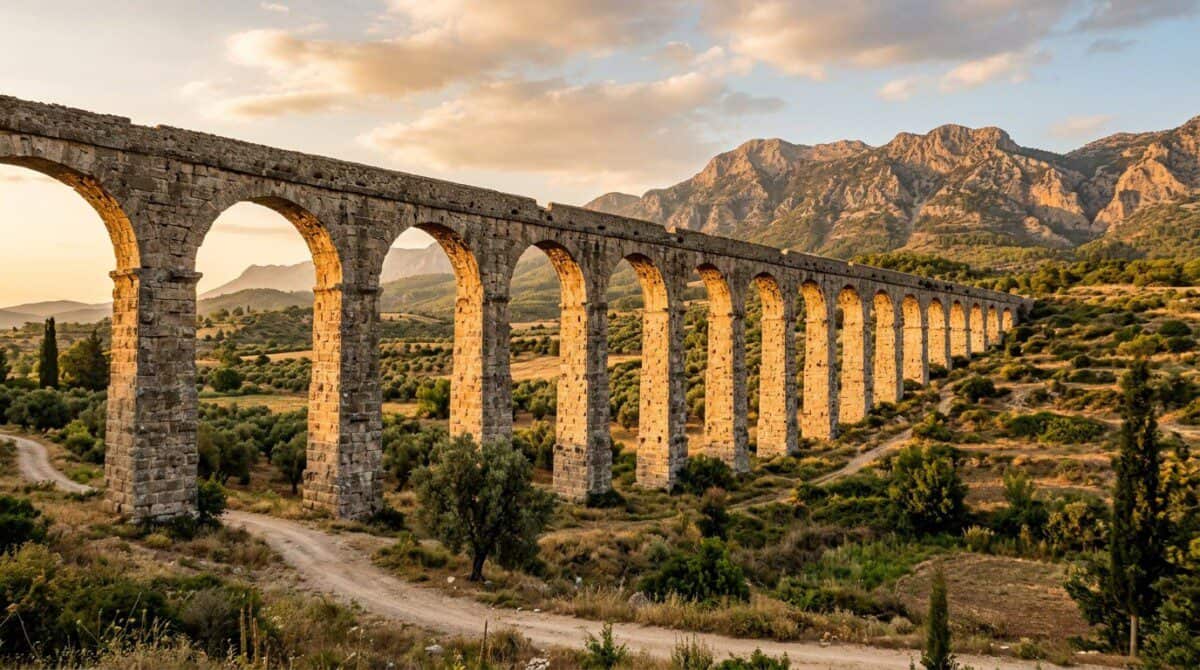
One of the most impressive features of the broader Aspendos region is not at the main archaeological site, but visible across the valley to the north. The Aspendos Aqueduct, also called the Eurymedon Aqueduct, brought water from springs in the foothills 19 kilometers away to the city’s nymphaeums, baths and fountains. The aqueduct is one of the engineering wonders of the Roman world.
The Engineering Problem
Bringing water from distant springs to ancient cities was a standard Roman engineering project. Most Roman aqueducts followed natural slopes, using gravity to flow water at a constant gradient over long distances. The Aspendos aqueduct faced a particular challenge: the source springs were higher than the destination city, but the terrain between included two deep valleys that the water had to cross.
The Roman solution involved a combination of techniques. For most of the route, the water flowed through a covered stone channel following the natural contour of the foothills. For the two deep valley crossings, the engineers used a system of inverted siphons, where the water flowed down one side of the valley, across the bottom under pressure, and up the other side using the principle that water seeks its own level.
The pressure required for the inverted siphons meant the water pipes had to be exceptionally strong. The Romans built monumental stone arch bridges across the valleys to carry the water at high elevation, reducing the maximum pressure on the pipes. The result is a hybrid engineering solution combining gravity flow, monumental arch bridges and pressurized inverted siphons in a single integrated system.
The Twin Towers
The most visible features of the surviving aqueduct are the two massive stone towers that flank the largest valley crossing. These towers, called Aspendos Aqueduct Towers or simply the Twin Towers, are about 30 meters tall and connected by a stone bridge that originally carried the water channel across the valley.
Each tower contains a chamber at the top where the water was decanted from one pressurized section into another, allowing controlled regulation of the flow. The towers are essentially water control valves, similar in function to modern hydraulic control stations but built entirely of cut stone with no moving parts.
The towers are still standing essentially intact, with their stone facing largely preserved and their internal chambers accessible to visitors willing to climb the original stairs. The view from the top of the towers across the valley and out to the distant Mediterranean is one of the most striking in southern Turkey.
Visiting the Aqueduct
The aqueduct towers are about 1 kilometer north of the main Aspendos archaeological site, on a separate road accessed from the highway. The area is free to enter (no ticket required) and is rarely visited because most tourists do not realize it exists. Allow 30 to 45 minutes for a visit including the climb to the top of one of the towers.
Bring water, sturdy shoes for the climb up the original Roman stairs, and your camera. The stairs are uneven and lack handrails, so the climb requires caution but is not technically difficult. The views and the sense of standing on 2,000-year-old engineering justify the effort.
For a complete Aspendos experience, visit the main archaeological site first (theater, acropolis, agora) and then drive to the aqueduct towers for the engineering masterpiece. Together they give you a complete picture of the Roman city as a fully functioning urban environment.
How to Get to Aspendos and Practical Planning
Aspendos is in the Antalya province of southwestern Turkey, in the historical region of Pamphylia between the Taurus mountains and the Mediterranean coast. The site is easily accessible from the major resort areas of Antalya and Side.
From Antalya
Antalya is the main international gateway to the region, with daily flights from Istanbul, Ankara and many European cities. The drive from Antalya to Aspendos takes about 45 minutes on the modern D400 coastal highway. The route is straightforward with clear signage.
Rental cars are widely available at Antalya airport (around 800 to 1,500 lira per day). Driving gives you flexibility to combine Aspendos with the other Pamphylia ancient cities (Perge, Side) on the same day, as well as visits to the aqueduct towers.
Public bus connections from Antalya otogar (bus station) to the village of Aspendos run several times daily, with onward minibus connections to the archaeological site. The journey takes about 90 minutes and costs around 60 lira each way. Less convenient than driving but realistic for budget travelers.
From Side
Side is the closest major resort town to Aspendos, about 30 kilometers (35 minutes by car) to the south. Many visitors based in Side make Aspendos a half-day trip, often combining it with the nearby Manavgat waterfall and bazaar. See my Side guide for more on the wider Pamphylia experience.
Organized day tours from Side typically cost 500 to 1,000 lira per person including transport, guide and lunch. The tours usually combine Aspendos with another site (Perge or Manavgat) for a full day experience. Most Side hotels can arrange tours through their reception desks.
By rental car (around 800 lira per day in Side), the drive to Aspendos is direct and easy. The roads in the Antalya region are well maintained and well signed. Park at the main visitor parking lot at the archaeological site.
The Visit Itself
Aspendos is open daily from 08:00 to 19:00 in summer and 08:00 to 17:00 in winter. Entry is around 350 Turkish lira for international visitors. Allow 90 minutes to 2 hours for the theater alone, longer if you also explore the acropolis and the aqueduct towers.
From the parking lot, a short walk takes you to the theater entrance. The main theater visit is well organized with clear visitor routes and interpretive signs in English. The acropolis is reached by a separate path heading west from the theater, taking about 20 minutes each way with a moderate uphill climb.
Bring water, sunscreen and a hat. The theater has some shade in the seating bowl but the acropolis is fully exposed. Comfortable walking shoes are essential for the uneven terrain. The summer temperatures can exceed 40 degrees Celsius, so plan visits for early morning (08:00 to 11:00) or late afternoon (16:00 to 19:00).
The Aspendos Opera and Ballet Festival
The annual Aspendos Opera and Ballet Festival, organized by the Turkish State Opera and Ballet, holds performances in the original Roman theater every summer in June and July. The programming typically includes major operas (Verdi’s Aida is a perennial favorite for the obvious historical resonance), ballet productions, classical concerts and occasional pop performances.
Tickets cost 500 to 2,000 lira depending on the performance and seating section. The front rows directly facing the stage are the most expensive, with upper rows progressively cheaper. The acoustic quality is excellent throughout the theater, so even budget seats give a great experience.
Buy tickets online at the festival website or through Turkish ticket agencies. Performances typically start at 21:00 to take advantage of cooler evening temperatures and atmospheric lighting. The festival website publishes the full program each spring (around April or May) for the upcoming summer season.
Combining Aspendos with Perge, Side and the Pamphylia Cities
Aspendos was one of four major cities in the ancient region of Pamphylia (the Greek name for the coastal plain of modern Antalya province). The other three (Perge, Side and Sillyon) all have substantial archaeological remains and are easily combined with Aspendos on a 2 or 3 day Pamphylia ancient cities itinerary.
Perge
Perge, 30 kilometers west of Aspendos and 18 kilometers from Antalya, has the most complete Roman city layout of all the Pamphylia sites. The Hellenistic city gate, the colonnaded main street, the agora, the nymphaeum, the stadium and the theater are all visible and well preserved. Walking the full length of the main street, with the rebuilt columns marching ahead of you, is one of the most evocative ancient city experiences in Turkey.
Allow 2.5 to 3 hours for a thorough Perge visit. The site is easy to combine with Aspendos in a single full day, with Perge in the morning and Aspendos in the afternoon. Both sites are along the D400 highway making the connection straightforward.
Side
Side, 30 kilometers south of Aspendos, combines a modern Mediterranean resort with substantial ancient ruins built into the modern town. The Temple of Apollo at the harbor, the Roman theater, the agora and the necropolis are all visible alongside the hotels and restaurants. Side has a different character from the more remote sites, with the ancient ruins integrated into a living tourist town.
Side works well as a base for visiting both Aspendos and Perge, with daily organized tours and abundant accommodation in all price ranges. See my Side guide for full details on the town and its history.
Sillyon
Sillyon, the fourth Pamphylia city, is the least visited but the most dramatically situated. The site sits on top of a 200-meter-high mesa with sheer cliffs on all sides, accessible only by a single winding path. The ancient city included a substantial theater, council chambers, residential quarters and Hellenistic fortifications, with most structures partly preserved.
The view from the top of Sillyon over the Pamphylia plain to the Mediterranean is one of the most spectacular in the region. The climb takes about 30 minutes from the parking lot and is moderately strenuous. Allow 2 to 3 hours for the full visit including the climb up and down.
For other Turkish destinations beyond Pamphylia, see my guides to Ephesus, Antalya Old Town, Pamukkale and Aphrodisias.
Frequently Asked Questions
Why is Aspendos better preserved than other Roman theaters?
A combination of factors. The theater was built unusually solidly, with thick walls and high-quality stone. It was used continuously through the Byzantine period and even into the Seljuk Turkish period, when it was converted into a caravanserai (commercial inn). The continued use meant the structure was maintained rather than dismantled for building materials. Geographic isolation away from major medieval cities also reduced the pressure to recycle the stones. The 19th and 20th century archaeological recognition of the site as exceptionally important led to careful preservation by the modern Turkish government.
Can I attend a performance at Aspendos?
Yes, the annual Aspendos Opera and Ballet Festival in June and July offers regular performances. Tickets are available online and through Turkish ticket agencies. The combination of the original Roman theater as venue and classical opera or ballet as content creates one of the most memorable cultural experiences possible in Turkey. Book accommodation well in advance for festival nights, as Antalya and Side hotels fill quickly.
How long does a Aspendos visit take?
The theater alone takes 60 to 90 minutes for a focused visit. Including the acropolis and the agora adds another 90 minutes to 2 hours. The aqueduct towers add another hour with the drive. A full Aspendos experience including all three takes 4 to 5 hours, which is realistic for a half-day visit from Antalya or Side.
Is Aspendos suitable for children?
Yes, the theater in particular fascinates children, who can climb to the upper rows, run around the stage and test the acoustics. The open spaces and dramatic scale make Aspendos a more visually engaging site than some other Roman ruins. Bring water and snacks. The acropolis hike can be tiring for very young children.
When is the best time to visit?
April, May, September and October offer the best balance of comfortable temperatures and good light. Summer (June through August) is hot (often 35-40 degrees Celsius). Early morning or late afternoon summer visits avoid the worst heat. Winter visits are cool and quiet, with the theater offering a special atmosphere in low-season sunshine.
How does Aspendos compare to other Turkish theaters?
Aspendos is the most complete Roman theater in Turkey and arguably in the entire Mediterranean. The Hierapolis theater is also very well preserved but lacks the complete stage building. The Ephesus Great Theater is larger (25,000 capacity) but has lost most of its stage building. Aspendos’s combination of completeness, original architectural decoration and continued performance use makes it unique. The UNESCO tentative list includes Aspendos as nominated for World Heritage status.
About the Author
I’m Ilknur Acar, the founder of Bir Dakikada Geziyorum. Aspendos is the Roman theater that always exceeds the expectations of friends I bring there for the first time. The combination of the complete architecture, the original Roman acoustics and the continued performance tradition makes it unlike any other ancient site in Turkey. I write history-rooted travel guides that respect the layered past of Turkey and the eastern Mediterranean. Follow along for more.