Last Updated: 17 May 2026
Pergamon (modern Bergama in northwestern Turkey) was one of the three great Hellenistic capitals of the eastern Mediterranean, alongside Alexandria in Egypt and Antioch in Syria. From its founding around 281 BC until its absorption into the Roman Empire in 133 BC, Pergamon was the seat of the Attalid dynasty, a small kingdom of Greek rulers who built one of the most culturally ambitious capital cities of the ancient world. The Acropolis of Pergamon, perched on a 335-meter limestone hill above the modern town, contains the steepest theater of antiquity, the foundation of the famous Pergamon Altar (now in Berlin), the second-greatest library of the ancient world (after Alexandria), and palace remains that still convey the grandeur of a kingdom that briefly rivaled the great Hellenistic empires.
In this guide I will share the spectacular Acropolis with its dramatic hilltop position, the medical complex of the Asclepion (one of the most important healing sanctuaries of the ancient world), the Roman lower city with its monumental Red Basilica, and the practical logistics of reaching Bergama from Izmir or Ayvalik. I will tell you why a Pergamon visit is one of the most overlooked great experiences in Turkey, and how to combine it with other Aegean coast sites.
Key Takeaways
- Pergamon is a UNESCO World Heritage Site combining a spectacular Hellenistic acropolis on a 335-meter hill with a substantial Roman lower city, occupied continuously from the 3rd century BC to the 14th century AD.
- The Pergamon Theater is the steepest in the ancient world, with 80 rows of seats descending at a 70-degree angle from the hilltop, providing dramatic views over the surrounding plain.
- The Pergamon Altar, originally on the acropolis, was excavated by German archaeologists in the 1870s and is now displayed in the Pergamon Museum in Berlin (one of the most important Greek monuments outside Greece).
- The Library of Pergamon held 200,000 scrolls at its peak and was a major rival to the Library of Alexandria. Marc Antony reportedly gave the Library of Pergamon to Cleopatra as a wedding gift to replenish her library.
- The Asclepion of Pergamon, 2 kilometers from the acropolis, was one of the most important medical sanctuaries of the ancient world, with the physician Galen (one of the most influential medical writers in history) trained here in the 2nd century AD.
- Reach the acropolis by a modern cable car from central Bergama, eliminating the steep 30-minute climb up the hill.
The Acropolis of Pergamon
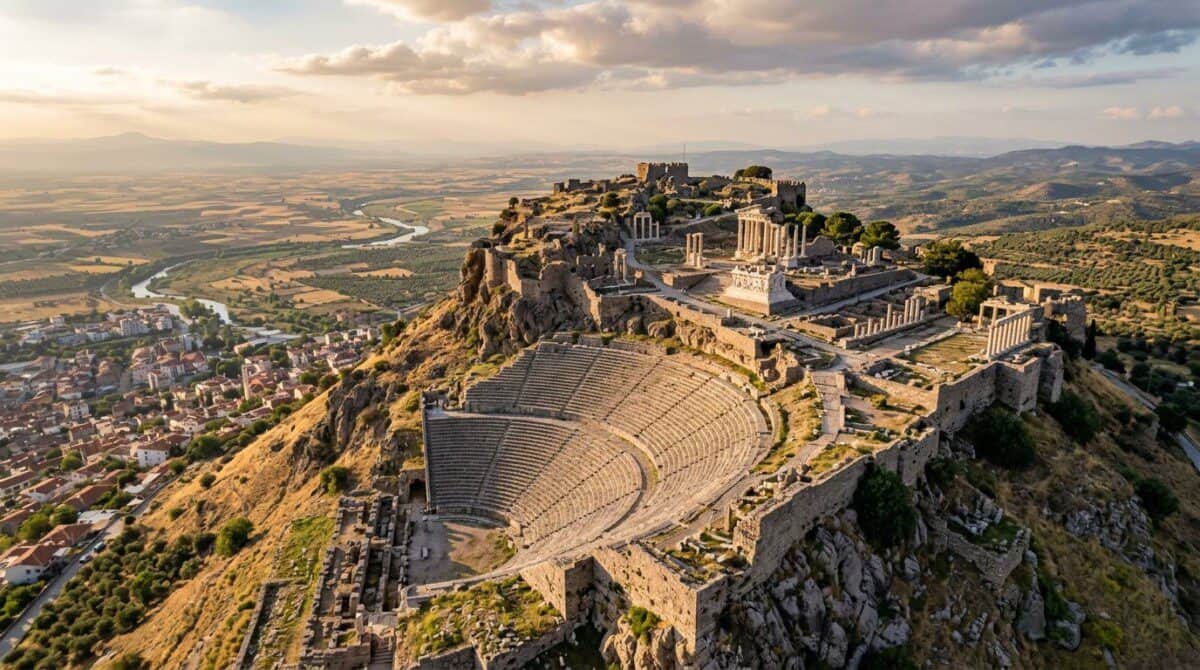
The Acropolis of Pergamon sits at the top of a steep limestone hill 335 meters above the modern town of Bergama. The acropolis was the political, religious and royal center of the Hellenistic kingdom, with palaces, temples, theater, library and the famous altar all crowded onto the small hilltop. Walking through the ruins today, with sweeping views of the surrounding plain and distant mountains, gives you a powerful sense of why the Attalid kings chose this position for their capital.
The Attalid Dynasty
The kingdom of Pergamon emerged from the chaos that followed Alexander the Great’s death in 323 BC. Lysimachus, one of Alexander’s successors, deposited his treasury at Pergamon in the care of a eunuch named Philetairos around 282 BC. When Lysimachus died in 281 BC, Philetairos kept the treasury and used it to found an independent dynasty. The Attalid dynasty he founded ruled Pergamon for 150 years.
The Attalids transformed Pergamon from a hilltop fortress into one of the most culturally sophisticated capitals of the Hellenistic world. They patronized Greek art, literature and philosophy on an enormous scale, building the famous library, the great altar, palaces and temples that made Pergamon a cultural rival to Alexandria. Their wealth came from agricultural land, trade routes and the silver mines of the surrounding region.
The dynasty ended in a strange way. The last Attalid king, Attalos III, died in 133 BC without an heir. In his will he bequeathed his entire kingdom to the Roman Republic, perhaps because he saw Roman power as inevitable and wanted to spare his people the violence of a Roman conquest. The Roman Senate accepted the inheritance and Pergamon became the province of Asia, the wealthiest province in the Roman East.
The Theater
The most spectacular feature of the Acropolis is the theater carved into the steep western slope of the hill. The theater has 80 rows of stone seats, descending at a remarkable 70-degree angle, with capacity for 10,000 spectators. Standing in the orchestra and looking up at the seats receding into the sky, you understand why this is called the steepest theater of the ancient world.
The steepness was a practical solution to the topography. The hilltop site did not provide enough flat ground for a conventional theater layout, so the architects exploited the natural slope to fit the massive seating area into a small horizontal footprint. The result is acoustically excellent (the steep angle reflects sound efficiently) and visually dramatic (the audience seems to hang above the stage).
The stage building (skene) was originally wooden and removable, set up only during performance seasons. After performances, the wooden structure was dismantled to reveal the panoramic view over the plain. This was unique to Pergamon and reflects the importance the Attalids placed on the visual relationship between the theater and the surrounding region.
The Pergamon Altar and Its Berlin Exile
The Pergamon Altar, also called the Great Altar of Zeus and Athena, was one of the most magnificent monuments of Hellenistic art. The structure was 36 meters wide and 33 meters deep, with a monumental staircase climbing to a colonnaded enclosure where sacrifices were performed. The base of the altar was decorated with a continuous frieze 120 meters long showing the mythological battle between the Olympic gods and the Giants (Gigantomachy).
The frieze is one of the most ambitious sculptural compositions of the ancient world. The figures are over-life-size, with the gods and giants depicted in violent combat with dramatic poses, swirling drapery and expressive faces. The artistic style is high Hellenistic baroque, emotionally intense and technically virtuosic.
The altar was excavated by German archaeologists Carl Humann and Alexander Conze in the 1870s, with the agreement of the Ottoman government that the finds would be shared. The German share, including the entire frieze, was shipped to Berlin where it was reassembled in the purpose-built Pergamon Museum. The altar remains in Berlin today, while the foundations are visible on the original Pergamon acropolis.
The Turkish government has periodically requested the return of the altar, without success. Whether the original location at Pergamon would benefit from the altar’s return is debated. The foundations on the acropolis are clearly marked and you can imagine the original structure rising above them. The site of the altar gives a powerful sense of its original position and significance, even without the actual monument.
The Library and the Royal Palaces
The Pergamon Library was one of the two greatest libraries of the ancient world, alongside the Library of Alexandria. At its peak under King Eumenes II (197-159 BC), the library held approximately 200,000 scrolls covering Greek literature, philosophy, science, history and rhetoric. The library was located in the northern part of the acropolis, adjacent to the temple of Athena.
The Library’s Architecture
The library building contained four main rooms. The largest room, about 16 by 13 meters, housed the main collection. The walls were lined with wooden cabinets containing the scrolls, with the cabinets raised on stone platforms to protect against dampness. A large statue of Athena stood at one end of the room as the patron deity of learning.
The remaining three rooms served as reading rooms, conservation workshops and offices for the librarians. The library staff included copyists who reproduced texts for export and exchange with other libraries, scholars who specialized in particular fields of literature, and administrators who managed the collection and catalogued new acquisitions.
The famous story of how parchment was invented at Pergamon is told by Pliny the Elder. When the Egyptian Ptolemy V banned the export of papyrus to Pergamon (to prevent the rival library from expanding), the Pergamon scholars developed a process for treating animal skins to create a writing surface as smooth as papyrus but more durable. The new material was named pergamenum (Latin for “from Pergamon”), which became parchment in English. Whether the story is literally true or a later invention, it captures the cultural rivalry between the two libraries.
The Royal Palaces
The royal palaces of the Attalid kings were located at the highest point of the acropolis. The palace complex included formal reception rooms, private royal apartments, administrative offices, a small private theater, gardens with elaborate water features and baths. The architecture combined Greek classical traditions with Anatolian and Persian influences, reflecting the cosmopolitan character of the dynasty.
Most of the palace complex is reduced to foundations and lower walls, but the layout is clear and the scale gives a sense of the original grandeur. Mosaic floors from several palace rooms have been recovered and are now displayed in the Bergama Archaeological Museum. The famous “Doves Mosaic” by Sosos of Pergamon, which inspired countless later imitations including the famous Roman mosaic in the Capitoline Museum, originally came from one of these palace rooms.
The temple of Athena, adjacent to the library and the palaces, was the religious heart of the royal precinct. The temple housed a famous cult statue of Athena Polias (Athena the City-Protector) and contained dedications from victories and royal celebrations. The foundations are still visible and the surrounding area was decorated with statues, columns and inscriptions that survive in fragments.
Reaching the Acropolis
A modern cable car, opened in 2010, runs from the base of the hill in central Bergama up to the acropolis entrance. The cable car takes about 4 minutes and runs continuously throughout the visiting hours. The cost is around 50 lira each way or 80 lira return.
The cable car eliminates the steep 30-minute climb that was previously required and makes the acropolis accessible for visitors with limited mobility. The original Greek and Roman road up the hill is still visible (and walkable for those who want the climb), but most visitors now use the cable car for efficiency.
At the top, the acropolis covers a substantial area requiring at least 90 minutes for a thorough walk. The main visitor route loops through the theater, the altar site, the library, the palaces and the temples. Interpretive signs in English explain the various structures and their significance. Allow 2.5 to 3 hours for a complete acropolis visit.
The Asclepion and the Medical Tradition
The Asclepion of Pergamon was one of the most important medical sanctuaries of the ancient world. Dedicated to Asclepius, the Greek god of medicine, the sanctuary combined religious healing rituals with practical medical treatment in ways that anticipated modern integrated medicine. The site is 2 kilometers from the acropolis, in the southwestern part of the modern town.
Galen and the Medical Tradition
The most famous physician associated with Pergamon was Galen (129-216 AD), born in the city and trained at the Asclepion in his youth. Galen later moved to Rome where he served as physician to the emperor Marcus Aurelius and wrote dozens of medical treatises that dominated European and Islamic medicine for over a thousand years. Galen’s anatomical, physiological and therapeutic teachings remained the foundation of Western medical education until the 17th century.
The Asclepion provided Galen with his first medical training in an environment that combined Hippocratic clinical practice with the broader Hellenistic medical tradition. The sanctuary attracted physicians from across the Greek and Roman world, both to receive training and to consult with the resident medical staff on difficult cases.
Patients at the Asclepion underwent treatments combining rituals (incubation in the sacred dormitory where dreams were interpreted as divine medical advice), physical therapies (bathing in mineral waters, exercise programs, dietary regulation, massage) and pharmaceutical treatments (herbal medicines, mineral preparations). The recovery rate was reportedly high, and grateful patients dedicated marble tablets describing their cures, many of which survive.
The Architectural Complex
The Asclepion was organized as a sacred precinct with multiple specialized buildings around a central courtyard. The Sacred Way, a colonnaded road about 800 meters long, led from the lower city to the sanctuary entrance, with shops and offices along its length serving the pilgrims and patients.
The main courtyard of the Asclepion contained the Temple of Asclepius (a circular building with a domed ceiling, similar in style to the Pantheon in Rome), the sacred dormitory where patients slept hoping for divine medical dreams, the Sacred Spring (its mineral water was used in treatments), and the small theater that hosted both ceremonial performances and educational lectures.
The Library of the Asclepion, separate from the main acropolis library, contained specialized medical texts and case studies. The library is preserved in foundations and lower walls, with the original layout still visible. The connection between the library and the medical treatment areas suggests that learning and healing were treated as integrated activities by the Pergamon medical tradition.
The Sacred Spring and the Tunnels
The Sacred Spring at the Asclepion still flows today, with the original Roman water channels still distributing the mineral water to the various treatment areas. The water has a slightly radioactive content (from natural geological sources) that may have provided some genuine therapeutic effect alongside the ritual significance.
The most evocative feature of the site is the long underground tunnel that connected the various treatment buildings. Patients walked through the tunnel from one treatment to another, with priests reciting prayers and ritual texts overhead through openings in the ceiling. The walking through the tunnel was itself a therapeutic exercise, with the cool air and the rhythmic prayers contributing to the healing atmosphere.
The tunnel is open to visitors and walking its full length (about 80 meters) is a memorable experience. The cool air, the ancient stone walls and the imagination of countless patients who walked the same path 2,000 years ago combine into an unusual archaeological experience that complements the more conventional sightseeing of the acropolis.
The Roman Lower City and the Red Basilica
The lower city of Pergamon, on the plain at the foot of the acropolis hill, developed mainly during the Roman period after Pergamon was incorporated into the Roman Empire. The Roman city was wealthy and well-built, with monumental buildings that complemented the Hellenistic acropolis above.
The Red Basilica
The most striking surviving Roman building in the lower city is the Red Basilica, a massive temple complex built in the 2nd century AD and originally dedicated to the Egyptian deities Isis and Serapis. The building takes its name from the red brick of which it was constructed, a distinctive material choice for a major religious monument.
The main temple is a rectangular structure approximately 60 meters long and 26 meters wide, with walls preserved to their full original height of 19 meters. The exterior walls have lost their marble cladding but the massive brick structure is essentially intact. Two large round towers flank the main building, originally containing chapels for subsidiary deities.
In the Byzantine period the temple was converted into a Christian basilica dedicated to Saint John. The famous Book of Revelation mentions Pergamon as one of the seven churches addressed by John, with the critique that the city was the place “where Satan’s throne is” (a likely reference to the dominant pagan religious culture). The conversion of the Red Basilica into a Christian church marked the eventual Christian victory over the pagan religious establishment.
The Lower Agora and the Roman Theater
The Lower Agora was the main commercial square of the Roman city, surrounded by colonnades, shops and administrative buildings. The square covers approximately 80 by 80 meters and was the primary marketplace for goods imported from across the Roman world. Foundations of the surrounding structures are visible, with some sections preserving original wall standings.
The Roman Theater of the lower city, distinct from the spectacular Hellenistic theater on the acropolis, was a smaller structure with capacity for about 3,000 spectators. The theater served primarily for civic ceremonies and small dramatic performances, with the larger acropolis theater reserved for major festival events.
The Roman gymnasium and the Roman baths complete the lower city ensemble. Both were substantial buildings that served the leisure and educational needs of the Roman citizens. The gymnasium combined athletic training facilities with educational lecture rooms, in the traditional Greek pattern that the Romans inherited and continued.
The Bergama Museum
The Bergama Archaeological Museum in central Bergama displays the artifacts recovered from the various Pergamon excavations. The collection includes original sculptures from the acropolis and the Asclepion (those not removed to Berlin), the famous Doves Mosaic from the royal palace, dedicatory tablets from the Asclepion, and Roman-period sculptures and inscriptions from the lower city.
The museum is small but well-curated, with good English-language labels and contextual displays. Allow 90 minutes to 2 hours for a thorough visit. The museum is in the center of Bergama town, walking distance from most hotels and restaurants.
For visitors interested in seeing the Pergamon Altar in its full reassembled glory, a separate trip to the Pergamon Museum in Berlin is required. The Berlin museum is one of the most important displays of Greek monumental art outside Greece itself. Combining a visit to the Pergamon site in Turkey with a visit to the Berlin museum gives you the most complete possible understanding of this remarkable Hellenistic kingdom.
How to Get to Pergamon and Practical Planning
Pergamon is in the Bergama district of Izmir province in western Turkey. The site is accessible from Izmir or from the resort town of Ayvalik on the Aegean coast.
From Izmir
Izmir Airport has flights from Istanbul, Ankara and many European cities (London, Paris, Frankfurt, Vienna, Brussels, Stockholm in summer). From Izmir city center, the drive to Bergama takes about 1.5 hours on the modern highway. Bergama is approximately 110 kilometers north of Izmir.
The IZBAN suburban train and bus connections from Izmir to Bergama are frequent and inexpensive. Direct buses from Izmir otogar (bus station) to Bergama run every 30 minutes during the day and take about 90 minutes. Tickets cost around 60 to 80 lira. The Bergama bus station is in the center of the town, walking distance to the cable car and the museum.
For more flexibility, rent a car at Izmir Airport (around 800 to 1,500 lira per day). Driving allows you to combine Bergama with other sites such as Sardis, Ephesus or Cesme on a single multi-day itinerary. The roads are well maintained and well signed.
From Ayvalik
Ayvalik, a Mediterranean resort town on the Aegean coast about 60 kilometers north of Bergama, is a popular base for visiting Pergamon. The drive from Ayvalik to Bergama takes about 50 minutes. Many visitors stay in Ayvalik for the beaches and atmosphere, then take a day trip to Bergama.
Ayvalik also has ferry connections to the Greek island of Lesvos (Mytilene), making it a convenient stop on a Greek island-hopping itinerary that includes the Turkish mainland. From Lesvos you can continue to Chios, Samos and on to other Aegean islands.
Where to Stay
Bergama has a modest selection of hotels suitable for overnight stays. The Hera Hotel, the Athena Pension and the Aristonicus Hotel are reliable mid-range options with prices in the 600 to 1,500 Turkish lira per night range. The town is small and most hotels are within walking distance of the cable car and the main attractions.
For more comfort, stay in Izmir (with its many international-standard hotels) or Ayvalik (with its waterfront hotels and Mediterranean atmosphere). Either option works for day trips to Bergama.
For an unusual experience, consider one of the boutique hotels in the historic Greek and Ottoman quarters of Bergama old town. These hotels occupy restored 19th-century houses with traditional architecture and offer a more authentic experience than the modern hotels. The Aristonicus Boutique Hotel is the best-known option.
The Visit Itself
The Acropolis is open daily from 08:30 to 19:00 in summer (reduced hours in winter). Entry is around 200 Turkish lira plus the cable car fee. The Asclepion is open similar hours with separate entry of around 100 lira. The Bergama Archaeological Museum is open Tuesday through Sunday and charges around 50 lira.
Allow a full day for a thorough Pergamon visit. A typical itinerary includes the acropolis in the morning (3 hours), lunch in Bergama town, the Asclepion in the early afternoon (2 hours) and the museum and Red Basilica in the late afternoon (2 hours). The total comes to about 7 hours including travel between sites.
Bring water, sunscreen and a hat. The acropolis has very limited shade and the summer temperatures can be extreme. Comfortable walking shoes are essential, especially for the uneven terrain at the Asclepion and around the acropolis ruins. For more on the wider Aegean coast, see my guides to Ephesus, Pamukkale and Troy.
Frequently Asked Questions
Is Pergamon worth visiting given that the altar is in Berlin?
Yes, absolutely. The Pergamon site contains far more than the altar, including the spectacular theater, the library, the palaces, the Asclepion and the Red Basilica. The setting on the dramatic hilltop above Bergama gives a sense of place that no museum can replicate. The combination of the Pergamon site visit and a separate visit to the Berlin museum is ideal but the site alone is rewarding.
How does Pergamon compare to Ephesus?
Both are major ancient sites of the Aegean coast but they offer different experiences. Ephesus is larger, more complete and more impressive in its individual monuments (the Library of Celsus, the Great Theater). Pergamon has the more dramatic setting (the hilltop acropolis) and the more interesting medical and intellectual history (the Asclepion and the great library). Both are worth visiting on a thorough western Turkey trip.
Can I do Pergamon as a day trip from Izmir?
Yes, a day trip from Izmir is comfortable. Take an early morning bus or rent a car, arrive at Bergama around 10:00, spend 6 to 7 hours visiting the major sites, and return to Izmir in the evening. Hire a guide locally if you want detailed explanation. Organized day tours from Izmir typically cost 800 to 1,500 lira per person.
What is the best time to visit?
April, May, September and October offer the best weather for the exposed acropolis and Asclepion. Summer (June through August) is very hot, often exceeding 35 degrees Celsius on the acropolis. Plan early morning or late afternoon visits in summer. Winter is cool and quiet, with some risk of rain.
Is the acropolis suitable for children?
Yes, with supervision. The cable car ride is fun for children and the dramatic theater fascinates most visitors of all ages. Some of the terrain near the ruins is uneven, so close attention is needed. Bring water and snacks. The Asclepion tunnel is particularly memorable for children with its underground atmosphere.
Where can I find more on the historical context?
The UNESCO World Heritage listing for Pergamon provides additional context on the multi-layered site. The Pergamon Museum in Berlin has extensive online resources about the altar and the Hellenistic kingdom. Modern works on Hellenistic history (like Peter Green’s “Alexander to Actium”) give the broader political and cultural context that shaped Pergamon’s rise and fall.
About the Author
I’m Ilknur Acar, the founder of Bir Dakikada Geziyorum. Pergamon is one of those Turkish archaeological sites that consistently exceeds the expectations of visitors who arrive thinking they will see another ancient ruin and instead encounter the legacy of one of the great cultural capitals of the Hellenistic world. I write history-rooted travel guides that respect the layered past of Turkey and the eastern Mediterranean. Follow along for more.