Last Updated: 17 May 2026
Fethiye is one of those rare Turkish towns where ancient Lycian civilization, modern marina life and natural coastline collide in a single day. I have stayed in Fethiye on and off for the last decade, sometimes for a quick weekend, sometimes for three weeks straight, and it remains the place I recommend most often to first-time visitors to the Turquoise Coast. The town itself is built on top of ancient Telmessos, a Lycian city whose rock-cut tombs still stare down at modern apartment blocks from the cliffs above the harbor.
In this guide I will share the Lycian rock tombs that hover above the town, the 12 Islands boat tour that defines a Fethiye summer day, the canyon of Saklikent that runs cold even in August, and the smaller corners of the area most cruise visitors never reach. I will tell you how I plan my own days here, where I eat, and which days of the week are worth avoiding because of the cruise schedule.
Key Takeaways
- The Lycian Rock Tombs of Amyntas, dating to the 4th century BC, are carved directly into the cliff face and are best visited at sunset when the limestone glows orange.
- The 12 Islands boat tour is the classic Fethiye day out, running daily from April to October from around 800 Turkish lira per person including lunch.
- Saklikent Gorge is 18 kilometers long, the second longest canyon in Europe, and the river running through it stays around 8 degrees Celsius even in August.
- Fethiye Tuesday Market is the largest and best stocked traditional market on the Aegean-Mediterranean coast, perfect for spices, olives and local cheese.
- The Lycian Way, a 540-kilometer long-distance trail, passes right through Fethiye and offers shorter day hike options accessible from the town.
- For a quieter base, consider staying in Calis Beach or Ovacik instead of central Fethiye, both have easy dolmus links to the town center.
The Lycian Rock Tombs and Ancient Telmessos
The first time I walked up the steep stone steps to the tomb of Amyntas, I had to stop halfway and just look back at Fethiye laid out below me. The whole town, the marina full of gulets, the bay curving away to the Greek island of Rhodes in the distance, all framed by the silent rock face above. The tomb has been watching this view for 2,400 years, and standing in front of it you join a long line of visitors stretching from antiquity to today.
Who Were the Lycians
The Lycians were an Anatolian people who lived along the southwestern coast of Turkey from at least the second millennium BC. They had their own language, their own script, their own pantheon of gods, and a strong sense of independence that lasted even after they were conquered by the Persians and later absorbed into the Roman Empire. The Greek historian Herodotus wrote that the Lycians traced descent through their mothers, not their fathers, which was unusual in the ancient Mediterranean.
Lycia was a federation of around 23 city-states, with cities like Xanthos, Patara, Myra and Telmessos forming the main centers. The federation operated as a democratic league with weighted voting, an early experiment in representative government that some scholars have suggested influenced the American founding fathers when they drew up the United States constitution. The Lycian League is mentioned in James Madison’s Federalist Papers as a model worth considering.
Telmessos, the city beneath modern Fethiye, was one of the most important Lycian ports. It was the gateway between the Aegean and the Mediterranean and a major center for trade in timber, wine and grain. The city’s most distinctive cultural feature was its tradition of carving elaborate temple-style tombs directly into the cliff faces above the urban area, where the dead could watch over the living for eternity. The tombs are still there. The city itself sits under modern Fethiye, buried by earthquakes and a thousand years of rebuilding.
The Tomb of Amyntas
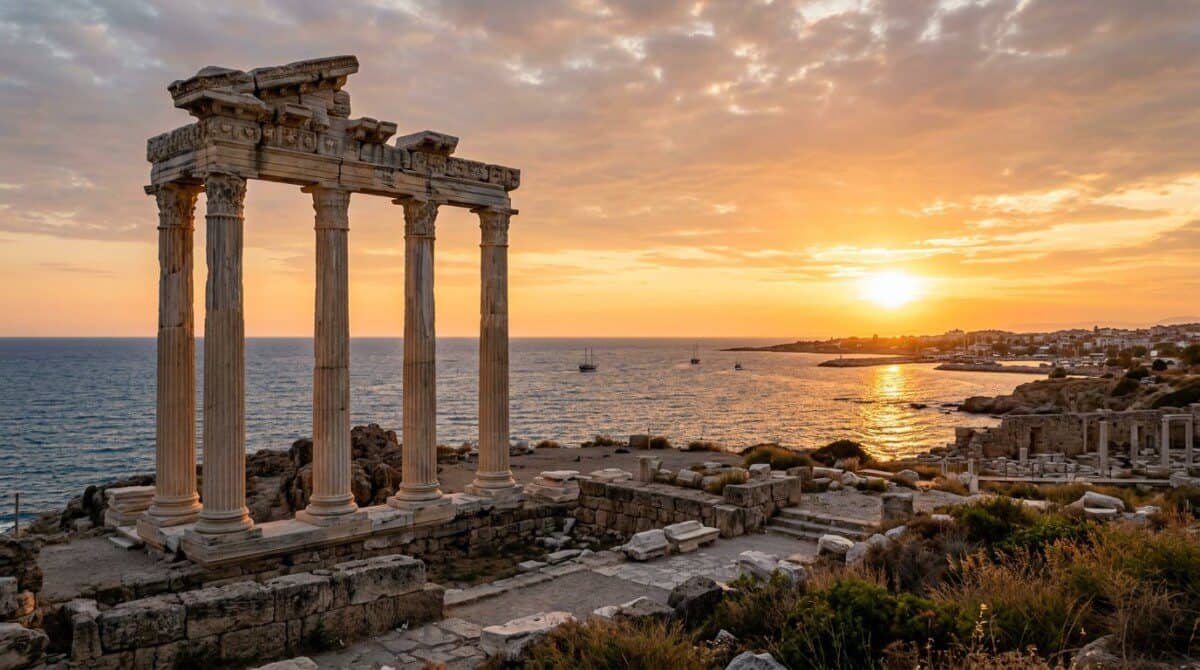
The most famous of the Fethiye rock tombs is the Tomb of Amyntas, carved into the cliff above the town center around 350 BC. The facade is shaped like an Ionic Greek temple, with two columns supporting a triangular pediment, and an inscription in Greek that simply reads “Amyntas, son of Hermagios.” We know nothing else about Amyntas, who he was, what he did, why he deserved such an elaborate tomb. The mystery is part of the appeal.
Inside the tomb is a single rectangular chamber with stone benches along three walls, where the body would have been laid out along with grave goods. The tomb was looted in antiquity and again in the 19th century, so the original contents are long gone. What remains is the architectural ambition, a Greek temple turned ninety degrees and carved into solid rock, an engineering feat that required months of work by skilled stonemasons working with bronze chisels.
You reach the tomb by climbing a staircase of about 220 steps from the town below. Bring water, take it slowly, and stop on the platforms to admire the views. There is no shade on the climb, so morning or late afternoon is best. The site is open from sunrise to sunset and entry is free. At the top you can walk right up to the facade, touch the columns, and look into the burial chamber, an immediacy that would never be allowed at a more famous tourist site.
The Other Tombs and the Sarcophagi
The Tomb of Amyntas is the most famous, but there are dozens of other Lycian rock tombs scattered around Fethiye, some inside the modern town and some on the surrounding hillsides. You can see a cluster of smaller temple-style tombs just below Amyntas, and a row of plain rectangular tombs at the eastern end of the cliff. Most are accessible by short walking paths, and the smaller ones often have no other visitors around.
In the streets of central Fethiye you will also see Lycian sarcophagi, free-standing stone coffins with arched lids that look like little stone houses. The most striking is in front of the post office in the main square, a 2,400-year-old tomb sitting between a kebab shop and a phone repair place. The Lycians liked to place sarcophagi at street corners and intersections so the dead could continue to participate in city life, an idea that modern Turkey has preserved by simply building around them.
The Fethiye Museum, two minutes walk from the main shopping area, has a small but well-curated collection of Lycian, Greek and Roman artifacts from the surrounding region. The Trilingual Stele, a stone inscribed in Lycian, Greek and Aramaic, is the most important piece on display and helped 20th-century scholars decipher the Lycian language. Entry to the museum is a few dozen lira and it takes about 45 minutes to walk through everything.
The 12 Islands Boat Tour, a Day at Sea
If you spend even one summer day in Fethiye and do not get on a boat, you have missed the point of the town. The 12 Islands tour is the local classic, a full day on a wooden gulet visiting half a dozen anchorage spots in the bay south and west of the town. It is not glamorous, it is not exclusive, you will share the boat with 30 other people, but it is exactly the kind of relaxed Mediterranean boat day that this coast was built for.
What the Tour Includes
A standard 12 Islands tour leaves the Fethiye marina around 10:30 in the morning and returns around 18:00 in the evening. The itinerary varies between operators but typically includes 5 or 6 swimming stops at islands and bays such as Yassicalar, Tersane, Hayirsiz, Domuz, and Gocek bays. The boat anchors for 30 to 60 minutes at each stop, long enough for a proper swim, a snorkel, or just a float on the surface staring at the blue.
Lunch is usually served on board around 13:00 and includes grilled chicken or fish, rice, salad and bread. Some boats serve better food than others, the more expensive operators will offer fresh-grilled sea bass while the budget boats stick to the basics. Drinks (beer, soft drinks, wine) cost extra. The boats also sell ice cream and snacks throughout the day. I recommend bringing your own bottled water just to be safe, the on-board prices are tourist prices.
The tour costs between 750 and 1,200 Turkish lira per person depending on the season, the operator and what is included. Most tours include the lunch, but check before you book. The boats are largely identical in layout, two-deck wooden gulets with shaded seating, sun deck loungers and a ladder into the water. They depart from Fethiye marina, where you can compare boats in the morning before choosing.
Which Bays Are the Best
The order and selection of bays varies by operator, but a few stand out for the right reasons. Aquarium Bay (Akvaryum Koyu) is named for its crystal-clear water and is the best snorkeling stop, with visibility down to 15 meters on a calm day. You can see fish swimming around the rocks and the occasional octopus hiding in crevices. Bring your own mask and snorkel, the boats often only have a few sets and they are not always in great condition.
Hayirsiz Adasi (Bad Luck Island, also called Cleopatra’s Bay) has a small ruined Byzantine monastery and a tiny beach. The water is shallow and warm, perfect for less confident swimmers. Tersane Adasi (Shipyard Island) is the largest of the 12, with ruins of an Ottoman naval dockyard from the 19th century. Some tours stop here long enough for you to walk around the ruins on shore, others just anchor offshore for swimming.
Yassica Adalari (Flat Islands) is a chain of low islands separated by narrow channels of turquoise water. Boats anchor in the channels and you can swim from one island to the next in a few minutes. This is the most photogenic stop on most itineraries, with shallow sandy bottoms and pine trees coming right down to the water. Bring a waterproof phone case if you want to take pictures while floating, the colors are extraordinary.
Booking Tips and What to Bring
You can book the tour at the marina the morning of, walking from boat to boat and comparing prices, or through your hotel reception the night before. Booking through a hotel adds a small commission but is more convenient if you are short on time. I recommend walking the marina yourself, the boats look quite different up close and you can pick one based on the size of the sun deck, the apparent quality of the food being prepared, and whether the music being tested looks like your kind of music.
Bring a swimsuit, a towel, sunscreen, a wide-brimmed hat, a long-sleeved cover-up for the sun, a snorkel mask if you have one, a phone in a waterproof case, and 200 lira in cash for drinks and tips. The boats have toilets but no showers, so you will be sticky with sea salt by the end of the day. A hat with a chin strap is useful, the wind picks up in the afternoon and ordinary hats fly off into the sea.
The tour runs daily from late April to late October, weather permitting. In peak summer (July, August) every boat sails full, so book the night before. In May, June and September you can usually walk on board on the day. October trips are sometimes cut short by autumn winds, but the water is still warm enough to swim. Winter tours do not run, the boats are pulled out of the water and serviced from November to March.
Saklikent Gorge and the Inland Adventures
About 50 kilometers east of Fethiye, the Saklikent Gorge cuts 300 meters deep into the Akdaglar mountains. It is the second longest canyon in Europe at 18 kilometers, though only the first 4 kilometers are accessible to visitors. Walking through this gorge in the middle of an August heatwave, with snow-cold water rushing around your knees and the canyon walls towering above you, is one of the strangest and most memorable experiences in southern Turkey.
How to Walk the Gorge
Entry to Saklikent is at the village of the same name. You pay a small park fee at the gate, then walk down a wooden boardwalk to the entrance of the gorge. The first part of the gorge has river crossings where the water comes up to your waist, sometimes higher in spring. There is a chain to hold onto and helpers (for tips) who will guide you across the deepest sections. Most visitors stop here, but the gorge continues for another three kilometers if you keep going.
The deeper you go, the narrower and more dramatic the canyon becomes. The walls rise hundreds of meters above your head, the water gets colder and faster, and the light dims to a blue twilight even at midday. Past the first kilometer the path is just the riverbed itself, with shallow pools, smooth stones and occasional swimming holes deep enough for a quick dunk. You can usually walk for about an hour and a half before reaching impassable sections, then turn back the way you came.
Bring water shoes or sandals with a back strap, ordinary flip-flops will be swept away by the current. Bring a swimsuit under your clothes, you will get soaked from the waist down whether you plan to or not. A waterproof phone case is essential, the gorge is one of the most photogenic places in Turkey and you will want pictures. Most importantly, do not enter the gorge in spring or after heavy rain, flash floods are real and people have died in them.
Restaurants and Activities at the Entrance
At the entrance to the gorge there is a cluster of trout restaurants built on wooden platforms over the river. The water is so cold and clean that local trout farms thrive here, and the restaurants serve them grilled whole with salad and bread. You sit on cushions on the platform, with the river rushing beneath you and the canyon entrance visible upstream. This is one of the best lunch settings in the region, and the food is genuinely good.
Beyond the restaurants you can also organize rafting trips on the Esen Cayi river that flows out of the gorge, suitable for beginners and children over 8. Trips run from spring to early autumn and cost around 500 lira per person for a 2-hour float with rapids of grade 2 and 3. There is also zip-lining across the gorge from a platform near the entrance, a 200-meter ride at 30 meters above the river. Both activities are well organized by local operators and have good safety records.
The drive from Fethiye to Saklikent takes about 75 minutes by car. You can rent a car for around 1,200 lira per day in Fethiye, or book a day tour for around 600 lira per person that includes transport, lunch at one of the trout restaurants, and time at the gorge. Tours often combine Saklikent with a stop at Tlos, a nearby Lycian city with rock tombs and a Roman theater, making for a varied day of canyon walking and ancient ruins.
Other Inland Options Worth a Day
The mountains behind Fethiye hide several other places that reward the effort of getting there. Kayakoy, the abandoned Greek village 8 kilometers south of Fethiye, was emptied during the 1923 population exchange between Greece and Turkey and has been preserved as an open-air museum. Walking through its 500 stone houses, two churches and dozens of shops, all roofless and slowly being reclaimed by nature, is a moving experience that you can do in two hours. Entry costs around 80 lira.
Babadag, the 1,960-meter mountain above Oludeniz, is where paragliders launch from for the famous tandem flights down to the Blue Lagoon. You can take the cable car to the top even if you do not want to paraglide, just for the views over the Aegean and the chain of small islands stretching toward Rhodes. The cable car costs around 700 lira return and runs from 09:00 to 18:00 in summer. I have written a separate guide to paragliding from Babadag and the Blue Lagoon if you want the full details.
The Lycian Way, the 540-kilometer long-distance trail that runs from Fethiye to Antalya, passes right through the Fethiye area and offers shorter day hikes. The section from Kayakoy to Oludeniz takes about 4 hours and ends at the beach at the Blue Lagoon, a perfect downhill walk with sea views the whole way. The Cultural Routes Society maintains the trail and publishes good maps and detailed route guides.
Fethiye Town, Where to Eat and the Tuesday Market
Fethiye itself is a working Turkish town, not just a tourist resort. The marina and Old Town are full of visitors in summer, but you only need to walk five minutes inland to find ordinary Turkish neighborhoods with bakeries, barbershops, fruit stalls and tea gardens. This mix is one of the things I like most about Fethiye, you can have an authentic Turkish experience and a relaxed beach holiday in the same week without moving hotels.
The Tuesday Market
Every Tuesday, the area around the bus station fills with hundreds of stalls selling fruit, vegetables, herbs, spices, cheeses, olives, honey, fresh fish, clothing, leather goods, fabrics and household items. The Fethiye Tuesday Market is one of the largest weekly markets in southern Turkey and draws shoppers from villages 50 kilometers away. The atmosphere is loud, hot, fragrant and exactly what you want from a Turkish bazaar.
Start at the food section in the morning when the produce is freshest. Look for white cheese (beyaz peynir) in big plastic tubs, sold by the kilo. Try cherries, figs and apricots in season. Buy small quantities of saffron, sumac, dried oregano and red pepper flakes to take home as souvenirs that actually get used. The honey vendors will let you taste their pine, citrus and chestnut varieties before you decide.
The clothing and textile section has Turkish towels (pestemal), kilims, scarves and inexpensive cotton clothing. Quality varies and so do prices, so haggle politely. Vendors expect to negotiate and the opening price is often 30 to 50 percent above what they will actually accept. A genuine handmade kilim will cost several thousand lira even after bargaining, factory-made imitations cost a fraction of that. Ask the vendor directly which is which, they will usually tell you honestly.
Where to Eat in Town
Mod Yacht Lounge, on the marina, serves modern Turkish cuisine with sea views and a wine list that includes excellent local Aegean whites. The seared sea bass with samphire is a standout. Reservations recommended for sunset dinner in summer. Cem and Can, a small fish restaurant tucked behind the Old Town, has no view but the best grilled fish in Fethiye. The owners select the fish themselves at the morning market and grill them simply over charcoal with olive oil and salt.
For breakfast, head to Cinarli Bahce in the Pasa Kaptan neighborhood. The full Turkish breakfast spread costs around 250 lira per person and includes cheeses, olives, honey, jams, eggs, fresh bread, salads, fruits and unlimited tea. Sit at one of the outdoor tables under the pomegranate tree and you will not need to eat again until evening. For a quick lunch, try Tantuni Konya behind the harbor for spicy beef wraps that cost less than 80 lira.
Ice cream lovers should find Mado, a Turkish chain that makes traditional Maras-style ice cream with goat milk and salep, served stretchy and chewy in a way that surprises most first-time tasters. The pistachio flavor is the one to try. There are three Mado locations in central Fethiye. Avoid the over-priced ice cream shops directly on the marina aimed at cruise tourists, the quality is poor and the prices are absurd.
Where to Stay
For central convenience, the area around the marina has dozens of small hotels and apartments. Yacht Classic Hotel, Hotel Unique and Villa Daffodil are reliable mid-range options with breakfast included and easy walking access to restaurants and the harbor. Expect to pay 1,500 to 3,500 lira per night in summer, less in shoulder season.
For a beach-town atmosphere, stay in Calis Beach, 5 kilometers west of Fethiye. Calis has a 4-kilometer pebble beach, a sunset-watching promenade, and dozens of restaurants and bars. It is quieter than Fethiye town and the dolmus runs to and from the center every 15 minutes until 23:00. Hotels in Calis cost about 20 percent less than equivalent properties in central Fethiye.
For a quieter mountain retreat, consider Ovacik or Hisaronu, twin villages above Oludeniz with cooler temperatures and panoramic views. These are popular with British package tourists in summer and feel more like a Mediterranean hill resort than a Turkish coastal town, which some travelers love and others find off-putting. Decide based on whether you want a Turkish atmosphere or a familiar European one. For more on the area beyond Fethiye, see my guides to Bodrum and the Greek island of Rhodes, both accessible by ferry from this part of the coast.
How to Get to Fethiye and Plan Your Trip
Fethiye is in the Mugla province of southwestern Turkey, on the Mediterranean coast between Antalya and Marmaris. Most international visitors arrive through Dalaman Airport, 50 kilometers to the east, or through Bodrum Milas Airport, 230 kilometers to the northwest. Both have direct flights from London, Manchester, Berlin, Amsterdam and many other European cities during the summer season.
From Dalaman Airport
Dalaman is the closest airport and the easiest way to reach Fethiye. The Havas airport bus runs from Dalaman directly to Fethiye otogar (bus station) and takes about 90 minutes. Tickets cost around 200 lira and the bus runs to meet most arrivals and departures. Check the current schedule at the Havas counter in the airport arrivals hall. A private taxi from Dalaman to Fethiye costs around 1,500 lira and takes about 75 minutes.
Renting a car at Dalaman gives you the most flexibility, especially if you want to do day trips to Saklikent, Kayakoy and the Lycian Way. Rental costs range from 1,000 to 2,500 lira per day depending on the season and car type. International chains (Avis, Sixt, Europcar) have desks in the airport. Book online in advance for the best prices, especially in July and August when local supply tightens.
The drive from Dalaman to Fethiye takes about 50 minutes via the coastal D400 road. Traffic is light outside of weekends. The road is paved, well marked and easy to navigate, but watch for speed cameras around the small towns along the way. Turkish driving culture can be assertive, so leave plenty of following distance and do not be surprised by sudden lane changes.
From Bodrum, Antalya and Other Cities
From Bodrum, regular intercity buses run via Mugla to Fethiye and take about 4 hours. Pamukkale, Kamil Koc and Metro Turizm all serve this route. Tickets cost around 350 lira. Bus stations in Bodrum and Fethiye are well organized with food kiosks, baggage storage and free wifi.
From Antalya, buses to Fethiye take about 4 hours via the coastal road, with stops at Kas and Kalkan. The route is one of the most scenic in Turkey, with the road following the Mediterranean shore for much of the way and passing several Lycian ruins. If you have time, break the journey at Kas for a night or two, the small harbor town is one of my favorites on the entire Lycian coast.
From Istanbul, the easiest option is a domestic flight to Dalaman, taking about 90 minutes from Istanbul Sabiha Gokcen or Istanbul Airport. Direct buses run from Istanbul to Fethiye overnight, taking about 14 hours, but only the very budget-conscious or very curious travelers should consider this. The flight is worth the extra cost.
When to Visit
The best months are May, June, September and early October, when temperatures are pleasant (25 to 30 degrees Celsius), the sea is warm, and the crowds are manageable. July and August are hot (35 to 40 degrees regularly) and the marina is packed, but the energy is fun if you like a busy resort atmosphere.
April and late October are shoulder seasons with cooler temperatures, fewer crowds and lower prices. Some boat tours and restaurants close in November and reopen in March. Winter visits are quiet and peaceful, with the marina half empty and locals reclaiming the town, but you cannot swim and many tourist services shut down completely.
For festivals, the Olympos Yacht Festival takes place in Fethiye every October, when classic gulets gather in the marina for a week of racing and parties. The Air Games festival in Babadag happens every June, with paragliders from around the world competing in accuracy and acrobatic events. Both are great fun if you can time a visit.
Frequently Asked Questions
How many days should I spend in Fethiye?
Three to four days is the minimum for a proper visit, allowing one day in town including the Lycian Rock Tombs, one day on a 12 Islands boat tour, one day for Saklikent and Kayakoy, and an optional day for the Blue Lagoon or paragliding from Babadag. With a week you can also fit in a side trip to Kas or to Rhodes by ferry, and have rest days at the beach.
Is Fethiye good for families with children?
Yes, Fethiye is one of the most family-friendly destinations on the Turkish coast. The beaches are shallow and safe, the boat tours are slow and gentle, and the markets and ancient ruins are interesting for older children. Calis Beach in particular has a long promenade with playgrounds, ice cream shops and easy access to the sea. Many hotels offer family rooms and kids menus.
Can I do Fethiye and Pamukkale on the same trip?
Yes, and it is a popular combination. The drive from Fethiye to Pamukkale takes about 3.5 hours via the inland route. Day tours run from Fethiye to Pamukkale departing around 06:00 and returning around 22:00, costing roughly 1,500 lira per person including transport, lunch and entry. For a more relaxed trip, drive yourself and stay one night in Pamukkale to enjoy the travertines at sunset and sunrise. See my full Pamukkale guide for details.
Is Fethiye safe to visit?
Yes, Fethiye is very safe by international standards. Turkey as a whole has low rates of violent crime against tourists, and Fethiye specifically is a small, friendly town where you can walk around at night without concern. Normal common-sense precautions apply, watch your belongings in crowded markets, lock your car, and avoid leaving valuables on the beach. The biggest practical risks are sunstroke and dehydration in summer.
How does Fethiye compare to Bodrum?
Fethiye is calmer, more family-oriented and has more accessible nature than Bodrum. Bodrum has a livelier nightlife, more luxury hotels and a more international cosmopolitan atmosphere. Both have ancient ruins, beautiful coastlines and good food. If you want clubs and yachts, choose Bodrum. If you want hiking, ancient tombs and gentle beach days, choose Fethiye. For specifics see my Bodrum guide.
Can I take a ferry from Fethiye to Rhodes?
No direct ferries currently run from Fethiye to Rhodes. The closest ferry port is Marmaris, 130 kilometers west, where daily catamarans run to Rhodes in about 50 minutes during the summer season. From Fethiye you can take a bus to Marmaris (3 hours) and catch the morning ferry. A day trip is possible but tight, two days is more relaxed. See my Rhodes Old Town guide for what to expect when you arrive.
About the Author
I’m Ilknur Acar, the founder of Bir Dakikada Geziyorum. Fethiye has been one of my regular destinations for over a decade, and I have watched it change from a quiet fishing town into a busy international resort while somehow keeping its Lycian soul intact. I write honest, practical, history-aware guides to Turkey and the eastern Mediterranean. Follow along for more.