Patmos Island Guide: Monastery of Saint John & the Cave of the Apocalypse
Last Updated: 17 May 2026
Patmos is the small Greek island where the apostle John, exiled by the Roman emperor Domitian in 95 AD, received the vision that became the Book of Revelation, the final book of the New Testament. Today the cave where the vision is said to have occurred, the monastery built around John’s gospel a thousand years later, and the entire island’s medieval village atmosphere give Patmos a unique status as both a religious pilgrimage site and a quiet Aegean island for travelers seeking something deeper than beach resorts. Patmos has never been developed for mass tourism, by deliberate local policy, and that absence shapes everything about visiting the island.
In this guide I will share the Monastery of Saint John (one of the most important Orthodox monasteries in the world), the Cave of the Apocalypse where John heard the revelations, the hilltop village of Chora with its astonishing collection of 17th and 18th century captains’ houses, the beaches and the smaller villages that round out a thoughtful 3 or 4 day visit. I will tell you how to time the religious sites to combine tourist visits with the actual rhythm of monastic life, and where to stay if you want to wake up to one of the most spiritually charged sunrises in the Mediterranean.
Key Takeaways
- The Monastery of Saint John the Theologian, founded in 1088, holds one of the most important manuscript libraries in the Orthodox world, with over 2,000 manuscripts including a 6th-century Gospel of Mark.
- The Cave of the Apocalypse, halfway between the harbor of Skala and the village of Chora, is where John is said to have received the vision recorded in the Book of Revelation around 95 AD.
- Chora village has 50 surviving captains’ houses (kapetanaika) from the 17th and 18th centuries, with whitewashed exteriors, painted ceilings and exquisite interior decoration.
- Patmos has no large beach resorts and no airport, deliberately preserved as a quiet pilgrimage and traveler destination by Greek government regulation.
- The orthodox Easter celebrations on Patmos, especially the Niptiras ceremony where the abbot washes the feet of 12 monks, are among the most atmospheric religious ceremonies in Greece.
- Three days is the minimum for a meaningful visit; four to five days lets you also explore the smaller villages and beaches at a quiet pace.
The Monastery of Saint John the Theologian
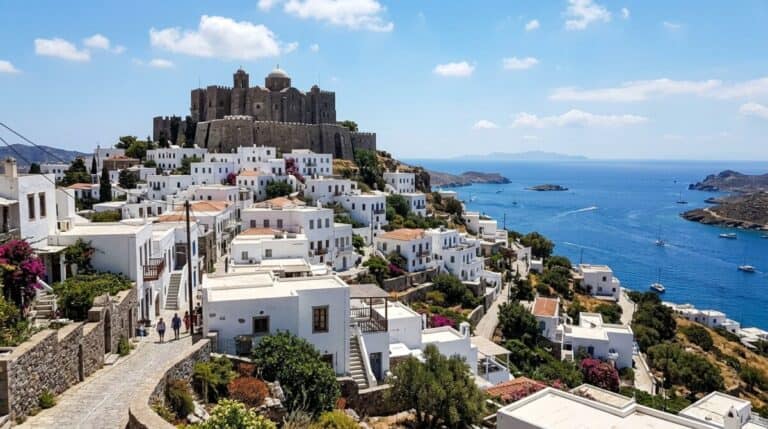
The Monastery of Saint John the Theologian dominates the skyline of Patmos from every direction. Its massive fortress walls, built in the late 11th century, rise above the hilltop village of Chora and can be seen from miles out at sea as you approach the island. Inside the walls is one of the most important Orthodox monasteries in the world, founded in 1088 by the monk Christodoulos as a community devoted to the memory of John’s revelations.
The Founding and the History
The monk Christodoulos arrived on Patmos in 1088 after receiving a charter from the Byzantine emperor Alexios I Komnenos granting him the entire island for the foundation of a monastery dedicated to John the Theologian. Christodoulos chose the highest hill on Patmos as the site, partly for spiritual reasons (the elevation suggesting closeness to God) and partly for defensive reasons (the medieval Mediterranean was a dangerous place, with constant raids by Arab and later Turkish pirates).
The monastery was built like a fortress, with thick stone walls, narrow windows, defensive towers and a small entrance gate that could be barred against attackers. The community grew rapidly in the 12th and 13th centuries, becoming one of the most important Orthodox centers in the eastern Mediterranean. By the 16th century the monastery owned property throughout the Aegean and supported schools, hospitals and missionary activities far beyond Patmos itself.
The Ottoman conquest of the Aegean in the 14th and 15th centuries actually benefited the Patmos monastery, as the Ottomans (unlike the Latins who had ruled briefly during the Crusader period) granted the monastery autonomous rule over the island in exchange for tax payments. For nearly 500 years, until Greek independence in the 1820s, Patmos was effectively a monastic state, with the abbot of Saint John as the temporal authority over the island.
Inside the Monastery
The monastery is open to visitors, with restrictions, almost every day. You enter through the small main gate (originally designed to allow only one person at a time, for defense) into a small courtyard. From here, multiple chapels, cells, refectories and other buildings extend through the complex. The architecture is a mix of original 11th and 12th century work and later additions and restorations.
The Katholikon (main church), at the heart of the monastery, dates from the 11th century and features the original Byzantine wall paintings, an extraordinarily ornate iconostasis (icon screen) with hand-carved gilded woodwork, and several venerated icons including the Saint John icon attributed to the legendary painter Manuel Panselinos in the 14th century. The interior is small but the visual density is overwhelming, allow at least 30 minutes for a thorough look.
The Chapel of the Holy Cross, next to the main church, contains a fragment of the True Cross brought to Patmos in the 12th century. The chapel walls are covered with 17th century frescoes in excellent condition. The Refectory (dining hall), with its long stone table and 12th century frescoes, gives a sense of how monastic communal life was organized.
The Library and the Manuscripts
The Patmos Monastery library is one of the most important in the Orthodox world, with over 2,000 manuscripts spanning more than 1,500 years of Greek Christian intellectual tradition. The collection includes 5th and 6th century Gospel manuscripts (some of the oldest surviving Christian texts), hundreds of medieval theological and liturgical works, and an extensive collection of Byzantine and post-Byzantine documents on the history and administration of the eastern Mediterranean.
The most famous item in the collection is the Codex Purpureus Petropolitanus, a 6th century manuscript of the Gospel of Mark written in silver ink on purple-dyed vellum. The codex is incomplete (only 67 leaves survive of the original 300+), with other leaves of the same manuscript scattered between Saint Petersburg, the Vatican, the Vienna State Library and other collections. The Patmos pages are kept in a controlled display case in the museum section.
The library is generally not open to casual visitors, with research access granted only to credentialed scholars. However, the monastery museum, housed in former cells of the monks, displays selections of manuscripts, icons, vestments, sacred vessels and other treasures from the monastery’s collection. The museum is open most days and entry is included with the monastery admission ticket.
Visiting Practicalities
The monastery is open Monday through Saturday from 08:00 to 13:30, and on Sunday afternoons from 16:00 to 18:00. Closed on certain religious feast days. Entry to the monastery is free, with a small fee (around 4 euros) for the museum. Photography is not allowed inside the buildings.
Dress code is strictly enforced. Men must wear long pants and shirts with sleeves. Women must cover their shoulders and wear skirts or dresses below the knee. The monastery provides wrap-around skirts and shawls at the entrance for visitors not appropriately dressed, but bringing your own is more comfortable.
The walk up to the monastery from the village of Chora takes 5 minutes. The walk up from Skala port takes about 40 minutes on a stepped path called the Apocalypse Way, which also passes the Cave of the Apocalypse halfway up. A local bus also runs from Skala to Chora and the monastery, costing around 2 euros each way.
The Cave of the Apocalypse
Halfway between Skala port and the hilltop village of Chora, just off the main road, is the small monastery and cave complex that has been venerated as the site of John’s vision since the early Christian period. The cave is small (just a few square meters of usable space), but the religious atmosphere and the sense of historical connection are powerful even for non-Christian visitors.
John the Theologian and the Revelation
John the Theologian, also called John the Evangelist, was one of the original twelve apostles of Jesus. According to early Christian tradition, after the death of Jesus John spent time in Ephesus (modern Turkey) preaching and writing the Gospel of John. Around 95 AD, during the persecution of Christians under the Roman emperor Domitian, John was exiled to the small island of Patmos, where he is said to have lived for about 18 months.
During his exile on Patmos, John is recorded in the New Testament as having received a series of apocalyptic visions, which he wrote down in a letter to seven Christian communities in Asia Minor. This letter, the Book of Revelation, became the final book of the New Testament. The vivid imagery of the four horsemen, the seven seals, the beast with seven heads and the New Jerusalem all date from this period of exile on Patmos.
After Domitian’s death in 96 AD, John was allowed to return to Ephesus where he is traditionally said to have died around 100 AD. He is the only one of the twelve apostles believed to have died of old age rather than martyrdom. The Cave of the Apocalypse on Patmos became a pilgrimage site within decades of John’s death, and has remained one continuously for nearly 2,000 years.
What You See in the Cave
The cave is accessed through a small church built around the entrance in the 17th century. You descend a short flight of stairs into the cave chamber, where the space is filled with icons, candles and three significant features pointed out by the resident monks.
The first is a triangular crack in the ceiling of the cave, said to be where God’s voice spoke to John, splitting the rock with the power of the divine words. The crack is naturally formed but the religious interpretation has been part of the cave’s identity since the early medieval period.
The second is a small triangular niche in the wall, said to be the place where John rested his head while sleeping. The niche is preserved as a holy spot and visitors often touch it for blessings. The third is a small ledge, said to be where John placed his hands to rise up after his visions. All three features are marked with silver fittings and lit by candles.
The atmosphere inside the cave is intense, with incense, chanting (when monks are present), candle smoke and the constant murmur of pilgrims praying or quietly reading the Book of Revelation. Whether or not you accept the religious interpretation of the site, the sense of two thousand years of continuous devotion is palpable.
The Surrounding Complex
The cave is part of a larger monastic complex that includes a 17th century chapel above the cave, a small museum displaying icons and manuscripts, and a guesthouse for pilgrims. The complex is owned by the Monastery of Saint John but operates as a separate site with its own visiting hours and tickets.
The Theological School of Patmos, established at the cave complex in 1713 by the local monk Makarios Kalogeras, was one of the most important Orthodox educational institutions during the Ottoman period. The school produced many of the theologians, bishops and intellectual leaders of the Orthodox world during the 18th and 19th centuries. The building is still standing and is part of the complex.
Visiting hours for the cave are typically 08:00 to 13:00 and 16:00 to 18:00 daily. Entry is around 4 euros (small donation expected). The same dress code applies as for the main monastery, modest clothing covering shoulders and knees. Photography inside the cave is not allowed, but you can photograph the exterior of the complex and the views over Skala harbor.
Chora Village and the Captains’ Houses
The village of Chora, sprawled around the base of the Monastery of Saint John, is one of the most beautifully preserved medieval villages in the Aegean. The whitewashed houses, the narrow stone lanes, the small chapels tucked into corners, all of it is genuine and continuous, with families living in the same houses that their ancestors built 300 years ago. Chora is a UNESCO World Heritage Site as part of the Patmos monastery complex.
The Captains’ Houses
The most distinctive feature of Chora is the collection of about 50 captains’ houses (kapetanaika in Greek), built in the 17th and 18th centuries by wealthy Patmian sea captains who made their fortunes in the long-distance Mediterranean trade. The captains traded across the Aegean, the Black Sea, the western Mediterranean and as far as India, bringing back wealth that they invested in elaborate homes designed to display their prosperity to their neighbors.
The houses follow a similar plan, with a small entrance from the street leading into a central courtyard, around which the main rooms are arranged on two floors. The exterior is plain whitewashed stone with small windows, deliberately understated to avoid attracting Ottoman tax assessors. The interior is the opposite, with painted ceilings, ornate furniture, Persian carpets, Venetian mirrors and elaborate wall hangings that displayed the captain’s wealth and travels.
Several of the captains’ houses are open to visitors as small museums or as luxury rental properties. The Simandiri House Museum displays a captain’s house preserved in its original 18th century condition, with all the furnishings, kitchen equipment and personal effects of the original family. The visit takes about 45 minutes and is open afternoons in summer. Other captains’ houses operate as boutique hotels or as private residences and can sometimes be seen from outside courtyards visible through their open gates.
Walking the Village
Chora is designed as a defensive maze, with narrow twisting streets that disorient strangers (originally intended to confuse pirates who managed to penetrate the village). Today the layout just means you get pleasantly lost while exploring. The streets are too narrow for cars, so the village is car-free and feels protected from the modern world.
The main square of Chora, the Plateia Eleftherias, is the social center of the village with several tavernas, cafes and small shops. The Cathedral of Saint Christopher, in a small building on the square, is the main parish church of Chora and dates from the 17th century. The interior has fine icons and a hand-carved wooden iconostasis.
Walking through the back streets you discover dozens of small whitewashed chapels, each dedicated to a different saint and each with a different history. Many of these chapels were built by individual families as private votive offerings, often after a sailor returned safely from a dangerous voyage. Most are closed except on their saint’s feast day, but you can usually peek through the iron grilles to see the interior.
Where to Eat in Chora
Vegghera Restaurant, on the main square of Chora, serves modern Greek cuisine in a former captain’s house with a small terrace overlooking the village. The menu changes seasonally and the wine list features good Greek bottles from Santorini, Crete and the northern mainland. Reservations recommended. Expect to pay 50 to 80 euros per person.
To Kafenio tis Choras, on a small side street near the main square, is a traditional Greek kafenio serving meze plates, ouzo and local Patmian wine. The atmosphere is informal, the prices are reasonable (15 to 25 euros per person), and you sit at small tables under a grape vine in the courtyard. This is the right place for an afternoon ouzo after a monastery visit.
For a quick lunch or breakfast, the bakery just off the main square serves excellent fresh bread, cheese pies (tyropites) and small pastries. Buy a few items, find a quiet bench with a view, and have a Greek picnic with the village atmosphere as your accompaniment.
Skala, the Beaches and the Other Villages
Skala, the main port and only town of Patmos at sea level, is where the ferries dock and where most of the modern infrastructure (banks, supermarkets, car rentals, restaurants) is concentrated. Skala is pleasant but not particularly atmospheric, and most visitors stay in Chora or in the smaller villages around the island rather than in Skala itself.
Skala Town
The Skala harborfront has a string of cafes, tavernas and small bars facing the moored boats. The atmosphere is friendly and informal, especially in the evening when local Patmians gather for the volta (evening promenade) along the waterfront. Several tavernas serve good fresh fish at moderate prices, with the Tzivaeri Restaurant being a long-established favorite.
The Apocalypse Bookshop, on a small street behind the harbor, has the best selection of books about Patmos, John the Theologian and Orthodox spirituality in English, French and German. The owner is knowledgeable and happy to recommend books based on your interests. This is the right place to buy a copy of the Book of Revelation to read during your visit.
The Saint John ferry connection from Skala to neighboring islands runs daily in summer to nearby Lipsi, Leros and Arki. Day trips to Lipsi (one of the prettiest of the smaller Dodecanese islands, with excellent beaches and a few small tavernas) take about 35 minutes each way. The cost is around 20 euros round trip.
The Beaches of Patmos
Patmos has several good beaches, mostly on the southern and southwestern coasts. None are particularly large, and none have organized beach club infrastructure, which is part of the appeal.
Psili Ammos, on the southern coast, is the most beautiful beach on the island, with a long stretch of fine white sand and shallow turquoise water. The beach is accessible only by a 30-minute walk from the parking lot, which keeps the crowds away. There is a small taverna at the beach serving simple lunches. Bring water and shade.
Lambi Beach, on the northern coast, is famous for its multicolored pebbles, in shades of pink, red, white and grey. The beach is accessible by car and has a small parking lot and a taverna. The water is clear and good for swimming, though the pebbles can be hard on bare feet, water shoes recommended.
Petra Beach, on the southwestern coast, is a small cove between cliffs with crystal clear water and good snorkeling. There are no facilities, so bring everything you need. The beach is accessible by a short walk from a small parking area.
The Smaller Villages
Grikos, on the southern coast, is the most developed beach village on Patmos, with several small hotels, a few tavernas and a beach with sunbed rental. The village retains its traditional character despite the tourism, with whitewashed houses around a small church and a fishing harbor where local boats dock.
Kampos, on the northern part of the island, is a small village with a beach and a few tavernas. The beach is sheltered from the meltemi winds that affect the more exposed beaches on the western and northern coasts. Kampos has a more residential feel than other beach villages, with many Patmian families having summer homes here.
The interior villages of Patmos, like Sapsila and Diakofti, are small agricultural communities mostly inhabited by older residents. Walking through these villages gives you a sense of traditional Patmian rural life, with goat herds, small olive groves and family chapels. The Diakofti area also has the ruins of a small ancient temple to Artemis, with little remaining but worth a brief visit for the historical context.
For more on the wider Greek island experience, see my guides to Santorini, Mykonos, Rhodes and Crete.
How to Get to Patmos and Practical Planning
Patmos has no airport, by deliberate Greek government policy to preserve the island’s quiet character. All visitors arrive by ferry from neighboring islands or from Athens. The lack of air access means Patmos sees significantly fewer tourists than islands with airports, which is exactly the point.
Getting In
The most common ferry route is from Piraeus (Athens), with overnight ferries running 3 to 5 times per week in summer. The journey takes 8 to 10 hours and is most comfortable in a cabin (around 70 to 100 euros each way for a single cabin). The ferries have restaurants, bars and outdoor seating.
From other Greek islands, regular summer ferries connect Patmos with Rhodes (about 5 hours), Kos (about 3 hours), Leros (1 hour), Samos (2 hours) and Mykonos (3-4 hours). The Kos and Leros connections are most useful for combining Patmos with other islands. From Samos you can also reach Patmos via a small boat connection that runs daily in summer.
The closest airport to Patmos is on Samos (45 minutes by ferry from Patmos). Many visitors fly into Samos from Athens or directly from European cities in summer, then take the morning ferry to Patmos. This is generally faster than the overnight ferry from Piraeus.
Where to Stay
For the most atmospheric experience, stay in Chora village. Several of the captains’ houses have been converted to small boutique hotels with antique furniture, exposed stone walls and dramatic views. Hotel Niko’s Sea View, Archontariki Hotel and the Patmos Aktis Resort (just below Chora, with beach access) are all good options in the 150 to 400 euro per night range.
For convenience near the ferry port, stay in Skala. The Hotel Skala, Hotel Captain’s House and Hotel Patmos Aktis offer mid-range rooms within walking distance of the harbor. Prices typically 100 to 250 euros per night.
For a beach focus, stay in Grikos or Kampos. The Petra Hotel in Grikos and the Onar Studios in Kampos offer beach access with traditional Patmian atmosphere. Prices around 100 to 300 euros per night.
Getting Around
The Patmos public bus connects Skala with Chora, Grikos and Kampos with services every 1 to 2 hours in summer. Bus fares are 2 to 4 euros. The buses are old but reliable. For more flexibility, rent a car (40 to 70 euros per day) or scooter (20 to 30 euros per day) from one of the agencies in Skala.
Taxis are limited on Patmos (only a few cars on the entire island) and difficult to flag in summer. Pre-book through your hotel for transfers and important journeys.
When to Visit
May, June, September and October offer the best balance of warm weather, calm seas and manageable visitor numbers. Easter on Patmos is a major religious event and attracts pilgrims from around the Orthodox world, with elaborate ceremonies at the monastery and the Cave of the Apocalypse. The Easter dates vary each year based on the Orthodox calendar, check ahead if you want to time your visit accordingly.
July and August are warmer but still calmer than the major tourist islands. The lack of large hotels and the strict zoning regulations mean Patmos never feels overcrowded even at peak season. Many of the visitors in summer are religious pilgrims or repeat visitors who know and love the island’s quiet character.
Winter (November to March) sees most tourist services close, though some hotels and restaurants in Skala and Chora remain open year-round. The monastery and the cave continue regular operation throughout the year, and a winter visit can be a special experience for travelers seeking pure silence and authenticity.
Frequently Asked Questions
How many days should I spend on Patmos?
Three days is the minimum for a meaningful visit, allowing one day for the monastery and cave, one day for exploring Chora and the captains’ houses, and one day for the beaches and smaller villages. Four to five days lets you slow down and absorb the island’s atmosphere properly. Patmos rewards unhurried visitors.
Do I need to be religious to enjoy Patmos?
No, but you should respect the religious character of the island. The monastery, the cave and many of the chapels are active places of worship, not just tourist attractions. Visitors of any faith or none are welcome, but appropriate dress, quiet behavior and respectful attention to the rules are expected. Even non-religious visitors often find the spiritual atmosphere moving.
Can I combine Patmos with other Greek islands?
Yes, Patmos is part of the Dodecanese island group and pairs naturally with Kos, Leros, Lipsi or Rhodes. A two-island trip combining Patmos with one of these works well. For a longer trip, you can combine Patmos with Samos (a 45-minute ferry away), giving you access to the Samos airport for international flights.
Is Patmos suitable for families with children?
Yes, though it is not a typical family beach island. The atmosphere is quiet and contemplative, more suited to older children interested in history and religion than to young children seeking entertainment. The beaches are good and the safety is excellent (very low crime, friendly locals). For families seeking a quieter, more cultural experience than the main resort islands, Patmos is a good choice.
What is special about Orthodox Easter on Patmos?
The Easter celebrations on Patmos are among the most authentic and atmospheric in Greece. The Niptiras ceremony on Holy Thursday, where the abbot of the monastery washes the feet of 12 monks in a public ceremony in the main square of Chora, is a unique event seen nowhere else. The midnight resurrection liturgy at the monastery, with the entire island lit only by candles, is unforgettable. If you can plan a visit around Orthodox Easter, the experience is exceptional.
How does Patmos compare to other Greek islands?
Patmos is quieter, more spiritual, and more atmospheric than most Greek islands. The deliberate lack of mass tourism (no airport, strict building regulations) means the island feels closer to its traditional character than islands like Mykonos, Santorini or Crete. Visitors who want beaches, nightlife and resort amenities should choose other islands. Visitors who want depth, beauty, history and silence will find Patmos uniquely rewarding. The UNESCO World Heritage listing covers the Monastery of Saint John, the Cave of the Apocalypse, and the historic center of Chora.
About the Author
I’m Ilknur Acar, the founder of Bir Dakikada Geziyorum. Patmos is the Greek island I recommend to friends who want a deeper, quieter experience of the Aegean, the one that lingers in your memory longer than the famous postcard islands. I write history-rooted travel guides that respect the layered past of the Mediterranean. Follow along for more.
💬 Have a question or a correction? Write to me on Instagram.