Last Updated: 17 May 2026
Aphrodisias is the ancient Greek and Roman city in southwestern Turkey where the marble for some of the greatest sculptures in the Mediterranean was quarried, carved and exported, and where the best-preserved Greco-Roman stadium in the world stands almost intact. Most international visitors to Turkey have never heard of it, which is part of why it has remained quiet and surprisingly atmospheric compared to the better-known sites like Ephesus and Pergamon. Walking through the marble streets and across the stadium’s still-grass-covered seating, with the sound of cicadas and the smell of pine and fig trees in the air, is one of the most peaceful archaeological experiences available in Turkey.
In this guide I will share the unique sculpture tradition that made Aphrodisias one of the most celebrated artistic centers of the Roman Empire, the spectacular stadium that could seat 30,000 spectators, the Temple of Aphrodite that gave the city its name and protection, the museum with sculpture so good it changed scholars’ understanding of Roman art, and the practical logistics of reaching this off-the-beaten-track site. I will tell you why a day at Aphrodisias is unlike any other ancient site visit in Turkey, and how to combine it with Pamukkale for a full classical antiquity day.
Key Takeaways
- Aphrodisias is a UNESCO World Heritage Site dedicated to the goddess Aphrodite, with continuous occupation from around 5800 BC and major construction from the 2nd century BC to the 7th century AD.
- The Stadium of Aphrodisias, 262 meters long with seating for 30,000, is the best-preserved Greco-Roman stadium in the world, with almost all of its original stone seating intact.
- Aphrodisias was famous in antiquity for its sculpture school, with sculptors trained at the city producing statues for Rome, Athens, Alexandria and Ephesus.
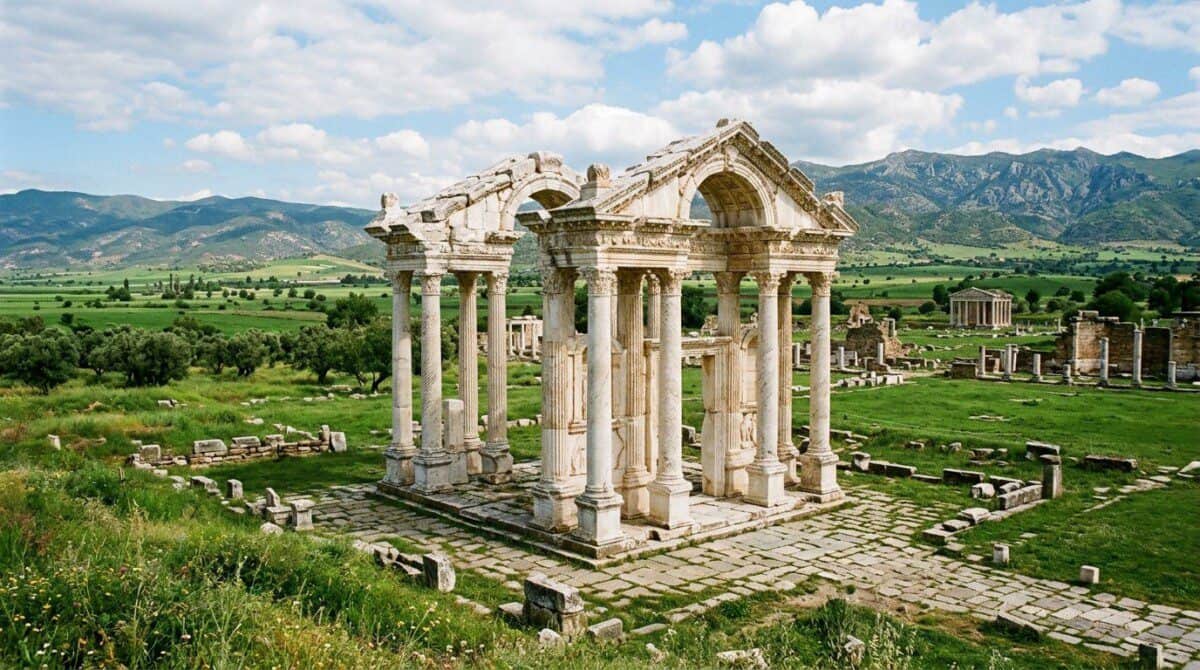
- The Tetrapylon, a monumental four-sided arched gateway, has been beautifully reconstructed (anastylosis) and is one of the most photogenic Roman monuments in Turkey.
- The Aphrodisias Museum on site displays original sculptures including the magnificent Sebasteion reliefs depicting Roman imperial victories.
- The site is 200 kilometers east of Izmir and 100 kilometers from Pamukkale, accessible as a half-day trip from Pamukkale or a longer day trip from Izmir or Bodrum.
The Sculpture Tradition That Made Aphrodisias Famous
Aphrodisias was not just another Greek city in the Roman Empire. It was the artistic capital of the eastern Mediterranean, the place where the finest marble in the Roman world was quarried and where the most prestigious sculpture school in the ancient world trained generations of artists. To understand the site you need to understand the unique combination of geology, religion and artistic culture that created this remarkable place.
The Geology of the Region
Aphrodisias sits at the foot of the Babadag mountains, which contain extensive deposits of high-quality crystalline white marble. The marble of Aphrodisias is exceptionally pure, with very fine crystal structure that allows the most delicate carving without breaking. Roman sculptors and architects recognized this material as among the finest available in the Mediterranean, comparable to the famous Pentelic marble used for the Parthenon in Athens.
The marble quarries are located about 2 kilometers north of the ancient city, on the slopes of the mountains. The quarries operated continuously from the 1st century BC through the 7th century AD, with vast quantities of marble extracted and shipped throughout the Roman world. Some of the most famous Roman sculptures in major European museums today were carved from Aphrodisian marble.
The presence of high-quality stone, combined with the city’s location at the meeting point of major trade routes between the Aegean and the Anatolian interior, made Aphrodisias the natural center for a major sculpture industry. By the 1st century AD the city had become the most important marble-working center in the eastern Roman Empire.
The Sculpture School
The Aphrodisias sculpture school was famous throughout antiquity. Inscriptions on statues from across the Roman Empire identify their sculptors as “Aphrodisians,” a designation that functioned like a brand mark of artistic excellence. Sculptors trained at Aphrodisias worked in Rome itself, in Athens, in Alexandria, in Antioch, in Ephesus and in every major city of the Mediterranean world.
The Aphrodisian style is recognizable for several characteristic features. The carving is exceptionally fine, with delicate attention to surface texture (skin, hair, fabric folds) and the use of running drill techniques to create deep undercuts that gave the sculptures dramatic light-and-shadow effects. The figures are typically idealized but with individualized portraits when the subject was a real person, combining classical Greek formal traditions with Roman realism.
The Aphrodisian sculptors specialized in several categories of work, including imperial portraits (for the Roman emperors and their families), mythological compositions (gods, heroes, mythological scenes), funerary sculpture (elaborate sarcophagi for wealthy clients) and architectural sculpture (capital, friezes and decorative elements for monumental buildings). The output was enormous and the quality consistently high.
What This Means for Your Visit
Aphrodisias today contains the largest concentration of original Roman sculpture of any archaeological site in the world. The on-site museum displays hundreds of statues, reliefs, capitals and architectural elements recovered from the city itself. Many of these were never finished or were rejected by their original Roman clients, meaning they remained at the workshop where they were carved and survived to be excavated in modern times.
The unfinished and rejected sculptures are particularly valuable for understanding Roman sculpture technique. You can see the various stages of carving, from rough blocks with the figure outlined, to partially completed works showing how the sculptors planned their compositions, to fully finished pieces that simply happened to not be sold. This kind of insight into the ancient workshop is not available anywhere else.
The Sebasteion reliefs, displayed prominently in the museum, are the most extensive collection of Roman imperial propaganda sculpture surviving anywhere. The reliefs originally decorated a monumental imperial cult building dedicated to the Roman emperors, with each panel depicting a Roman victory over a particular subject people. The artistry is exceptional and the political subject matter gives a clear window into how Rome saw itself and how it wanted to be seen by its subject populations.
The Stadium, Theater and Other Monumental Buildings
Beyond its sculpture, Aphrodisias is a major archaeological site in its own right, with monumental buildings spread across about 40 hectares of preserved ancient cityscape. The visit takes you through 800 years of Greco-Roman urban development, from the late Hellenistic period (2nd century BC) to the early Byzantine (7th century AD).
The Stadium
The Stadium of Aphrodisias is the single most spectacular feature of the site. The structure is 262 meters long and 59 meters wide, with seating capacity for approximately 30,000 spectators. The vast majority of the original stone seating survives intact, and the entire structure is so well preserved that you can imagine the crowds filling the seats for the chariot races and athletic competitions that took place here in antiquity.
The stadium was built in the 1st or 2nd century AD and served both athletic and entertainment purposes. The eastern end was modified in late antiquity to convert it into an arena for gladiator combats and wild animal hunts, with the surviving curved end showing the rebuilt sections clearly. The original full-length track was used for traditional Greek athletic events including foot races, the long jump, the discus and the javelin.
The seating is organized in 22 tiers on each side, with the rows of stone benches carved directly from massive blocks of local marble. Some sections still have inscribed reservation marks indicating which seats belonged to particular families or trade guilds in the ancient city. You can walk along the original spectator routes, sit on the actual stone seats, and stand on the racing track itself.
From the upper rows of the stadium you have a sweeping view over the surrounding countryside, with the Babadag mountains in the distance and the agricultural fields of the modern Karacasu plain. The atmosphere is genuinely magical, especially in the late afternoon when the sun lights up the white marble seating against the green grass that has grown over the central track.
The Tetrapylon
The Tetrapylon, a monumental four-sided arched gateway built around 200 AD, is one of the most beautifully preserved Roman monuments in Turkey. The structure has four richly carved columns supporting an elaborate sculptural pediment, with relief carvings of acanthus leaves, mythological figures and decorative panels. The Tetrapylon stood at the entrance to the sacred precinct of Aphrodite and marked the boundary between the religious and the public areas of the city.
The Tetrapylon was carefully reconstructed (a process called anastylosis) using its original blocks in the 1980s, after centuries of collapse and dispersal. The reconstruction work was a major undertaking but successful, and the standing monument today is essentially identical to the ancient original. The reconstruction provides a powerful example of what can be achieved with patient archaeological detective work and careful reassembly.
The carvings on the Tetrapylon are among the finest examples of Aphrodisian sculpture in situ at the city. The acanthus capitals, the figured panels and the decorative friezes all show the technical excellence and artistic sophistication that made Aphrodisian sculpture famous throughout the Roman world. Spend at least 20 minutes here to study the details before moving on.
The Temple of Aphrodite
The Temple of Aphrodite gave the city its name (Aphrodisias means “place of Aphrodite”) and was the religious center of the city for over a thousand years. The temple was originally built in the 1st century BC in Ionic style, with 14 columns along each long side and 8 across the front. The temple housed a famous cult statue of Aphrodite that was venerated throughout the Greek and Roman world.
The temple was converted into a Christian basilica in the 5th century AD, with major modifications to the structure. The Ionic columns were rearranged to form a Christian church layout, with the original temple cella becoming the central nave and additional walls and chapels added. The transformation preserved the original columns and capitals, which are still standing today.
Walking around the temple gives you a powerful sense of religious continuity and change. The same columns supported the pagan temple of Aphrodite, the Christian basilica of the Virgin Mary, and (after the Arab conquests of the 7th century) eventually a small Byzantine settlement that incorporated parts of the structure into ordinary houses. The cycle of religious meaning embedded in the stones is one of the most evocative aspects of Aphrodisias.
The Theater and the Agora
The Aphrodisias Theater, built into the side of the small acropolis hill, could seat about 8,000 spectators and is well preserved in its lower sections. The stage building (skene) is partly intact, with sections of its original architectural decoration visible. The theater hosted dramatic performances and public meetings throughout the Greek and Roman periods.
The South Agora, with its long colonnaded pool surrounded by porticos, was the social and commercial center of the city. The pool, originally lined with marble panels and edged with statues, served both decorative and practical purposes. Citizens met here to conduct business, discuss politics and engage in the leisure activities that defined Greco-Roman urban life.
The Hadrianic Baths, north of the agora, were among the largest bath complexes in the eastern Roman Empire. The substantial brick walls of the central halls still stand, with sections of the original marble flooring and decorative wall panels in situ. The baths included hot rooms, warm rooms, cold rooms, exercise yards and meeting rooms, providing a complete urban leisure experience.
The Aphrodisias Museum and the Sculptures
The Aphrodisias Museum, on the site adjacent to the ruins, is one of the best small archaeological museums in Turkey. The collection contains hundreds of original sculptures, reliefs and architectural fragments recovered from the city, displayed in well-designed galleries that allow you to see the works close up. Allow at least 90 minutes for a thorough visit.
The Sebasteion Reliefs
The most important room in the museum displays the marble reliefs from the Sebasteion, an elaborate imperial cult complex built in the 1st century AD to celebrate the Roman emperors. The reliefs originally decorated the three-story porticos that flanked the central temple, with approximately 200 panels arranged in tiers. About 80 of these reliefs survive in good condition.
The subject matter of the reliefs is Roman imperial propaganda at its most ambitious. The first tier shows scenes from Greek mythology and legendary Roman history. The second tier depicts Roman emperors (Augustus, Tiberius, Claudius, Nero and Hadrian) in various heroic and symbolic poses. The third tier shows allegorical representations of all the peoples conquered by Rome (with personifications of Britain, Egypt, Africa, Parthia, the Jews and many others) depicted as defeated females being subdued by Roman soldiers.
The artistic quality of the reliefs is exceptional. The compositions are dynamic and sophisticated, with multiple figures interacting in dramatic three-dimensional space. The carving is delicate and precise, with detailed attention to facial expression, drapery and gestural communication. As a single collection of Roman imperial propaganda sculpture, the Sebasteion is unmatched anywhere in the empire.
The Portrait Sculptures
The museum’s collection of Roman portrait sculptures includes some of the finest examples of the genre surviving from antiquity. The portraits include emperors, philosophers, athletes, local benefactors, ordinary citizens and various mythological characters. The range from idealized symbolic figures to highly individualized real-person portraits shows the full sophistication of the Aphrodisian school.
The portrait of the philosopher Polemaeanus, in particular, is one of the most striking ancient portraits to survive. The figure is shown in middle age with a long beard, intelligent eyes and a thoughtful expression that suggests the inner life of the subject. The technical execution is masterful, with the marble somehow conveying the texture of skin, the softness of hair and the weight of fabric all at once.
Other notable portraits include statues of Roman senators, generals and provincial governors who patronized the Aphrodisias sculpture school. The faces are remarkably individualized, with each subject showing distinct features rather than the generic idealized faces that characterize earlier Greek sculpture. The combination of Greek classical form with Roman realism is uniquely Aphrodisian.
The Unfinished Works
One of the most fascinating sections of the museum displays unfinished sculptures recovered from the Aphrodisian workshops. These works were either abandoned during carving or rejected after completion and stored at the workshops where they remained until being buried by collapsing buildings or simply lost over time.
The unfinished works show every stage of the carving process. Some are simple rough-cut blocks with the outline of a figure barely sketched out. Others are partly carved, with the major shapes complete but the details (hair, drapery folds, facial features) still rough. A few are virtually complete but with minor flaws or marks that caused them to be set aside.
Studying these works gives you a direct insight into ancient sculpture technique that no completed work can provide. You can see exactly how the sculptors planned their compositions, how they roughed out the figures, how they progressively refined the surfaces, and how they handled the final delicate work that gave Aphrodisian sculpture its characteristic refinement. This is the closest you can come in modern times to watching a Roman sculptor at work.
How to Get to Aphrodisias and Practical Planning
Aphrodisias is in southwestern Turkey, in the modern province of Aydin. The site is geographically isolated, with no nearby cities and limited public transport, which is part of why it remains relatively uncrowded compared to other major Turkish ancient sites.
From Pamukkale
The most popular approach to Aphrodisias is from Pamukkale, about 100 kilometers (approximately 90 minutes by car) to the east. Many visitors combine Pamukkale and Aphrodisias in a single 2 or 3 day trip, with one day at Pamukkale and one day at Aphrodisias. The drive between the two sites passes through the Buyuk Menderes river valley, with views of olive groves, cotton fields and the surrounding mountains.
Most Pamukkale-based tour operators offer organized day tours to Aphrodisias for around 800 to 1,500 lira per person, including transport, lunch and a guide. The tours typically depart at 08:30 and return to Pamukkale by 17:00. This is the easiest way to visit Aphrodisias if you do not have your own transport.
If you are driving yourself, the road from Pamukkale to Aphrodisias is generally good with clear signage. The last 30 kilometers passes through smaller villages and includes some narrow road sections, but the route is straightforward. The site has a large parking lot and clear directions from the entrance.
From Other Major Cities
From Izmir, Aphrodisias is about 200 kilometers (3 hours by car) southeast. The drive takes you through the Buyuk Menderes valley with stops possible at smaller archaeological sites. From Bodrum, the drive is about 230 kilometers (3 to 3.5 hours), making a long day trip technically possible but exhausting. From Antalya, the drive is about 300 kilometers (4 to 4.5 hours), best done with an overnight stay in Pamukkale or Karacasu.
Public transport options are limited. Bus connections from Denizli (the largest city near Pamukkale and Aphrodisias) to the village of Karacasu (the modern village closest to the site) run several times daily. From Karacasu you need a taxi for the final 12 kilometers to the site. This option works for budget travelers but requires patience.
From Istanbul, the most practical approach is to fly to Denizli or Izmir airports (both with daily flights from Istanbul), rent a car, and drive to Aphrodisias as part of a larger southwestern Turkey itinerary. Direct day trips from Istanbul are not realistic due to the distances involved.
Where to Stay
The village of Karacasu, 12 kilometers from the site, has a few small hotels and guesthouses including the Aphrodisias Pension and the Hotel Bel-Air. Prices are modest (400 to 800 Turkish lira per night including breakfast). The location is convenient for early morning visits but the village has limited dining options.
Pamukkale, 90 minutes away, has the widest range of hotels and is the best base for combining Aphrodisias with the famous travertine terraces. See my Pamukkale guide for detailed accommodation recommendations.
Aydin, the provincial capital, is 90 minutes from Aphrodisias and has more modern hotel options. The Hilton Garden Inn Aydin and the Mercure Aydin are reliable international-standard choices for travelers wanting more comfort. Aydin is also a good base for visiting other archaeological sites in the region.
The Visit Itself
Aphrodisias is open daily from 08:30 to 19:00 in summer and 08:30 to 17:00 in winter. Entry is around 300 Turkish lira for international visitors. The museum is included in the site ticket.
From the parking lot, a 500-meter walk takes you to the site entrance and ticket office. The site is large and the visit involves about 3 kilometers of walking on uneven terrain. Comfortable shoes are essential. Bring water, sunscreen and a hat for the open areas of the site.
The visit takes about 2.5 to 3 hours for the archaeological site and 90 minutes for the museum. A combined visit of 4 to 5 hours is realistic if you take your time. Audio guides are available at the entrance for around 100 lira and provide good context. Private guides can be hired for 600 to 1,200 lira for groups.
Combining Aphrodisias with Other Sites and the Wider Region
Aphrodisias is best appreciated when combined with other classical antiquity sites in southwestern Turkey. The region contains an extraordinary concentration of ancient cities, with Aphrodisias just one of many sites that deserve attention.
Aphrodisias with Pamukkale and Hierapolis
The combination of Aphrodisias with Pamukkale and the ancient city of Hierapolis (built on top of the travertines at Pamukkale) makes a perfect 2 or 3 day southwestern Turkey itinerary. Hierapolis is a complete Greco-Roman city with theater, agora, necropolis, baths and temples, all built around the famous Pamukkale hot springs.
A typical itinerary would include one day at Pamukkale and Hierapolis (the travertines in the morning, the ancient city in the afternoon), one day at Aphrodisias, and an optional third day for the nearby Laodicea (a substantial Hellenistic and Roman city about 30 minutes from Pamukkale).
For details on Hierapolis and Pamukkale, see my Hierapolis Pamukkale guide and Pamukkale day trip guide.
Aphrodisias with Ephesus
Aphrodisias is about 250 kilometers (3.5 hours by car) from Ephesus, making them combinable in a longer itinerary. Both sites are excellent and complementary, with Ephesus offering the famous Library of Celsus and Great Theater, and Aphrodisias offering the unique sculpture tradition and the spectacular stadium.
A combined Ephesus + Aphrodisias + Pamukkale itinerary makes a substantial 5 to 7 day southwestern Turkey trip. For Ephesus details, see my Ephesus ancient city guide.
The Laodicea Side Trip
Laodicea, about 6 kilometers from Pamukkale and 90 kilometers from Aphrodisias, is a substantial ancient city with multiple churches mentioned in the Book of Revelation, a complete agora, two theaters and an extensive necropolis. The site is much less crowded than the major attractions and provides a quieter alternative for visitors looking for a half-day archaeological experience.
Laodicea was the home of one of the seven churches addressed by John in the Book of Revelation, with the famous critique that the church was “neither hot nor cold but lukewarm.” The early Christian community here was wealthy but spiritually complacent according to the biblical text. Visiting the actual ruins of this church gives you a powerful sense of early Christian history in the region.
For other Turkish destinations beyond Aphrodisias, see my guides to Cappadocia, Antalya Old Town and Side.
Frequently Asked Questions
Why is Aphrodisias less famous than Ephesus?
Mostly because of geography. Ephesus is close to the major resort areas of Kusadasi and is easily reached as a day trip from popular cruise stops. Aphrodisias is geographically isolated, requiring deliberate effort to visit. This is actually one of Aphrodisias’s great advantages, the site is rarely crowded and you can experience it almost as the early excavators did. Aphrodisias is arguably as important as Ephesus archaeologically and artistically, and many serious travelers consider a visit here more rewarding because of the calm atmosphere.
How long does a visit take?
Allow 4 to 5 hours for the site and museum combined. A rushed visit of 2.5 hours is possible but you will miss most of the museum and the stadium feels different when you have time to walk its full length. The site is large and walking distances are substantial, so plan accordingly.
Is Aphrodisias good for children?
Yes, with the right preparation. The stadium is genuinely impressive for children, who can run on the actual track where ancient athletes ran. The museum displays are accessible and visual. The site is large enough that children can wander a bit (under supervision) without bothering other visitors. Bring water, snacks and patience for the educational element.
When is the best time to visit?
April, May, September and October offer the best combination of comfortable weather and low crowd levels. Summer (June through August) is hot (often 35+ degrees Celsius) but the site is large enough that you can find shade. Winter is quiet but cool, with some risk of rain. Visit at opening time (08:30) for the smallest crowds.
Should I take a guide?
For first-time visitors, a guide or audio guide is strongly recommended. The site is complex and the various monuments span 800 years of history. Without context, you will see beautiful stones but miss much of the significance. The audio guides at the entrance are good and inexpensive. Private guides give you more flexibility and depth.
What is unique about Aphrodisian sculpture?
The Aphrodisian school combined Greek classical formal traditions with Roman realism, using the local high-quality marble and refined drilling techniques to produce sculptures with exceptional delicacy and dramatic light effects. Aphrodisian sculptors worked throughout the Roman Empire and signed many of their works, making the school one of the few ancient art traditions where we can identify individual artists. The UNESCO World Heritage listing for Aphrodisias provides additional historical and archaeological context.
About the Author
I’m Ilknur Acar, the founder of Bir Dakikada Geziyorum. Aphrodisias is the Turkish archaeological site I recommend most often to friends who have already visited Ephesus and want something deeper and quieter. The combination of the spectacular stadium, the unique sculpture tradition and the absence of crowds makes a visit here feel like a privilege. I write history-rooted travel guides that respect the layered past of Turkey and the eastern Mediterranean. Follow along for more.