Last Updated: 17 May 2026
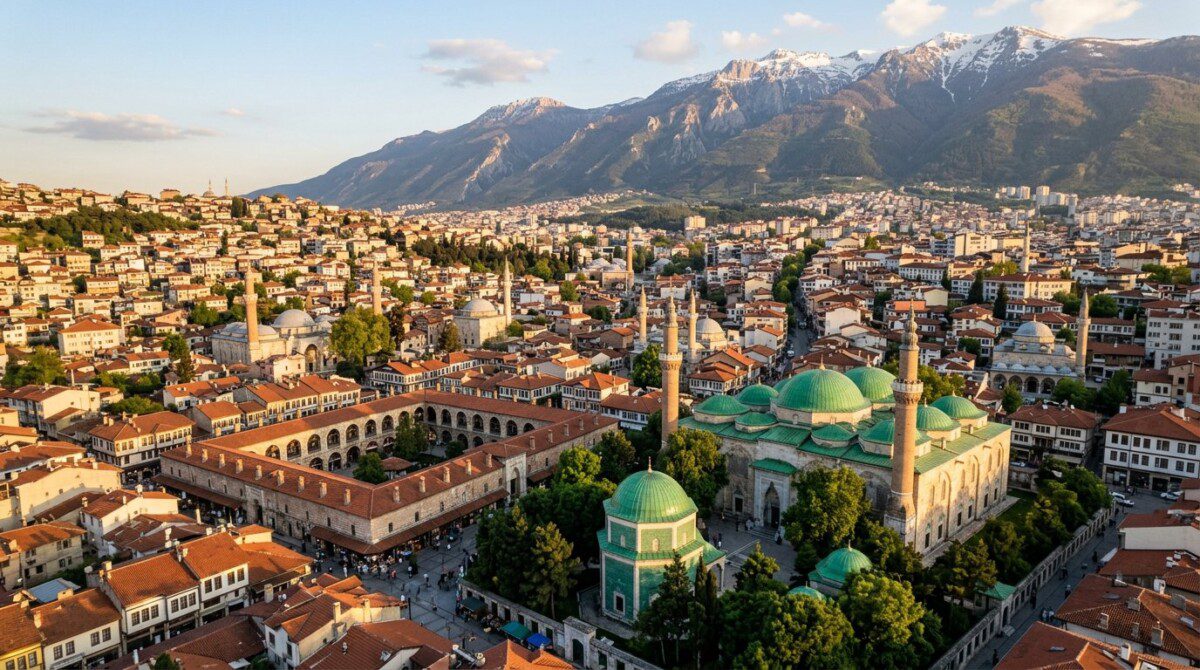
Bursa is the city where the Ottoman Empire was born. From its capture by Sultan Orhan in 1326 until the relocation of the Ottoman capital to Edirne in the mid-14th century and finally to Istanbul in 1453, Bursa was the political, religious and cultural center of the rising Ottoman state. The early sultans built their mosques, mausoleums and madrasas here, with the architectural style that would become recognizable across the Ottoman world first developed in the workshops and courtyards of medieval Bursa. The city today retains this early Ottoman heritage almost intact, with the green-tiled tomb of Sultan Mehmet I, the massive Ulu Cami (Grand Mosque) and the spectacular silk bazaar (Koza Han) all still functioning essentially as they did six centuries ago. Add the natural setting at the foot of Mount Uludag (the highest mountain in northwest Turkey) and the city becomes one of the most rewarding cultural destinations in Turkey that few international visitors reach.
In this guide I will share the early Ottoman heritage of Bursa, the famous silk and textile bazaars that have operated continuously since the 14th century, the natural beauty of Uludag with its winter ski resort and summer alpine meadows, the famous Bursa cuisine (especially the Iskender kebab that was invented here), and the practical logistics of reaching Bursa from Istanbul. I will tell you why a 2 or 3 day Bursa visit makes one of the best cultural breaks from Istanbul and how to plan it.
Key Takeaways
- Bursa was the first Ottoman capital from 1326 to approximately 1365, with extensive early Ottoman heritage including the Yesil Cami (Green Mosque), Yesil Turbe (Green Tomb) of Sultan Mehmet I, and the Ulu Cami (Grand Mosque) with its 20 domes.
- The silk trade made Bursa famous from the Byzantine period through the Ottoman era, with the Koza Han (Silk Cocoon Caravanserai) still operating as a working silk and textile market.
- Mount Uludag (2,543 meters), 36 kilometers from central Bursa, is Turkey’s most popular winter ski resort and a beautiful summer alpine destination with cable car access from the city.
- The Iskender kebab (sliced lamb on bread with tomato sauce, yogurt and melted butter) was invented in Bursa in the 1860s by Iskender Efendi and remains a Bursa specialty.
- Reach Bursa from Istanbul by ferry (2.5 hours including the bus connection from Yalova) or by high-speed bus across the Osmangazi Bridge (3 hours).
- Allow 2 days minimum for the historical sights, with a third day for Uludag and the broader region.
The Early Ottoman Heritage of Bursa
The Ottoman Empire’s birthplace at Bursa contains the earliest examples of the architectural and artistic traditions that would shape one of the great world cultures for the next 600 years. Walking through the religious complexes built by Sultans Orhan, Murad I, Bayezid I and Mehmet I gives you a unique window into the formation of Ottoman civilization at its most creative and energetic moment.
The Yesil Cami and Yesil Turbe
The Yesil Cami (Green Mosque) and Yesil Turbe (Green Tomb), built between 1419 and 1424 by Sultan Mehmet I, are the most spectacular surviving early Ottoman buildings. The complex sits on a hilltop on the eastern side of central Bursa, with sweeping views over the city below.
The Yesil Cami is the mosque proper, with a central domed space, two side iwans (arched chambers) and an entrance portico. The interior is decorated with thousands of green and blue Iznik tiles, with the mihrab (prayer niche) being the most elaborate single decorative element in the building. The tiles, the marble paneling, the inscribed calligraphy of Quranic verses and the painted plaster surfaces combine into one of the richest Ottoman decorative schemes ever created.
The Yesil Turbe across the courtyard is the tomb of Sultan Mehmet I himself, who restored the Ottoman state after the disastrous defeat by Tamerlane at Ankara in 1402. The exterior of the tomb is covered with the distinctive green tiles that give the building its name, with the octagonal structure topped by a tile-covered conical roof. The interior contains the marble sarcophagus of Mehmet I along with several family members.
Both buildings underwent extensive restoration in the 19th century after damage from earthquakes, with the original tile work largely preserved and the missing sections replaced with high-quality copies. The atmosphere of the combined complex is contemplative and beautiful, with the green tiles, the mountain views and the religious significance combining into one of the most moving Ottoman experiences in Turkey.
The Ulu Cami
The Ulu Cami (Grand Mosque) in central Bursa, built between 1396 and 1399 by Sultan Bayezid I, is the largest mosque of the early Ottoman period. The building covers an extensive rectangular plan with 20 domes supported on 12 massive piers, creating a forest-like internal space of remarkable openness and grandeur.
The building was funded by Sultan Bayezid’s vow before the Battle of Nicopolis (1396) that he would build 20 mosques if he won the battle. The compromise solution of one mosque with 20 domes allowed him to fulfill the spirit of the vow while also building one truly monumental structure. The interior decoration includes large calligraphic inscriptions of Quranic verses painted on the walls, often by Ottoman master calligraphers whose work is considered among the finest examples of Islamic calligraphic art.
The central fountain (sadirvan) for ritual ablutions sits under the central dome, which has a large oculus (circular opening) above to admit natural light and rain. The fountain is unusual for being inside the mosque rather than in the outer courtyard, a design choice that creates an internal water source as the visual and acoustic center of the building. The combination of the multiple domes, the calligraphic decoration and the internal fountain makes the Ulu Cami one of the most distinctive mosques in the Ottoman world.
The Other Early Ottoman Complexes
Bursa contains several other major early Ottoman religious complexes, each combining a mosque, a tomb for the founding sultan, a madrasa (religious school), a soup kitchen for the poor, and other public welfare buildings. The complex of Sultan Murad I (1366), the complex of Sultan Yildirim Bayezid (1395) and the complex of Sultan Mehmet I (the Yesil Cami already discussed) are the major examples.
The Sultan Murad I complex includes one of the most unusual mosques of the early Ottoman period, with a T-shaped plan that combined the traditional mosque with the architecture of dervish lodges (zaviye). The complex also includes a school, a soup kitchen and a public bath, all funded by an endowment (vakif) from the sultan that continued to support the institution for centuries after his death.
These early Ottoman complexes represent the Islamic Ottoman model of urban development, where royal patronage created entire mini-neighborhoods of religious, educational and social welfare institutions. The model spread throughout the Ottoman world and shaped the urban character of cities from Sarajevo to Baghdad. Bursa preserves the original prototype.
The Silk Bazaars and the Ottoman Commercial Heritage
Bursa was the silk capital of the eastern Mediterranean from the Byzantine period through the Ottoman era. The favorable climate for silk production (silkworms thrive on the mulberry trees that grow abundantly in the Bursa region) and the city’s strategic position on the trade routes from Asia to Europe combined to create a major silk and textile industry that operated continuously for over 1,500 years.
The Koza Han
The Koza Han (Silk Cocoon Caravanserai), built in 1490 by Sultan Bayezid II to fund his mosque complex in Istanbul, is the most important surviving Ottoman silk market. The building is a two-story stone caravanserai with a central courtyard, 95 rooms arranged around the upper and lower galleries, and a small mosque in the center of the courtyard.
The Koza Han still operates as a working silk and textile bazaar, with shops selling raw silk, silk yarn, silk fabrics, silk scarves, silk clothing and various textile products. Visiting the shops, watching the silk merchants negotiate with each other in the centuries-old patterns of the trade, and seeing the silk cocoons (kozalar) for sale exactly as they would have been in the 16th century, gives you a continuous link with the medieval Ottoman commerce.
The courtyard of the Koza Han is also a popular meeting place for locals, with the central mosque, several tea houses and the constant flow of merchants and customers creating an atmospheric setting. Stop for a Turkish tea at one of the tea houses and watch the daily life that has continued essentially unchanged for 530 years.
The Other Hans and the Bazaar Area
Bursa has several other surviving Ottoman caravanserais (hans) in the central bazaar area. The Emir Han, built around 1339 by Sultan Orhan, is the oldest Ottoman commercial building in Turkey and the prototype for the later Ottoman han design. The Geyve Han, the Pirinc Han (Rice Caravanserai), the Fidan Han (Sapling Caravanserai) and several other hans complete the commercial complex.
Each han traditionally specialized in different types of merchandise. The Koza Han for silk, the Pirinc Han for rice, the Fidan Han for nursery plants and saplings, and others for various commodities. The system reflects the Ottoman trade guild organization, with merchants in each trade required to operate from a specific location to facilitate quality control and tax collection.
Walking through the central bazaar area from one han to another takes you through the connecting covered passages and squares that organized commercial life in the Ottoman city. Many of the small streets still have their original names referring to the trades that were practiced there (Yorgancilar Sokak, Quilt-makers Street; Demirciler Sokak, Blacksmiths Street; and so on).
The Cumalikizik Village
About 12 kilometers east of central Bursa, the village of Cumalikizik preserves the most intact example of an Ottoman village in Turkey. The narrow cobblestone streets, the wooden Ottoman houses with their distinctive overhanging upper floors and bay windows, and the central square with its mosque and traditional shops all remain essentially as they were 500 years ago.
Cumalikizik is one of the seven villages founded by Ottoman warriors who were granted land in the area by Sultan Orhan in the early 14th century. The village name comes from the founders’ tribal name (Kizik) and the fact that the central village mosque hosted the Friday congregational prayer (Cuma in Turkish). The village has been continuously inhabited by descendants of the original founders for nearly 700 years.
Today the village has been carefully preserved as a UNESCO World Heritage Site (as part of the Bursa and Cumalikizik joint inscription), with strict regulations on building modifications and tourism development. Several small restaurants serve traditional Ottoman village food, and a small museum displays artifacts of village life. Allow 2 to 3 hours for a visit including lunch.
Mount Uludag and the Natural Beauty
Mount Uludag (Big Mountain), at 2,543 meters elevation, is the highest mountain in northwestern Turkey and one of the most popular natural destinations in the country. The mountain is 36 kilometers south of central Bursa, easily accessible by cable car or by mountain road.
The Mountain
Uludag has a complex character that varies dramatically by season. In winter (December through March), the upper slopes receive heavy snow and the mountain becomes Turkey’s most popular ski resort, with multiple lifts, ski schools, hotels and restaurants at the 1,800 to 2,200 meter elevation level. The skiing is good rather than spectacular, with the main draw being convenience for weekend visitors from Istanbul (a 4-hour drive from Istanbul to the slopes).
In summer (June through September), the mountain becomes a beautiful alpine destination with cool temperatures, wildflower meadows, walking trails and small lakes. The contrast with the lowland Bursa heat (often 35 degrees Celsius in summer) makes Uludag a popular day-trip escape for Bursa residents and visitors. Many summer hikers visit the high meadows (yaylas) and the small alpine lakes at higher elevations.
The mountain has religious and mythological significance in addition to its natural beauty. The Byzantines called it Mount Olympus of Bithynia, considering it the northwestern equivalent of the famous Mount Olympus of mainland Greece. Monasteries on the mountain operated continuously from the 4th century through the late Byzantine period, with the most famous being the Monastery of Stylites where monks lived on top of stone pillars as a form of extreme religious practice.
The Cable Car
The modern Bursa Cable Car (Teleferik) is the most convenient way to reach the upper Uludag slopes from the city. The cable car runs from the Teferruc lower station in central Bursa to the Sarialan upper station at 1,635 meters elevation, taking about 15 minutes for the full journey. The route gives spectacular views over Bursa, the Marmara Sea and the surrounding plain.
From Sarialan, you can hike or take a 4WD vehicle to higher elevations including the ski resort area. The cable car runs year-round, with extended hours during the winter ski season and shorter hours in the off-season. Tickets cost around 100 Turkish lira each way, or 180 lira for a return ticket.
For winter visitors, the cable car takes you directly to the ski resort base. For summer visitors, the Sarialan area has several restaurants, picnic facilities and walking trails. Many local Bursa families bring picnic lunches and spend the day in the cool mountain air, returning to the city in the evening.
Hiking and Outdoor Activities
Uludag has an extensive network of hiking trails ranging from easy alpine meadow walks to challenging multi-day routes to the summit. The most popular short hike is from Sarialan to the small Heybeli Lake (about 1 hour each way), with the route passing through pine forests and alpine meadows.
For more ambitious hikers, the summit route from Sarialan to the 2,543-meter peak takes about 5 to 6 hours each way and requires good fitness, sturdy hiking shoes and an early start. The view from the summit covers the entire western Anatolia region, with the Marmara Sea to the north, the Aegean coast in the far distance to the west, and the inland mountains stretching south. Snow can be present on the summit even in summer.
For winter activities, the Uludag ski resort area has multiple lifts, ski schools, equipment rental shops and dozens of mountain hotels. The skiing infrastructure is dated compared to European Alpine resorts but the snow conditions are reliable from late December through early March, and the prices are significantly lower than equivalent European destinations.
Bursa Cuisine and the Iskender Kebab
Bursa is one of the gastronomic centers of Turkey, with a distinctive regional cuisine that blends Ottoman court traditions with rural Anatolian peasant cooking. The most famous Bursa specialty is the Iskender kebab, which has spread throughout Turkey and the wider Turkish diaspora.
The Iskender Kebab and Its Inventor
The Iskender kebab was invented in Bursa in the 1860s by a butcher and restaurant owner named Iskender Efendi. His innovation was to combine traditional doner kebab (vertical-spit-roasted seasoned lamb) with three additional elements that transformed it into something entirely new: thin slices of lamb laid over pieces of toasted pide bread, with hot tomato sauce poured over the meat, a generous serving of yogurt on the side, and finally melted butter (burnt slightly to enhance the flavor) poured over the entire dish at the table.
The original Iskender restaurant, opened by Iskender Efendi in 1867, is still operating in central Bursa under the management of his descendants. The Iskenderoglu family preserves the original recipe and serves the dish in the traditional manner, with the table-side butter pouring being a small theatrical event that visitors enjoy watching. The restaurant has expanded to multiple locations in Bursa and now branches in Istanbul as well, but the original Bursa restaurant retains the most authentic atmosphere.
Several other long-established Bursa restaurants also serve excellent Iskender kebab, each with subtle variations on the original recipe. The Cicek Izgara, the Hacibey and the Kebapci Iskender (a separate establishment from the original family) all have loyal followings. A reasonable Iskender kebab costs around 200 to 300 Turkish lira at a quality restaurant.
Other Bursa Specialties
Beyond Iskender, Bursa has several other distinctive specialties. The kestane sekeri (candied chestnuts) are a famous Bursa product, with chestnuts from the Mount Uludag forests preserved in syrup using a centuries-old method. The candied chestnuts are sold in packages throughout the city and make excellent souvenirs.
The Bursa peach (Bursa seftalisi) is considered the best variety of peach grown in Turkey, with a perfect balance of sweetness and acidity. The peaches are in season from late June through August and are sold fresh at the central produce markets. Many visitors fill their bags with fresh peaches as a Bursa souvenir.
The pideli kofte (meatballs on pide bread) is a similar concept to Iskender but with meatballs instead of doner-cut lamb. The Cantik kofte, made with cumin and parsley, is the local meatball variety. The Inegol kofte from the nearby town of Inegol is another famous regional meatball, with restaurants in both Inegol and Bursa specializing in this variety.
The Traditional Bursa Breakfast
The Bursa traditional breakfast is a particular pleasure of the city. The classic breakfast includes white cheese (beyaz peynir), olives, fresh tomatoes and cucumbers, eggs, fresh bread, honey from the Uludag pine forests, kaymak (clotted cream) with bread or pancakes, and unlimited Turkish tea. The total spread can cover an entire table.
The neighborhood of Hisar in central Bursa has several excellent traditional breakfast restaurants, including the Sehir Konagi and the Cumbali Konak. Allow 2 hours for a proper breakfast experience, which can substitute for both breakfast and lunch.
For more about Turkish food and travel, see my guides to Istanbul, Cappadocia and Konya.
How to Get to Bursa and Practical Planning
Bursa is in the Marmara region of northwestern Turkey, easily accessible from Istanbul (the most common approach for international visitors) and reasonably accessible from the Aegean coast.
From Istanbul
The traditional and most scenic route from Istanbul to Bursa is by ferry across the Sea of Marmara, with the journey taking about 90 minutes from the Yenikapi pier in Istanbul to the Yalova pier on the southern shore. From Yalova, regular bus connections take you the remaining 60 kilometers to Bursa in about 90 minutes. The total journey takes 3 to 3.5 hours and gives you the experience of crossing the Sea of Marmara by ferry, which is part of the cultural heritage of Istanbul-Bursa travel.
Faster options include the high-speed catamaran from Istanbul to Bursa via the Mudanya pier, taking about 75 minutes for the sea crossing and then 30 minutes by bus to central Bursa. Total journey time is about 2.5 hours. Alternatively, the BUDO ferry service goes directly from Istanbul to the Mudanya pier with similar timing.
By road, the Osmangazi Bridge (opened in 2016) shortened the driving time from Istanbul to Bursa to about 2.5 hours via the high-speed coastal route. The bridge and toll road system is expensive but very fast. Daily bus services from Istanbul to Bursa take about 3 hours via the bridge route.
From Other Cities
From Izmir, Bursa is 320 kilometers (about 4.5 hours by car) to the north. Daily buses connect the two cities with travel times of about 5 hours. There is no high-speed train connection.
From Ankara, Bursa is 380 kilometers (about 5 hours by car) to the west. Daily buses and a daily train connect the two cities. The journey is long but straightforward.
From Cappadocia (Goreme, Urgup), Bursa is approximately 7 to 8 hours by car. Most visitors break the journey with an overnight in Ankara. International visitors with a Turkish trip including both regions usually fly between Cappadocia and Istanbul, then travel from Istanbul to Bursa via ferry or bus.
Where to Stay
Bursa has accommodation across all budget ranges. For modern comfort, the Hilton Bursa, the Wyndham Grand Bursa and the Almira Hotel are reliable international-standard options in the 2,000 to 4,000 Turkish lira per night range.
For an atmospheric stay in the historic city center, the Kitap Evi (Book House) is a converted Ottoman mansion now operating as a small boutique hotel. The Mavi Konak and the Marigold Thermal Spa Hotel are similar small atmospheric options. Prices typically 1,500 to 3,000 lira per night.
For budget travelers, several pensions in the central bazaar area offer simple rooms for 500 to 800 lira per night. The Hotel Atlas and the Hotel Bel are reliable mid-range budget options.
For a special winter experience, several mountain hotels on Uludag offer combined hotel and ski packages for around 4,000 to 8,000 lira per night per room including meals and ski passes. The Monte Baia Hotel and the Hotel Kervansaray Uludag are popular options.
The Itinerary
For a typical Bursa visit, plan 2 to 3 days. Day 1: Yesil Cami and Yesil Turbe in the morning, lunch at a traditional Iskender restaurant, Ulu Cami in the afternoon, central bazaar exploration and tea at the Koza Han in the late afternoon. Day 2: Cumalikizik village in the morning, lunch in the village, cable car to Uludag in the afternoon for the views or hiking. Day 3 (optional): Full day on Uludag for skiing (winter) or hiking (summer).
Bursa is comfortable to navigate by taxi and the central bazaar area is walkable. The historical sights are spread across the city but well connected by short taxi rides. Public buses also serve all the major destinations.
Frequently Asked Questions
How many days should I spend in Bursa?
Two days is the minimum for the major historical sights and traditional food. Three days lets you also include Uludag (cable car and/or activities) and Cumalikizik village. With a week you can do day trips to the Iznik (ancient Nicaea, famous for the early Christian councils) and other smaller sites in the wider region.
Is Bursa good for families?
Yes, Bursa is a family-friendly destination. The historical sights are interesting for children old enough to appreciate them, the food is varied and approachable for all ages, the Koza Han bazaar atmosphere is fun, and the Uludag cable car ride is consistently popular with children. The mountain offers skiing in winter and easy walking trails in summer, both suitable for families with older children.
What is the best time to visit?
April, May, September and October offer the best balance of pleasant weather and manageable crowds for the city sights. June through August are warm with peak Turkish domestic tourism. December through March is winter, with Uludag operating as a ski resort, attracting winter sports tourists while the city itself remains busy.
Can I do Bursa as a day trip from Istanbul?
Technically yes, but it is rushed. A day trip from Istanbul would include the ferry across the Sea of Marmara, the Yesil Cami, the Ulu Cami, lunch in the bazaar area, and the ferry back. You would miss Uludag, Cumalikizik and most of the deeper historical exploration. Two days is much better, with one overnight in Bursa.
Is the Iskender kebab really that good?
Yes, especially at the original Iskender restaurant or one of the few other authentic establishments in central Bursa. The combination of perfectly seasoned and cooked lamb, the absorbent pide bread, the rich tomato sauce, the cool yogurt and the melted butter is a complete sensory experience. The dish has been copied throughout Turkey but the original Bursa version is significantly better than the copies. Even if you have eaten Iskender elsewhere, trying it in Bursa is worth a meal.
What is the religious dress code at Bursa mosques?
Standard Turkish mosque dress code applies. Women should cover their heads, shoulders and knees. Men should wear long pants and shirts with sleeves. Most mosques provide scarves and wraps at the entrance for visitors who arrive underdressed. Shoes must be removed before entering the prayer halls. The dress requirements are enforced gently but consistently. The UNESCO World Heritage listing for Bursa and Cumalikizik provides additional context on the city’s heritage status.
About the Author
I’m Ilknur Acar, the founder of Bir Dakikada Geziyorum. Bursa is one of the Turkish cities that consistently exceeds first-time visitors’ expectations, partly because the international tourist marketing focuses so heavily on Istanbul that few realize the depth of cultural heritage in the original Ottoman capital just across the Sea of Marmara. I write history-rooted travel guides that respect the layered past of Turkey and the eastern Mediterranean. Follow along for more.