Last Updated: 17 May 2026
Konya is the central Anatolian city where one of the most influential mystical poets in human history lived, taught and was buried. Jalaluddin Rumi, called Mevlana (“Our Master”) in Turkish, lived in Konya from 1228 until his death in 1273 and is the spiritual founder of the Mevlevi Sufi order, famous worldwide for the whirling dervish ceremony. His tomb in central Konya, marked by a turquoise tiled tower visible from across the city, has been the most important pilgrimage site for Mevlevi followers for 750 years and remains one of the most spiritually charged places in Turkey today. Rumi’s poetry, written in Persian but venerated by Muslims, Christians, Jews, Hindus, Buddhists and the secular, makes him one of the bestselling poets in modern America despite being born in 13th century Afghanistan.
In this guide I will share the extraordinary life of Rumi, the Mevlana Museum (the converted dervish lodge where his tomb stands), the broader Seljuk Turkish heritage of Konya (this was the capital of the Anatolian Seljuk Sultanate from 1080 to 1308), the practical experience of attending a whirling dervish ceremony, and the logistics of visiting Konya from Cappadocia or Antalya. I will tell you why a Konya visit can be one of the most personally meaningful cultural experiences possible in Turkey, whether you are a religious pilgrim or a secular visitor curious about Islamic mysticism.
Key Takeaways
- Konya was the capital of the Anatolian Seljuk Sultanate from 1080 to 1308, with substantial Seljuk architectural heritage including the Alaeddin Mosque on the central hilltop and the Karatay and Ince Minareli madrasas.
- Jalaluddin Rumi (Mevlana, 1207-1273) lived in Konya from 1228 until his death and founded the Mevlevi Sufi order, known for the whirling dervish ceremony as a form of meditation and prayer.
- The Mevlana Museum, the converted Mevlevi dervish lodge containing Rumi’s tomb, draws over 3 million pilgrims and visitors annually, making it one of the most visited religious sites in Turkey.
- Authentic whirling dervish ceremonies (Sema) are held every Saturday evening at the Mevlana Cultural Center in Konya and during the annual Seb-i Arus festival in mid-December commemorating Rumi’s death.
- The annual Seb-i Arus (Wedding Night) festival from December 7-17 draws hundreds of thousands of pilgrims and visitors for ten days of religious ceremonies, dervish performances and cultural events.
- Konya is well connected by high-speed train from Istanbul (4.5 hours) and Ankara (90 minutes), with daily flights from Istanbul and good road access from Cappadocia (3 hours) and Antalya (5 hours).
Rumi, His Life and His Spiritual Teaching
Jalaluddin Rumi was born in Balkh (in modern Afghanistan) in 1207, into a family of scholars and mystics descended from the early Islamic caliphs. His father Bahaeddin Veled was an influential religious scholar who eventually relocated the family to escape the approaching Mongol invasions, settling in Konya around 1228 at the invitation of the Seljuk sultan Aladdin Keykubad I.
The Transformative Encounter with Shams
Rumi spent his first decades as a conventional Islamic scholar, training in Quranic interpretation, Islamic law, theology and Arabic literature. By his late 30s he was a respected teacher with hundreds of students, a chair at the major madrasa of Konya, and a comfortable position as a leading member of the city’s religious establishment.
In 1244, when Rumi was 37 years old, he encountered a wandering Persian mystic named Shams of Tabriz, who was about 60 years old at the time. The meeting transformed Rumi’s life. The two formed an intense spiritual friendship, with Rumi abandoning his teaching responsibilities to spend day and night in conversation with Shams about love, God and the nature of human experience. Rumi’s students were furious at being deprived of their teacher, and the city’s religious establishment was scandalized by what they saw as an inappropriate obsession.
The pressure became so intense that Shams disappeared from Konya, possibly murdered by Rumi’s followers. Rumi went into deep grief, and from this grief emerged the poetry that has made his name immortal. The Divan-i Shams (Collection of Shams), one of his major poetic works, was written in Shams’s name and addressed to him as if he were still present. The intense emotional and spiritual content of the poetry transforms personal loss into a meditation on the nature of love, presence, absence and divine reality.
The Masnavi and the Mature Teaching
Rumi’s masterpiece is the Masnavi, a six-volume narrative poem of approximately 25,000 verses that he composed during the last 12 years of his life. The Masnavi presents Rumi’s mature spiritual teaching through stories, parables, philosophical discussions and direct mystical addresses to the reader. Topics range from short anecdotes to extended theological investigations, all centered on the relationship between the individual soul and the divine reality.
The Masnavi has been called “the Quran in Persian” by Muslim scholars, an extraordinary claim that captures the work’s status in the Islamic mystical tradition. The poem is studied continuously in Mevlevi and other Sufi communities, with traditional masters spending their entire careers commenting on and teaching individual sections. The complete reading and commentary of the Masnavi typically takes many years.
Rumi’s teaching emphasizes love as the fundamental spiritual reality, the unity of all religious traditions at their deepest level, the transformation of the human personality through self-knowledge and divine remembrance, and the integration of intellectual understanding with emotional and physical experience. The famous quote “Come, come, whoever you are, even if you are an unbeliever, come” expresses the radically inclusive character of his spiritual community.
Rumi’s Death and Legacy
Rumi died on December 17, 1273. His funeral procession was attended by hundreds of thousands of mourners from all the religious communities of Konya: Muslims, Christians (both Greek Orthodox and Armenian), Jews, even the Hindu and Buddhist merchants of the city. The funeral procession reportedly took an entire day to complete the short distance from his home to his burial place, with the crowds so dense that movement was almost impossible.
Rumi called the day of his death his “Wedding Night” (Seb-i Arus in Persian), the night when his soul would be united with the divine beloved. This terminology reflects his fundamental teaching that death is not an ending but a fulfillment, a moment of ultimate union rather than separation. The annual commemoration of his death in mid-December is therefore a celebration rather than a mourning, with festive religious ceremonies, dervish performances and communal meals.
His son Sultan Veled and his disciples organized the Mevlevi order in the decades after his death, formalizing the teachings and practices that Rumi had developed informally. The order spread throughout the Ottoman Empire and beyond, with major lodges established in Damascus, Cairo, Sarajevo, Athens and many other cities. By the 19th century, the Mevlevi order had several hundred active lodges and was one of the most influential Sufi traditions in the Islamic world.
The Mevlana Museum
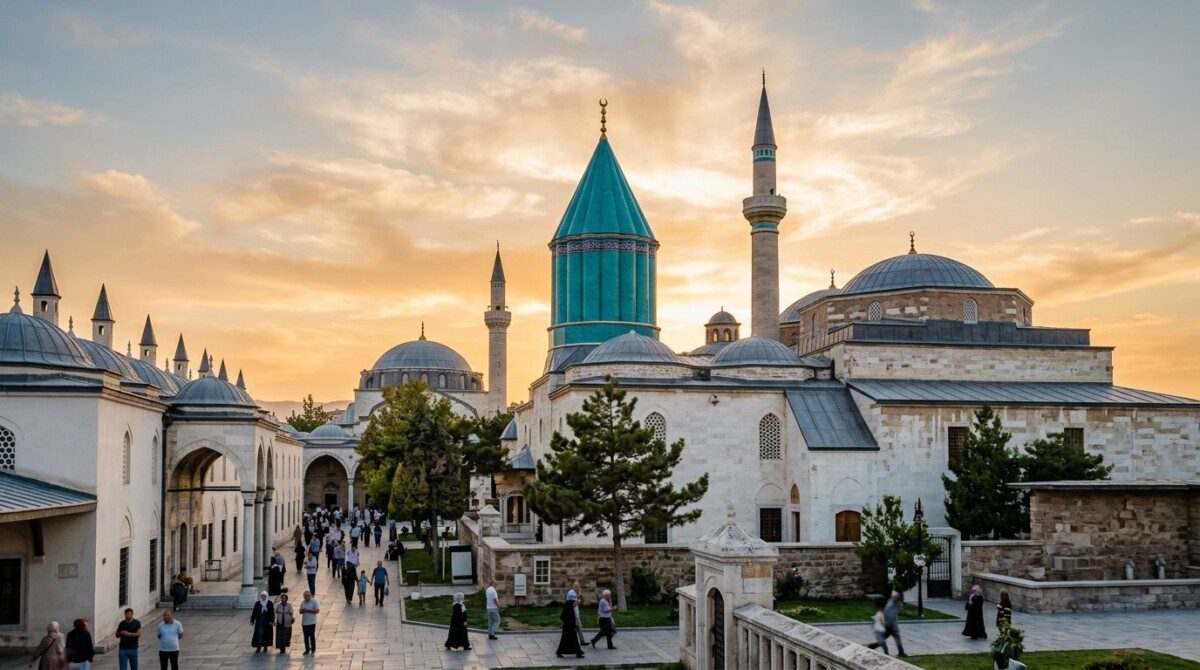
The Mevlana Museum, in central Konya, occupies the original Mevlevi dervish lodge where Rumi lived during his later years and where he was buried. The building has been the focal point of the Mevlevi spiritual community for 750 years and remains one of the most important religious sites in Turkey today, drawing both Muslim pilgrims and international visitors of all backgrounds.
The Building and Its History
The complex began with Rumi’s tomb, which was placed in a small mausoleum constructed by his son shortly after his death. Over the following centuries, additional buildings were added including the main mosque (semahane) where dervish ceremonies were performed, the dervish cells where the disciples lived, the kitchen and refectory, and various smaller buildings for administrative and ceremonial functions.
The most distinctive architectural feature is the turquoise tiled tower (yesil turbe) that rises over Rumi’s tomb. The tower’s distinctive color comes from the Iznik tiles that cover its exterior, with the conical form typical of Anatolian Seljuk funerary architecture. The tower has been visible from across Konya as the city’s most iconic landmark for 700 years.
The complex operated as an active Mevlevi dervish lodge from the late 13th century until 1925, when the Turkish Republic dissolved all Sufi orders as part of the secularization reforms of the early republic. The buildings were converted into a museum in 1926 and have operated in that form since.
What You See Inside
The visit begins at the main entrance, where you remove your shoes and don shoe covers (provided at the entrance). The first major room is the semahane (whirling ceremony hall), with the original wooden floor where dervish ceremonies were performed for centuries. The walls and ceiling are decorated with calligraphic inscriptions of Quranic verses and Rumi’s poetry. Display cases show original ceremonial costumes, musical instruments and ritual objects.
The next room is the cluster of tombs that includes Rumi himself, his father Bahaeddin Veled, his son Sultan Veled, several other family members, and various senior disciples and successors of the Mevlevi order. The tombs are arranged in long rows, each marked by a stone sarcophagus, with Rumi’s tomb at the center under the green tiled tower.
Rumi’s tomb is covered with elaborate cloth embroideries depicting Mevlevi symbols and Quranic calligraphy. Pilgrims of many backgrounds approach the tomb to pray, recite verses or sit silently in reflection. The atmosphere is intensely religious but also welcoming to all visitors. There is no requirement that you be Muslim or that you participate in any specific religious activity, but a respectful demeanor is expected.
The Manuscript Collection and Other Treasures
Beyond the tombs, the museum displays original manuscripts of Rumi’s works, including 14th-century copies of the Masnavi and the Divan-i Shams that were used at the lodge for teaching and ceremonial reading. The calligraphy of these manuscripts is among the finest examples of medieval Islamic book art surviving in Turkey.
The collection also includes ceremonial musical instruments (ney flutes, kudum drums and various string instruments used in the dervish ceremony), elaborate dervish clothing from various historical periods, prayer beads, calligraphic panels and various ritual objects used in Mevlevi worship over the centuries.
A small library section displays printed editions of Rumi’s works in dozens of languages, reflecting his global reach. Modern translations into English, French, German, Russian, Chinese, Japanese and many other languages are shown alongside traditional Persian, Arabic, Turkish and Urdu editions. The breadth of translation gives a visual sense of how broadly Rumi’s poetry has spread beyond its original Islamic context.
Visiting the Museum
The Mevlana Museum is open Tuesday through Sunday from 09:00 to 17:00 (closed on Mondays). Entry is free, an unusual feature for a major Turkish museum that reflects the religious character of the site. Photography is allowed but flash is prohibited.
Dress modestly. Women should cover their hair (scarves are available at the entrance if you do not have one) and wear clothing that covers shoulders and knees. Men should wear long pants and shirts with sleeves. These requirements are religious rather than legal, but they are firmly enforced and inappropriate clothing will be refused at the door.
The visit takes 60 to 90 minutes for a thorough walk through. Many visitors return multiple times during a Konya stay to attend different ceremonies or to spend time in quiet reflection at the tombs. The museum is most atmospheric in the early morning when local pilgrims are praying and the crowds are thinner.
The Whirling Dervish Ceremony
The whirling dervish ceremony (called Sema or Sama in Mevlevi tradition) is the distinctive ritual practice of the Mevlevi order and one of the most internationally recognizable Islamic religious practices. The ceremony combines music, poetry, movement and breathing into an integrated spiritual technology designed to facilitate mystical experience and divine remembrance.
The Form of the Ceremony
The Sema ceremony begins with a recitation of Quranic verses and Rumi’s poetry, followed by a slow musical introduction performed by an ensemble including ney flute, kudum drum, kanun stringed instrument and a chorus. The musical introduction creates a meditative atmosphere and prepares both the dervishes and the audience for what follows.
The dervishes enter wearing the distinctive Mevlevi clothing: a white tunic representing the burial shroud, a long brown cloak representing the body that will be cast off in spiritual ascension, and a tall conical hat representing the tombstone of the dervish’s worldly self. The dervishes line up before the master (sheikh) and receive his blessing.
The actual whirling begins with each dervish removing his brown cloak (symbolic of casting off worldly attachments) to reveal the white tunic underneath. The dervishes then begin to rotate slowly, with the right palm turned upward (receiving divine grace) and the left palm turned downward (transmitting that grace to the earth). The rotation accelerates gradually until each dervish is whirling at a constant rapid pace.
The Spiritual Meaning
The whirling is not entertainment but a form of meditation and prayer. The technique is designed to silence the discursive mind, focus awareness on the present moment, and create a physiological state conducive to mystical experience. The mathematical rotation mimics the motion of the planets around the sun, suggesting the harmony between human consciousness and the cosmic order.
The position of the hands has specific symbolic meaning. The right palm upward receives divine grace from above. The left palm downward transmits that grace to the world. The dervish becomes a conduit between heavenly and earthly realms, with the body itself becoming the instrument of spiritual mediation. The visual effect of multiple dervishes whirling in synchronized rotation is genuinely beautiful and moving even for observers without religious background.
The ceremony has four main phases (called salams), each representing a different stage of the spiritual journey: recognition of God as the supreme reality, recognition of God’s unity within the multiplicity of creation, the rapture of mystical love, and the return to the world to serve as a witness of divine reality. The full ceremony lasts about 90 minutes.
Attending a Ceremony
Authentic Sema ceremonies are held every Saturday evening at the Mevlana Cultural Center (Mevlana Kultur Merkezi), about 1 kilometer from the Mevlana Museum in central Konya. Performances start at 19:00 (winter) or 20:00 (summer) and last about 90 minutes. Entry is free but you must reserve seats in advance (typically online through the center’s website).
The Saturday ceremonies are conducted by qualified Mevlevi practitioners trained in the traditional manner. These are religious ceremonies rather than tourist performances, with the audience expected to maintain appropriate respect (no photography during the ceremony, no eating or drinking, no talking, remain seated throughout). The atmosphere is reverent and powerful.
The annual Seb-i Arus festival (December 7-17, commemorating Rumi’s death on December 17, 1273) features daily ceremonies, additional cultural events, exhibitions and academic conferences. The festival draws hundreds of thousands of visitors and tickets for the major events sell out months in advance. If you can plan a Konya visit around the festival, the experience is extraordinary.
The Other Konya Monuments
While the Mevlana Museum is the central attraction, Konya offers substantial other historical and cultural sites reflecting its long history as a Seljuk capital and Ottoman provincial center.
Alaeddin Mosque and the Citadel
The Alaeddin Mosque, on the central hilltop overlooking Konya, was built between 1156 and 1235 under several Anatolian Seljuk sultans. The mosque is the largest of the Anatolian Seljuk period and contains an unusual architectural feature: a flat wooden ceiling supported by ancient columns and capitals reused from Roman and Byzantine buildings (a typical Seljuk practice of incorporating earlier materials into new construction).
Adjacent to the mosque are the foundations of the Seljuk royal palace (Kosk) and the burial chambers of several Anatolian Seljuk sultans. The hilltop, called Alaaddin Tepesi (Alaaddin Hill), is now a public park with extensive views over the city and the surrounding plain. It remains the symbolic center of Konya’s urban identity.
The mosque is still active for daily prayer and welcomes visitors outside prayer times. Dress modestly. The interior is dim and atmospheric, with the ancient columns creating a sense of depth and historical layering. Allow 30 to 45 minutes for a thorough visit.
Karatay Madrasa and the Tile Museum
The Karatay Madrasa, built in 1251 by the Seljuk vizier Celaleddin Karatay, is one of the most beautiful Anatolian Seljuk educational buildings. The interior is covered with extraordinary tile work in blue, turquoise and white patterns, with calligraphic inscriptions of Quranic verses around the dome.
The building now houses the Tile Museum (Karatay Cini Eserleri Muzesi), with displays of the most important Anatolian Seljuk ceramic art. The collection includes wall tiles, dish ware, jugs and decorative objects from the major Seljuk production centers, particularly Kashan (in modern Iran) and Konya itself.
The combination of the building’s own outstanding tile work with the museum collections makes this one of the most rewarding small museum visits in Turkey. Allow 60 to 90 minutes for a careful look at both the architectural decoration and the displayed collection.
Ince Minareli Madrasa
The Ince Minareli Madrasa (Slender Minaret Madrasa), built in 1265, is another outstanding Seljuk educational building. The name comes from the unusually slender minaret that originally rose above the building (the minaret was struck by lightning in 1901 and only the stump remains today). The main facade has one of the most elaborate stone carving programs of any Seljuk building, with intertwining calligraphic patterns and floral designs creating a richly textured surface.
The building now houses the Museum of Wood and Stone Carving (Tas ve Ahsap Eserleri Muzesi), with displays of medieval Anatolian wood and stone craft. The collection includes carved wooden mosque doors, stone reliefs from various Seljuk buildings, ceremonial objects and architectural fragments.
The combination of the building’s exterior, the partial preservation of the original minaret base, and the carved object collection inside makes this another rewarding small museum visit. The building is about 200 meters from the Karatay Madrasa, so the two can be easily combined in a single half-day of Seljuk heritage exploration. For other Turkish destinations, see my guides to Cappadocia and Istanbul.
How to Get to Konya and Practical Planning
Konya is in central Anatolia, well connected by all major transport modes to Turkey’s main cities and well integrated into the standard tourist routes through Cappadocia and the southern coast.
From Istanbul
The high-speed train (YHT) from Istanbul to Konya takes 4.5 hours and runs daily. Tickets cost around 300 to 600 Turkish lira depending on class. The train is comfortable, scenic and significantly faster than driving (the 700-kilometer drive takes 8 to 9 hours). The Konya railway station is in the center of the city, walking distance to the main hotels.
Direct flights from Istanbul to Konya Airport take about 70 minutes, with multiple daily services. Flight prices vary from 500 to 2,000 lira depending on booking timing. The airport is about 13 kilometers from central Konya, with shuttle buses, taxis and rental cars available.
From Ankara
Konya is just 90 minutes from Ankara by high-speed train, making it an easy day trip or overnight stop. Train tickets cost around 200 lira, with frequent daily services. From Ankara central station you can be at the Mevlana Museum within 2 hours total, including walking time.
By car, the drive from Ankara to Konya takes about 3 hours on the modern highway. The route passes through agricultural plains and small towns, with relatively little traffic outside the immediate Ankara metropolitan area.
From Cappadocia
From the Cappadocia region (Goreme, Urgup, Nevsehir), the drive to Konya takes about 3 hours on the modern highway via Aksaray. Many Cappadocia-based tour operators offer organized day trips to Konya, with prices around 800 to 1,500 lira per person including transport, guide and meals.
For independent travelers, renting a car in Cappadocia (around 800 lira per day) and driving to Konya gives you full control over the timing. A 1 to 2 night stay in Konya makes the visit comfortable and allows time for the Saturday evening Sema ceremony if your itinerary timing works.
Where to Stay
Konya has the full range of accommodation options from luxury to budget. For modern comfort, the Hilton Garden Inn Konya, the Bera Konya and the Hich Hotel are reliable international-standard options in the 1,500 to 3,500 Turkish lira per night range. The Hich Hotel in particular is recommended for its atmospheric setting in a restored old Konya building near the Mevlana Museum.
For mid-range, the Hotel Mevlana Sema and the Otantik Konya offer good rooms with breakfast in the 600 to 1,200 lira per night range. These hotels are well located in central Konya, walking distance to the Mevlana Museum and the major Seljuk sites.
For budget, several pensions in the city center offer simple rooms with breakfast for 300 to 600 lira per night. Konya has fewer hostels than larger Turkish tourist destinations, but the budget hotels are perfectly adequate for travelers wanting to spend their money on experiences rather than accommodation.
The Visit Itself
Allow at least 2 full days for a thorough Konya visit covering the Mevlana Museum, the major Seljuk sites and a Saturday evening Sema ceremony. The most efficient itinerary is: Day 1 – arrive in the morning, Mevlana Museum (3 hours), Alaeddin Mosque area (90 minutes), traditional dinner; Day 2 – Karatay and Ince Minareli Madrasas (4 hours), other smaller museums, Sema ceremony in the evening (if Saturday).
For a focused 1-day visit, prioritize the Mevlana Museum (3 hours) and the Alaeddin Mosque (90 minutes), with time for lunch in the area between them. This gives you the essential Konya experience but misses the Sema ceremony and the Seljuk madrasa museums.
Konya is a conservative Muslim city, more religiously observant than the coastal tourist areas. Dress conservatively (covered shoulders and knees), avoid public displays of affection, and respect the religious atmosphere especially during prayer times when many shops and restaurants briefly close. The local people are extremely welcoming to respectful visitors.
Frequently Asked Questions
Can non-Muslims visit the Mevlana Museum?
Absolutely. The museum is open to all visitors regardless of religion. Many of the most enthusiastic international visitors are non-Muslim, drawn by Rumi’s poetry and the international reputation of the Mevlevi tradition. The only requirements are modest dress and respectful behavior. The atmosphere is genuinely welcoming to all sincere visitors.
How does the Konya Sema ceremony compare to the tourist versions in Istanbul?
The Konya ceremony is much more authentic and religiously serious than most tourist performances. The dervishes are qualified Mevlevi practitioners performing the genuine religious ceremony, not professional performers doing a stylized show. The Konya ceremony lasts the full 90 minutes (most tourist shows are abbreviated to 30-45 minutes) and follows the complete traditional structure. If you have any interest in the religious meaning of the ceremony, attend the Konya version rather than a tourist show.
Is Konya safe for tourists?
Yes, Konya is very safe by international standards. The city is conservative and family-oriented, with low crime rates and welcoming attitudes to foreign visitors who behave respectfully. Solo female travelers report feeling safer in Konya than in many Western cities, with the conservative religious atmosphere actually providing additional social protection.
When should I visit?
April, May, September and October offer the best weather. Summer (June through August) is hot but the indoor museums provide relief. Winter is cool but the December Seb-i Arus festival is the most extraordinary cultural experience available. Plan around the festival if your timing allows.
What should I read before visiting?
Even a small amount of Rumi’s poetry will dramatically enhance the experience. Coleman Barks’s translations (controversial among scholars for their literary freedom but extraordinarily readable) have introduced Rumi to millions of English-speaking readers. Annemarie Schimmel’s “I Am Wind, You Are Fire” provides excellent scholarly context. The Mevlana Museum’s bookshop sells various editions in multiple languages.
Can I combine Konya with other Turkish destinations?
Yes, Konya combines naturally with Cappadocia (3 hours by car, very common combination), with Antalya and the southern coast (5 hours, less common but rewarding), or with Ankara (90 minutes by train). A 2-week Turkey itinerary can easily include all of these destinations with Konya as one stop. The UNESCO World Heritage listing for the Mevlevi Sema Ceremony (an intangible cultural heritage listing) provides additional context on the ceremony’s global significance.
About the Author
I’m Ilknur Acar, the founder of Bir Dakikada Geziyorum. Konya is one of those cities where you arrive expecting one experience and leave with another. The combination of Rumi’s poetry, the dervish ceremony and the Seljuk architectural heritage creates a depth of cultural experience that few Turkish cities can match. I write history-rooted travel guides that respect the layered past of Turkey and the eastern Mediterranean. Follow along for more.