Last Updated: 17 May 2026
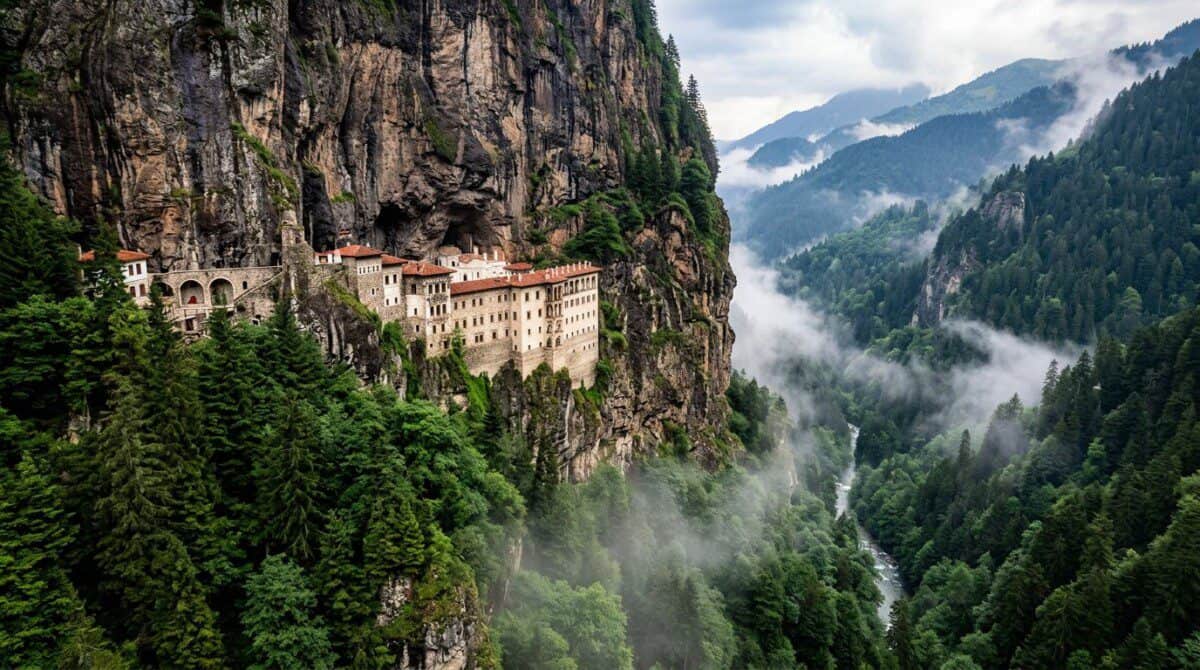
Sumela Monastery is one of those places where the location alone justifies the journey. Built into a near-vertical cliff face 1,200 meters above sea level in the Altindere National Park near Trabzon on Turkey’s Black Sea coast, the monastery clings to the side of a forested gorge with a 300-meter drop directly below the chapel buildings. The Greek Orthodox monks who founded Sumela in the 4th century AD chose the location for its inaccessibility, its dramatic natural beauty and its proximity to a sacred icon of the Virgin Mary that one of the founders had carried from Athens. The monastery operated continuously for nearly 1,600 years, until the Greek population of the Black Sea coast was deported during the Turkish-Greek population exchange of 1923. Today the building stands as a UNESCO-protected cultural monument, partly restored, with original Byzantine frescoes still visible inside the rock chapel.
In this guide I will share the strange and dramatic history of Sumela, the practical experience of visiting the cliff-side monastery (including the steep climb that all visitors face), the wider Pontic mountains and the high-altitude alpine lakes that surround the site, the cuisine of the Black Sea region, and the practical logistics of reaching Trabzon from Istanbul or Ankara. I will tell you why this is one of the most unusual cultural sites in Turkey and how to combine it with the spectacular natural beauty of the Eastern Black Sea region.
Key Takeaways
- Sumela Monastery is a Greek Orthodox monastery built into a cliff face at 1,200 meters elevation in the Altindere National Park, 50 kilometers south of Trabzon on Turkey’s Black Sea coast.
- Founded around 386 AD by two Athenian monks who reportedly carried a sacred icon of the Virgin Mary painted by Saint Luke, the monastery operated continuously until the Greek population deportation of 1923.
- The original Byzantine frescoes inside the rock chapel are partly preserved, with restoration ongoing since the 2010s. The work has stabilized the structure and reopened previously dangerous areas.
- The monastery is accessed by a 30-minute walk from the visitor parking up a stepped path through pine forest. Allow 2 to 3 hours for the visit including the climb up and down.
- The wider Altindere National Park and the surrounding Pontic mountains offer some of the most beautiful alpine country in Turkey, with high meadows (yaylas), glacial lakes and dramatic rock formations.
- Combine Sumela with the city of Trabzon (Hagia Sophia Byzantine church, the bazaar, the old town) and the Uzungol alpine lake for a 3 to 5 day Black Sea region itinerary.
The History of Sumela Monastery
Sumela has one of the most romantic foundation stories of any monastery in the Orthodox world. According to tradition, in 386 AD two Athenian monks named Barnabas and Sophronios received a vision from the Virgin Mary instructing them to find a cave in the Pontic mountains where they should establish a monastic community. They traveled across the Aegean to the Black Sea coast, climbed into the mountains south of Trabzon, and found the cave that matched their vision in a near-vertical cliff face above the Altindere stream.
The Founding Tradition and the Sacred Icon
The two monks carried with them a sacred icon of the Virgin Mary, said to have been painted by the apostle Luke himself during the Virgin’s lifetime. The icon, called the Panagia Sumela (Mother of God of Sumela), became the focal point of the monastery and the source of its sacred reputation. Pilgrims traveled to Sumela from throughout the Byzantine Empire to venerate the icon, with reports of miraculous healings and answered prayers spreading the monastery’s fame.
The icon was kept in the rock chapel at the heart of the monastery, with elaborate gold and silver embellishments added over centuries by donors and miraculously cured pilgrims. The icon survived Persian raids in the 6th and 7th centuries, the Arab attacks of the 8th and 9th centuries, and the Seljuk Turkish incursions of the 11th and 12th centuries, partly because the monastery’s remote and inaccessible location protected it from most invading armies.
During the early 20th century, with the Greek-Turkish wars and the deportation of the Pontic Greek population looming, the monks of Sumela took the icon with them when they evacuated the monastery in 1923. The icon was hidden in various locations in northern Greece before finally being installed at a new Sumela Monastery built in the village of Kastania, in Greek Macedonia, where it remains today.
The Monastery’s Cultural Role
Throughout the Byzantine, Trapezuntine (the Empire of Trebizond that ruled the eastern Black Sea coast from 1204 to 1461) and Ottoman periods, Sumela was a major center of Orthodox monasticism, scholarship and art. The monastery library held important manuscripts, the workshops produced ecclesiastical art for churches throughout the region, and the school trained generations of priests and bishops.
The monastery received substantial patronage from the Trapezuntine emperors, particularly Alexios III Komnenos (1349-1390), who funded major construction and expansion projects. The Ottoman sultans, after the conquest of Trebizond in 1461, continued the imperial protection of Sumela, granting the monastery special tax-exempt status and confirming its religious privileges through formal decrees.
This unusual continuity of imperial patronage across Christian and Muslim rule reflects the monastery’s local significance and the practical Ottoman policy of accommodating established Orthodox institutions. The monks paid an annual tribute to the Ottoman authorities but otherwise operated their community without significant interference until the early 20th century political upheavals.
The 1923 Deportation and Modern Restoration
The Greek Orthodox population of the Eastern Black Sea coast, called the Pontic Greeks, had lived continuously in the region for over 2,500 years (since Greek colonization in the 8th century BC). The 1922-1923 Greek-Turkish War and the subsequent population exchange treaty deported nearly all of these Greeks to mainland Greece, ending the continuous Greek Christian presence in the region.
The Sumela monks evacuated the monastery in late 1923, taking the sacred icon and as many manuscripts and ecclesiastical treasures as they could carry. The building was abandoned and entered a long period of decay, with looting, vandalism and natural weathering damaging the structures over the following decades. By the 1950s the monastery was a ruin.
Restoration work began in the 1990s and accelerated dramatically in the 2010s. Major structural stabilization was completed in 2017, allowing safe public access to most of the monastery for the first time in nearly a century. The original Byzantine frescoes have been partly conserved using modern techniques, with the most damaged areas left in their preserved state rather than being aggressively restored. The result is a sympathetic and historically responsible restoration that respects both the original construction and the centuries of accumulated patina.
The Monastery Building and What You See
The Sumela complex consists of about 72 rooms arranged in a multi-story building constructed against and into the cliff face. The complex includes the rock chapel (the original sacred cave), the main monastery chapels and library, the monks’ cells and dormitories, the refectory and kitchen, the guest house for pilgrims, and the various administrative and storage spaces needed for a self-sufficient religious community.
The Approach
The visit begins at the visitor center and parking area in the Altindere National Park, about 50 kilometers from Trabzon. From the parking area, a stone-stepped path climbs through pine forest for about 30 minutes (about 800 meters horizontal distance and 100 meters elevation gain). The path is well maintained but steep in places, with handrails on the most exposed sections.
The first view of the monastery from below the cliff is spectacular and worth waiting for. The white-painted exterior walls cling to the dark grey limestone cliff, with the gorge dropping away on three sides and the surrounding forested mountains rising in every direction. The visual impact has been described by many visitors as the most striking architectural setting in Turkey.
The final approach to the monastery entrance is via a covered staircase that climbs the cliff face, designed both to protect the entrance from rockfall and to channel approaching visitors in single file for security control in the historical period. The staircase emerges at the main entrance gate, where the modern visitor reception is located.
The Rock Chapel
The original sacred cave, transformed into the main chapel of the monastery, is the heart of the visit. The cave is approximately 12 meters wide and 6 meters deep, with the natural rock ceiling rising to about 5 meters. The cave was sealed off from the outside by a frescoed front wall to create the chapel interior.
The interior walls and ceiling are covered with Byzantine frescoes from multiple periods, with the earliest dating from the 9th century AD and the latest from the 19th century. The subject matter includes the standard Orthodox iconographic program: Christ Pantocrator in the central dome, the Virgin Mary in various poses, scenes from the lives of Christ and the apostles, and processions of saints and martyrs.
The frescoes are in mixed condition. Some areas are well preserved with vivid colors and detailed faces still clearly visible. Other areas have been damaged by water seepage, vandalism (some figures have their eyes scratched out, a traditional anti-icon vandalism), centuries of candle smoke and natural fading. The overall effect is moving rather than discouraging, with the layered history of devotion and survival visible on every wall.
The Other Buildings
The main monastery building, attached to the rock chapel, contains the various rooms needed for monastic life. The library was located on the upper floors, the dormitory cells were arranged in long corridors, the refectory was the largest single room with capacity for about 50 monks, and the kitchen and storage rooms were on the lower levels close to the water sources.
Several smaller chapels are scattered throughout the complex, dedicated to particular saints or commemorating specific events in the monastery’s history. The chapel of Saint Barbara, dedicated to the patron saint of the mountains, is particularly atmospheric. The chapel of the Holy Trinity contains some of the best preserved later frescoes (from the 18th century) showing the elaborate baroque influences that had reached even this remote monastery by that period.
The administrative wing contains rooms that once held the monastery’s official records, financial accounts, and correspondence with the Patriarchate of Constantinople. These records were partly evacuated in 1923 and are now preserved in Greek archives, providing valuable historical material on the monastery’s long history.
The Aqueduct and Water Supply
The Sumela monastery had a sophisticated water supply system that brought spring water from higher in the mountains to the monastery buildings. The water flowed through stone channels carved into the cliff face and into ceramic pipes that distributed it to the various rooms. Some of the original water supply infrastructure is visible from inside the monastery, particularly in the kitchen and washroom areas.
The Aqueduct of Sumela, a substantial stone bridge across the lower part of the gorge, brought additional water from a more distant source for the monastery gardens and the small agricultural plots that the monks cultivated below the buildings. The aqueduct is partly preserved and visible from the path leading up to the monastery, though it is fenced off for safety reasons.
The combination of multiple water sources, food storage rooms and the relatively isolated location made Sumela self-sufficient for extended periods, which was essential during the various political crises of its long history. The monks could withstand sieges and political turmoil while continuing their religious and intellectual activities.
The Wider Altindere National Park and the Pontic Mountains
The Altindere National Park surrounding Sumela contains some of the most beautiful mountain country in Turkey. The park covers about 4,800 hectares of pine forest, alpine meadows and rocky peaks, with the famous monastery as just one feature in a larger natural setting.
The Pontic Mountains
The Pontic Mountains run along Turkey’s Black Sea coast for over 600 kilometers, from the Aegean coast at the northwest to the border with Georgia in the east. The range is among Turkey’s wettest regions, with annual rainfall of 1,500 to 2,500 millimeters supporting dense forests of pine, fir, beech and hazel on the slopes and lush alpine meadows on the higher elevations.
The mountains rise abruptly from the Black Sea coast, with peaks reaching 3,000 to 4,000 meters within just 30 to 50 kilometers of the shore. This abrupt elevation gradient creates a remarkable diversity of microclimates and ecosystems compressed into a small horizontal distance. Subtropical vegetation along the coast gives way within hours of driving to alpine meadows, glacial lakes and tundra-like conditions at the highest elevations.
The region has been called the “Switzerland of Turkey” by tourism promoters, with some justification. The combination of high alpine scenery, traditional mountain villages with wooden architecture, hiking trails, dairy farms and the network of summer pasture villages (called yaylas) creates a distinctly Alpine atmosphere despite the location in northeastern Turkey rather than central Europe.
The Yaylas (High Pastures)
The yayla tradition is one of the distinctive cultural features of the Pontic mountains. Each lowland village has its associated yayla, a high-altitude summer pasture village where the entire village population moves with their cattle for the summer months (typically June through September). The yaylas have permanent wooden buildings, communal pastures and walking trails connecting them to neighboring yayla villages.
The yayla tradition has weakened in recent decades as rural populations have moved to coastal cities and the dairy economy has consolidated. But many yaylas are still actively used in summer, with cattle grazing on the alpine meadows, traditional cheese being produced by old methods, and the communal social activities of yayla life continuing among the older generation and increasing numbers of urban Turks who maintain family connections to their ancestral yayla villages.
Several yaylas have become popular tourist destinations, with simple guesthouses offering traditional food and authentic mountain experiences. Pokut Yaylasi, Sal Yaylasi and Ayder Yaylasi are among the most accessible and visited. Walking between yaylas on the traditional trails is one of the most rewarding hiking experiences in Turkey.
Alpine Lakes
The Pontic mountains contain numerous glacial lakes at high elevation, some of which are accessible by road and others requiring multi-day hikes. The most famous is Uzungol (Long Lake), a 1,300-meter elevation alpine lake about 100 kilometers southeast of Sumela. The lake sits in a forested mountain bowl surrounded by yaylas, with a small wooden mosque on the lakeshore providing one of the most photographed images in the Black Sea region.
Uzungol has developed into a popular weekend destination for Turkish tourists in summer, with multiple hotels, restaurants and traditional craft shops. The atmosphere can be crowded in peak season but the natural beauty justifies the visit despite the development.
For more remote alpine lakes, the Karagol (Black Lake) and the Sera Lakes require longer drives or short hikes from the nearest roads. The Aygir Lake at 3,200 meters elevation requires a full day of hiking but rewards the effort with absolutely pristine alpine scenery and the chance to see Caucasian grouse and other rare mountain wildlife.
Trabzon, the Black Sea City
The city of Trabzon, at the foot of the Pontic mountains 50 kilometers from Sumela, is the natural base for visiting the monastery and the surrounding region. Trabzon has its own substantial Byzantine and Ottoman heritage, with the famous Hagia Sophia church, the old city walls and the Ataturk Mansion all worth visits.
Hagia Sophia of Trabzon
The Hagia Sophia (Ayasofya) of Trabzon is a 13th-century Byzantine church built by the Trapezuntine emperor Manuel I Komnenos around 1250. The church is one of the most important late Byzantine buildings outside Constantinople and contains some of the best preserved frescoes of the period anywhere.
The interior walls are decorated with extensive fresco cycles showing scenes from the life of Christ, the lives of the apostles, and the various major Christian feast days. The artistic style combines traditional Byzantine iconographic conventions with influences from Caucasian Christian art (the Trapezuntine Empire was geographically close to Georgia and Armenia and had extensive cultural exchange with both regions).
The church was converted into a mosque in 1461 after the Ottoman conquest, then into a museum in 1964, then back into a mosque in 2013. Visitors of all backgrounds are welcome during non-prayer times, with the frescoes still fully visible (a modern decision to preserve the historical and artistic significance of the building rather than covering the figural representations).
The Old City and the Bazaar
The old city of Trabzon retains its Byzantine and Ottoman street plan, with narrow lanes climbing the hillsides from the harbor area. The Ataturk Mansion (Ataturk Kosku), a 19th century stone villa in classical Ottoman style, was given to Ataturk by the city and is now a museum displaying personal effects of the founder of modern Turkey.
The covered bazaar (Carsi) of Trabzon is one of the oldest in Turkey, with sections devoted to traditional crafts including copper work, leather goods, textiles and food. The Russian Bazaar at the harbor specializes in goods imported from Russia and the Caucasus, a heritage of Trabzon’s role as a major trading port for the Black Sea region.
For food, Trabzon is famous for its distinctive Black Sea cuisine featuring corn bread (mismir ekmegi), butter-rich pastries, hamsi (anchovy) prepared in many varieties, and the local cheese called Trabzon cheese. The traditional restaurants in the old city offer authentic versions of these specialties at reasonable prices.
The Boztepe Hill
The Boztepe hill rises 240 meters above central Trabzon and offers panoramic views of the city, the harbor, the Black Sea and the inland mountains. The hilltop has several teahouses and small restaurants where you can sit with a tea and watch the sunset over the Mediterranean (technically the Black Sea, but the sun sets in the same direction).
The hill is reached by car on a paved road, or by a steep walking path that takes about 45 minutes. The view from the top is particularly beautiful in clear weather, with the Pontic mountains visible to the south and the open Black Sea to the north. On exceptionally clear days you can see the coast of Russia 350 kilometers across the sea.
Several small Byzantine and Ottoman chapels and tombs are scattered on the hill, mostly visible only as foundations or small surviving structures. The historical layering of Christian and Muslim religious sites on the same hill reflects the multi-cultural heritage of the city.
How to Get to Sumela and Practical Planning
Sumela is in the Macka district of Trabzon province, about 50 kilometers southeast of central Trabzon. The site is accessible by car, by tour bus or by public minibus, all from Trabzon.
From Trabzon
Trabzon has a major international airport (TZX) with daily flights from Istanbul, Ankara, Izmir and several European cities. From the airport to central Trabzon is about 6 kilometers (15 minutes by car). Many international visitors fly into Trabzon directly and then travel to Sumela the following day.
From central Trabzon to Sumela, the drive takes about 75 minutes on the mountain road via Macka. The road is paved and well signed but winding through the mountain country. Several daily minibus services connect Trabzon with the Altindere National Park visitor center, taking about 90 minutes and costing around 80 Turkish lira each way.
Rental cars at Trabzon airport cost around 800 to 1,500 lira per day. Driving gives you the flexibility to combine Sumela with the Uzungol lake (another 2 hours east) and the yayla villages on a multi-day Black Sea region itinerary.
From Other Major Cities
From Istanbul, the drive to Trabzon takes 14 to 16 hours via the Black Sea coast route. Most visitors prefer to fly. Direct flights from Istanbul take about 90 minutes.
From Ankara, the drive to Trabzon takes about 11 to 12 hours via the central Anatolian route. Again, most visitors prefer to fly, with the flight from Ankara taking about 90 minutes.
From Georgia, the border crossing at Sarpi is about 175 kilometers east of Trabzon. The drive takes about 3 hours along the Black Sea coast. Many international visitors from Georgia, Armenia or Russia approach Sumela from this direction, often combining it with visits to other Black Sea destinations.
Where to Stay
Trabzon has the widest range of accommodation options for visitors to Sumela. The Hotel Buyuk Sumela, the Zorlu Grand Hotel Trabzon and the Novotel Trabzon are all reliable international-standard options in the 2,000 to 4,000 Turkish lira per night range. For lower budget, the Hotel Horon and the Hotel Nur are mid-range options around 800 to 1,500 lira.
For an authentic mountain experience, several small hotels and guesthouses in the Macka district offer traditional Pontic accommodation. The Altindere National Park has a few cabin-style accommodations that put you within walking distance of the Sumela path. These options are more atmospheric but less comfortable than the city hotels.
For the yayla experience, summer accommodation is available in many of the high pasture villages, including Pokut, Sal and Ayder Yaylasi. These are simple wooden buildings with traditional Pontic hospitality, ideal for visitors wanting to experience the alpine lifestyle.
The Visit Itself
Sumela Monastery is open daily from 09:00 to 18:00 in summer (April through October) and shorter hours in winter. Entry is around 200 Turkish lira for international visitors. The Altindere National Park has a separate small entry fee of around 50 lira.
Plan about 3 to 4 hours for the visit including the walk up, the monastery tour, and the walk back down. The climb up the path takes about 30 minutes and is moderately strenuous, with steep sections. Bring water, comfortable walking shoes and a light jacket (the elevation can be cool even in summer). Photography is allowed throughout the site but flash is prohibited inside the chapel.
The frescoes inside the rock chapel are protected by climate control, so the chapel can be slightly cooler than the outside temperature. The other rooms are unheated. The monastery complex has very limited facilities (no restaurant or cafe), so bring snacks or eat before/after the visit.
Frequently Asked Questions
Is Sumela accessible for visitors with mobility issues?
Partially. The walk up to the monastery is steep and not wheelchair accessible. Some sections of the monastery complex involve climbing internal stairs. However, the lower viewpoint near the parking area gives good views of the monastery from below and is accessible for most visitors. Plan accordingly if mobility is a concern.
How does Sumela compare to other Byzantine sites in Turkey?
Sumela is unique among Byzantine sites in Turkey for its dramatic mountain setting and its long continuous operational history. The Hagia Sophia in Istanbul is more architecturally important. The Chora Church (also in Istanbul) has better preserved frescoes. The various rock-cut churches in Cappadocia have older paintings. But Sumela’s combination of remote setting, complete monastery complex and active restoration makes it distinctive. See my Istanbul guide and Cappadocia guide for these other Byzantine sites.
What is the best time to visit?
May, June, September and early October offer the best balance of pleasant temperatures, manageable crowds and accessible mountain weather. July and August are warm with peak Turkish tourist crowds. April and late October are quieter but cooler with some risk of rain. Winter (November through March) sees the monastery closed for safety reasons due to snow on the access path.
Can I combine Sumela with Uzungol?
Yes, the combination is popular and works well. Sumela in the morning, drive to Uzungol (about 2 hours), arrive at Uzungol in the afternoon for the lake views and possibly an overnight stay, return to Trabzon the next day. A 2 to 3 day Trabzon-Sumela-Uzungol circuit is one of the classic Eastern Black Sea itineraries.
Is Trabzon safe for tourists?
Yes, Trabzon is generally safe for visitors. The city has standard urban safety considerations (watch your belongings, avoid empty areas at night) but no specific tourist safety issues. The wider mountain region is also safe, with the main concerns being natural hazards (weather, mountain roads) rather than security issues.
Can I attend an Orthodox service at Sumela?
Occasional special religious services are held at Sumela in summer, particularly around August 15 (the Feast of the Dormition of the Virgin Mary, the main feast day historically associated with the monastery). These services are organized by the Greek Orthodox Patriarchate of Constantinople with permission from the Turkish authorities, and they attract pilgrims from Greece and the diaspora. The schedule is announced each summer through Orthodox channels. The UNESCO tentative list includes Sumela as a nominated cultural heritage site.
About the Author
I’m Ilknur Acar, the founder of Bir Dakikada Geziyorum. Sumela is the Turkish cultural site that surprises visitors most consistently, because the dramatic mountain setting combines with the deep religious and cultural history in a way that nothing else in Turkey quite matches. The Eastern Black Sea region as a whole is the part of Turkey that I always recommend to friends who think they have seen everything. I write history-rooted travel guides that respect the layered past of Turkey and the eastern Mediterranean. Follow along for more.