Cappadocia 3 day itinerary planning is the difference between a holiday you remember and a holiday you talk about for years. I am İlknur Acar, a third-year history student, and the route below is the one I would walk a friend through if they had exactly seventy-two hours in this part of central Anatolia.
Last Updated: 16 May 2026
Key Takeaways
- Day 1 belongs to Goreme: the hot air balloons at sunrise, the Goreme Open Air Museum, and Red Valley at sunset
- Day 2 takes you south to Derinkuyu underground city, then west to the Ihlara Valley walk and Selime Monastery
- Day 3 closes with Pasabag, Devrent, Avanos pottery on the Kizilirmak River, and Uchisar Castle sunset
- Cappadocia balloon flights cost €180 to €230 per person and last 60 to 75 minutes (around 150 balloons launch daily)
- UNESCO has protected the region as a World Heritage Site since 1985
- The volcanic terrain was carved over 60 million years by three volcanoes (Erciyes, Hasandagi, Gulludag) and wind erosion

Day 1 in Cappadocia: Balloons, Byzantine Frescoes, and Red Valley
The first day in Cappadocia is the day that justifies the trip. You will see the famous balloons at dawn, you will walk through a UNESCO-listed rock-cut monastic complex, and you will end the day in a valley that turns the color of pomegranate at sunset. Planning this single day well is what separates a good Cappadocia trip from a frantic one.
Hot Air Balloon Sunrise Over Goreme
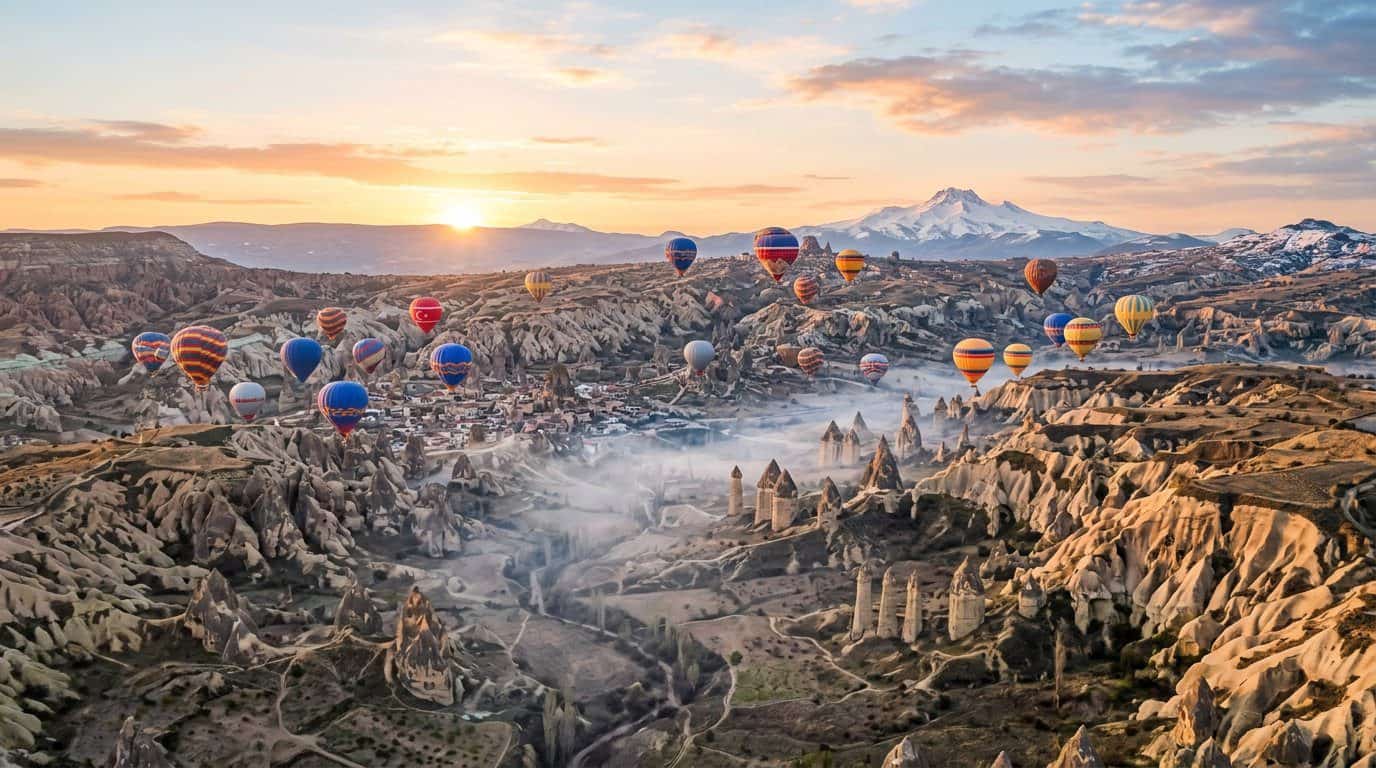
The Cappadocia balloon ride is the experience most travelers come here for, and I genuinely believe it earns its reputation. Hotel pickup is usually at 04:30. You ride to the launch field, watch the burners fire up the canopy in the dark, and step into the basket while the sky is still indigo. By the time you lift off, the eastern horizon is just beginning to brighten.
Around 150 balloons take off in the same window every clear morning. Within twenty minutes the entire sky over Goreme Valley is full of them. The Turkish General Directorate of Civil Aviation limits the licensed operators, and flights only proceed when wind speeds at altitude are below 18 knots, which is why cancellations happen even in peak season. Allow a backup morning in your three-day plan.
Pricing in 2026 ranges from €180 to €230 per person for a 60 to 75 minute flight, including transfers, a champagne toast on landing, and a flight certificate. Booking through your hotel often gets you 5 to 10 percent below online prices. Look for operators with at least a 4.5 rating on TripAdvisor and a clear safety record published on their website.
Goreme Open Air Museum: Byzantine Cave Churches
After breakfast, the Goreme Open Air Museum is a 15-minute walk from the town center. The site is a 4th-to-13th-century Byzantine monastic complex carved into the soft volcanic tuff. Christian monks lived, worshipped, and painted here for nine hundred years, and what remains today is one of the densest concentrations of preserved Byzantine wall painting outside Istanbul itself.
The five most important chapels are Tokali (Buckle Church), Karanlik (Dark Church), Yilanli (Snake Church), Elmali (Apple Church), and Carikli (Sandal Church). The Karanlik Kilise carries a small separate fee and is worth every lira: its 11th-century frescoes are the best preserved in the complex because the dark interior limited sunlight damage to the pigment. Bring a small flashlight; the lighting inside is deliberately kept dim to protect the paintings.
Allow two hours for the museum. Wear shoes with good grip; some of the chapel floors are slick from centuries of foot traffic. Cappadocia was added to the UNESCO World Heritage List in 1985 partly because of these churches, and the site is one of the most studied early Christian art collections in the world. The on-site signage is excellent and a guide is not strictly necessary unless you want deeper context.
Red Valley and Rose Valley at Sunset
The afternoon and sunset of Day 1 belong to the Red and Rose Valleys, two adjoining canyons west of Goreme. The local name “Kizil Vadi” (Red Valley) describes exactly what happens to the volcanic tuff when the sun starts to descend: the rock walls glow rose, coral, and deep pomegranate red.
The most popular walking trail runs about 4 kilometers between Cavusin and Ortahisar, passing the small Hacli Kilise (Cross Church) cut into the cliff face. The cross-shaped chapel still carries faded frescoes inside. Plan to arrive at the rim about an hour before sunset; the colors peak in the last twenty minutes and a few photographers will already be set up at the best viewpoints.
Cap the day with a glass of Kalecik Karasi, the indigenous Anatolian red grape that grows surprisingly well in the volcanic soil around Avanos. Most Goreme cave-restaurant rooftops serve it by the glass for around €5. After a 04:30 alarm, you have earned it.
Day 2 in Cappadocia: Underground Cities and the Ihlara Valley
The second day takes you south, away from the famous fairy chimneys, into terrain that hides most of its drama underground or inside long river canyons. This is the day most travelers underestimate, and the day they remember most when they get home.
Derinkuyu Underground City: Eight Levels Down
Derinkuyu is the largest excavated underground city in Turkey and one of the most extraordinary places you can physically walk through anywhere in the world. The site descends eight known levels into the volcanic rock to a depth of around 60 meters. At its peak it could shelter approximately 20,000 people along with their livestock, food stores, water cisterns, wineries, churches, and even a school.
The earliest construction is now dated to the Phrygian period (around the 8th to 7th century BCE), but the city saw its heaviest use during the early Byzantine era as a refuge for Christian populations during Arab raids in the 7th to 10th centuries CE. Massive circular stone doors, still in place, could be rolled across narrow corridors to seal off entire sections. Ventilation shafts cut through all eight levels keep the air breathable even today.
Wear layered clothing; the lower levels stay around 13°C year-round. The passages are narrow, low in places, and not suitable for travelers with significant claustrophobia or mobility limitations. Allow 90 minutes for the visit. Combine Derinkuyu with the smaller Kaymakli Underground City just 10 km north if you want to see two contrasting sites in one morning.
Ihlara Valley: A 14 km Byzantine Canyon Walk
An hour west of Derinkuyu, the Ihlara Valley cuts a 14 km canyon through the volcanic plateau, carved by the Melendiz River. The canyon walls are riddled with roughly 100 small Byzantine churches, several of which still hold visible frescoes. It feels like a secret version of Cappadocia almost no first-time visitor knows about.
The most rewarding section is the 4 km stretch between Ihlara village and Belisirma, which takes about 90 minutes at a relaxed pace. Pass the Agacalti Church (the Church Under the Tree, with stunning 11th-century frescoes of the Last Judgement), and continue past Sumbullu Church and Yilanli Kilise. The trail is flat, well-shaded, and follows the river the entire way.
Belisirma village has two or three small trout restaurants with tables set on wooden platforms over the river. Lunch here under the willow trees is one of those Cappadocia moments that nobody writes about and everyone remembers. Local rainbow trout, fresh bread, a glass of ayran, around €15 to €20 per person.
Selime Monastery: Cappadocia’s “Star Wars Valley”
End the day at Selime Monastery, the largest religious structure carved into rock anywhere in the Cappadocia region. The complex includes a cathedral-scale rock-cut church, a kitchen, stables, and monastic cells arranged across multiple terraces. Local guides have nicknamed the surrounding terrain “Cappadocia’s Star Wars Valley” because George Lucas was reportedly inspired by these formations.
The climb up to the upper terraces is steep and requires hands as well as feet in places. The reward is a panoramic view across the Melendiz River valley back toward the volcanic plateau you crossed earlier in the day. Allow an hour on site. Return to Goreme via Aksaray; the full driving loop for Day 2 is around 230 km and takes a long day, so an organized small-group tour is the easiest option.
Eat dinner in Goreme tonight, ideally somewhere with a rooftop terrace. The Pumpkin Restaurant and Topdeck Cave Restaurant are the two most reliable kitchens in town for slow-cooked testi kebabi (the famous pottery-baked Cappadocian lamb stew), with mains around €15 to €25.
Day 3 in Cappadocia: Fairy Chimneys, Avanos Pottery, and Uchisar Sunset
The third day is shorter on driving and richer in iconic scenery. This is also the day to schedule any extras: a second balloon attempt if the first morning was cancelled, an ATV ride through the valleys, a Turkish bath, or simply a slower morning in Goreme.
Pasabag and Monks Valley
Start the morning at Pasabag, also known as Monks Valley. Its three-headed fairy chimneys are the formations you see on most Cappadocia postcards: tall columns of volcanic tuff each capped by one or two basalt boulders, looking exactly like a row of mushrooms or pillared candelabras.
The Christian monk Saint Simeon is said to have lived alone in one of these tall columns in the 5th century, choosing solitude on a pillar above the desert. A small chapel and dwelling cell are carved inside one of the largest formations and you can walk in. The site is free and one of the easiest stops in Cappadocia, with paved paths and benches in the shade.
From Pasabag, a short 5 km drive takes you to Devrent Valley (sometimes called Imagination Valley), famous for animal-shaped rocks. Children love spotting the camel, the seal, the snake, and the dolphin. There are no churches or monuments here, only 60 million years of erosion carving improbable shapes out of soft tuff. Half an hour is enough.
Avanos Pottery on the Kizilirmak River
Next stop is Avanos, the riverside town built on the banks of the Kizilirmak (the Red River, the longest river entirely within Turkey at 1,355 km). Hittites were making pottery on these clay banks over 4,000 years ago, and the tradition has continued without interruption. Several family-run workshops still throw clay on traditional foot-powered wheels.
Galeri Ikman and Avanos Chez Galip are the two most established workshops. Both welcome visitors for free demonstrations: you can sit on the foot-wheel yourself and try a basic bowl form, then watch the master finish a wine pitcher in under five minutes. The quality of ceramics for sale here is far above the tourist trinkets you find in Goreme; expect to pay €20 to €200 for a serious piece.
While you are in Avanos, walk to the famous “Hair Museum” inside Galip’s workshop. Over the past four decades, more than 16,000 women have left a lock of their hair on the walls of this small underground chamber. Roger Ebert, Ali MacGraw, and various Hollywood visitors have all contributed locks. It is strange, slightly unsettling, and absolutely worth seeing.
Uchisar Castle: The Highest Sunset View in Cappadocia
For the final sunset, climb Uchisar Castle. The “castle” is a single natural rock outcrop riddled with tunnels, chambers, and stairs cut by Byzantine and medieval residents. At 1,330 meters it is the highest natural point in Cappadocia, and from the top you can see the entire region: Goreme below, the snow-capped Mount Erciyes on the eastern horizon, the chimneys of Cavusin to the north, and Mount Hasandagi rising to the southwest.
The climb is steep but short, around 15 minutes from the parking area to the summit. Bring water and a windproof layer; the top is exposed and noticeably cooler than the valleys below. The entrance fee is modest.
Watch the sun set over the western valleys, walk back down through Uchisar village, and treat yourself to a final dinner at Seki Restaurant in the Argos in Cappadocia hotel. The cave dining room and the wine list are the most refined in the region; expect €60 to €100 per person with wine. A fitting close to three days.
Where to Stay in Cappadocia: Cave Hotels Done Right
Choosing your base village in Cappadocia matters more than most regions in Turkey. Each village offers a distinct atmosphere, a different price point, and different proximity to the major attractions. The three smart options are Goreme, Uchisar, and Urgup.
Goreme: The Most Central Base
Goreme is the most central of the three main bases. From here you are within walking distance of the Open Air Museum, the balloon launch fields, Pigeon Valley, and Sunset Point. The village itself is full of cave hotels carved into the soft tuff cliffs, often with private terraces overlooking the valley.
Mid-range cave hotel rooms in Goreme run €80 to €200 per night for a clean, beautifully decorated room with a private cave terrace. Higher-end boutique properties like Sultan Cave Suites or Mithra Cave Hotel run €250 to €450 per night and offer some of the most photographed breakfast spreads in Turkey (the famous “Turkish breakfast on a rooftop with balloons rising” Instagram shot is taken here every morning).
The trade-off is that Goreme is the busiest village in Cappadocia. You will hear other guests, you will walk through tour groups, and the main street can feel crowded at peak times. For first-time visitors, this is the right base.
Uchisar: Higher, Quieter, Better Views
Uchisar sits above Goreme on the rim of Pigeon Valley. The village is much smaller, considerably quieter, and offers the most dramatic sunset views from your hotel terrace. The famous Argos in Cappadocia hotel is here, and so are a string of mid-range boutique cave hotels with views back over Goreme Valley.
Mid-range Uchisar properties run €120 to €280 per night. Upscale stays at Argos or Museum Hotel start around €450. The trade-off compared to Goreme: you need a car or taxi for some of the further-away valleys and the balloon-launch pickup is a few minutes longer.
For travelers on a second visit to Cappadocia, or for honeymoons, or for anyone who values quiet, Uchisar is the right base.
Urgup: Larger Town, More Restaurants, Lower Prices
Urgup is the largest town in the region, with more restaurants, more shops, and slightly lower hotel rates than Goreme. It is less of a cave-hotel experience and more of a working town with a long Cappadocian history. The Yunak Evleri and Esbelli Evi boutique stone-mansion hotels are highlights, with rooms from €150 to €350.
The downside is that Urgup is 7 km from Goreme, so daily transfers add up. For budget travelers or those who want a less touristy base while still being within a short drive of everything, Urgup works well.
Whichever base you choose, book at least three months ahead for peak summer and balloon-season weekends. Inventory is tight, prices rise quickly, and the best rooms with balloon-rise terrace views sell out first.
How to Get to Cappadocia and Get Around
Cappadocia is in central Anatolia, about 700 km southeast of Istanbul. The region is more accessible than most travelers expect, with two airports, a strong domestic flight network, and bus connections from every major Turkish city.
Flying Into Kayseri or Nevsehir Airports
Two airports serve Cappadocia. Kayseri Airport (ASR), 75 km from Goreme, has the most flights and is preferred by Turkish Airlines for their full-service routes. Nevsehir Airport (NAV), 45 km from Goreme, is closer and used mostly by Pegasus and AnadoluJet. Both have daily flights from Istanbul (Istanbul Airport and Sabiha Gokcen) and seasonal connections from Antalya and Izmir.
A return flight from Istanbul typically costs €50 to €120 depending on the season. The flight itself takes 75 to 90 minutes. Book through Turkish Airlines, Pegasus, or AnadoluJet directly for the best rates; aggregators usually add a 5 to 10 percent markup.
Most cave hotels offer airport shuttles for around €15 to €25 per person. The shared shuttle (Cappadocia Express) is the cheapest option at €10 per person and drops you at your hotel.
Driving Yourself vs Organized Day Tours
Renting a car gives you flexibility, especially for Day 2’s long loop. Rental rates start around €25 per day from local agencies at the Kayseri or Nevsehir airports. Roads are well-maintained, signposted in English, and driving is straightforward outside of the village center streets in Goreme and Avanos (which can be narrow and crowded).
The alternative is the “Green Tour” and “Red Tour” small-group day tours, the standard tourism format that covers most of Days 1 and 2 of this itinerary at €40 to €70 per person with English-speaking guide, transport, and lunch included. They are reliable and a good choice if you do not want to navigate yourself.
I usually recommend renting a car for Day 2 (the wide circuit through Derinkuyu, Ihlara, and Selime) and joining a small-group “Red Tour” for Day 3 (the closer-in valleys) if you want a guide for the historical context. Day 1 you walk or use hotel shuttles.
The Best Time of Year to Visit Cappadocia
The ideal months are mid-April to mid-June and mid-September to early November. In these windows the daytime weather is mild (18 to 25°C), evenings are cool but not cold, and balloon flights operate reliably most mornings. Mid-spring also brings the apricot and almond blossom across the valleys, which is genuinely beautiful.
July and August are hot (often above 35°C), crowded, and prices peak. The balloons still fly but the valley walks become punishing in the midday sun. December through February brings snow, dramatically beautiful but with frequent balloon cancellations; if you are flexible and want to see the fairy chimneys dusted in white, this is the gamble.
Mid-October through early November is my personal favorite. The light is golden, the crowds have thinned, and the wine harvest is happening in Avanos and Urgup. You can walk into a winery without an appointment and taste five Kalecik Karasi vintages for free.
The History Behind Cappadocia’s Landscape
One of the things that surprised me most when I started studying Cappadocia as part of my history degree was how completely human history is built on volcanic geology here. Without the soft tuff stone, none of the cave churches, none of the underground cities, none of the fairy chimneys would exist.
The Geology: Three Volcanoes and 60 Million Years
The Cappadocian plateau was formed by three volcanoes: Mount Erciyes (3,917 m, still active), Mount Hasandagi (3,253 m), and Mount Gulludag. Over roughly 60 million years, repeated eruptions deposited thick layers of volcanic ash that compacted into a soft white rock called tuff, capped with harder layers of basalt.
When wind and water began eroding the softer tuff faster than the harder basalt cap, the tuff below the basalt eroded into tapering columns, and the basalt remained on top as a protective cap stone. This is exactly what you see in Pasabag and Devrent. The mushroom-cap shapes are basalt sitting on slowly eroding tuff.
The same soft tuff that produced the fairy chimneys also made it possible for humans to carve into the rock with simple iron tools. The whole human story of Cappadocia depends on this geological coincidence.
The Hittites, the Persians, and the Romans
The earliest substantial settlement in Cappadocia dates to the Hittite Empire (around 1600 to 1200 BCE), with Kanesh (modern Kultepe, near Kayseri) one of their major trading centers. Assyrian merchants kept detailed cuneiform tablet records of their business in Kanesh, and these tablets remain among the most important sources for early Bronze Age trade.
After the Hittites collapsed, Cappadocia was successively ruled by Phrygians, Persians (under the Achaemenid Empire), Hellenistic kingdoms, and eventually Rome. The Romans incorporated the region as a province in 17 CE and built the Pontus-to-Mediterranean road system that crossed it.
For more about the Roman period in Anatolia, the Ephesus ancient city guide and Aphrodisias guide give you the wider Anatolian context.
The Christian Era and the Cave Monasteries
Christianity reached Cappadocia early, partly through the work of the Apostle Paul and partly through later missionary activity. By the 4th century the region had become a major center of Christian thought, producing three of the most influential Greek Church Fathers: Basil the Great of Caesarea, Gregory of Nyssa, and Gregory of Nazianzus.
From the 7th century onward, repeated Arab raids (and later Seljuk incursions) drove Christian communities to hide underground. The soft tuff that had made the monasteries possible also made it possible to carve entire cities beneath the surface. Derinkuyu, Kaymakli, and other underground cities reached their peak use during this defensive period.
The wall paintings in the Goreme Open Air Museum represent the final flowering of this Christian Cappadocian tradition, mostly dating from the 9th to 13th centuries. After the Battle of Manzikert (1071), Seljuk Turkish rule expanded across the region, and the slow shift toward Turkish-Islamic culture began.
Frequently Asked Questions About a Cappadocia 3 Day Itinerary
Is 3 days enough for Cappadocia?
Three full days is the sweet spot for first-time visitors. It gives you a balloon morning, the main valleys, one underground city, the Ihlara Valley walk, and the pottery and sunset on Day 3, without rushing. With only two days you will skip either the underground cities or the Ihlara Valley walk, and both are difficult to recommend leaving out. If you have a week, add a hike through Pigeon Valley, a horse-back ride through Love Valley, and a day at one of the regional thermal springs.
What is the best month to visit Cappadocia?
April to June and September to early November are ideal. Summer is hot and crowded; winter brings snow and frequent balloon cancellations, though the snowy fairy chimneys are spectacular if you are flexible with your dates.
Are the Cappadocia balloon rides safe?
Cappadocia balloon operators are tightly regulated by the Turkish General Directorate of Civil Aviation. Flights only proceed when wind speeds at altitude are below 18 knots, which is why cancellations happen even in peak season. Choose a licensed operator with a clear safety record and consistent recent reviews. The overall safety record for Cappadocia ballooning is strong by international standards.
Do I need a guide in Cappadocia?
For the Goreme Open Air Museum and the underground cities, a guide adds context that signage alone does not give. For the valleys, Avanos, and the sunset spots, self-guided exploration with a good map or trail app works perfectly. The most flexible approach is a private guide for one of the three days plus self-guided exploration on the others.
How much should I budget for 3 days in Cappadocia?
For a comfortable mid-range trip, budget €400 to €600 per person for 3 days including a cave hotel, a balloon flight, two organized day tours, all meals, and entrance fees. Backpackers can do it for around €250 per person; high-end travelers can easily spend €1,000+ per person on luxury cave suites and private guided tours.
Cappadocia, for me, has always felt like a place where geology and human history collide so completely that you stop being able to tell them apart. Plan your three days well, and you walk away with a story that lasts. If you want more inspiration for the wider Turkey trip, see our Pamukkale day trip guide and the Istanbul Old City walking tour.
About the author: İlknur Acar is the founder of Bir Dakikada Geziyorum, a Turkish travel publication with 250+ long-form destination guides. She is a third-year history student, has lived for three years in Kyiv, and has visited 11 countries.