Last Updated: 17 May 2026
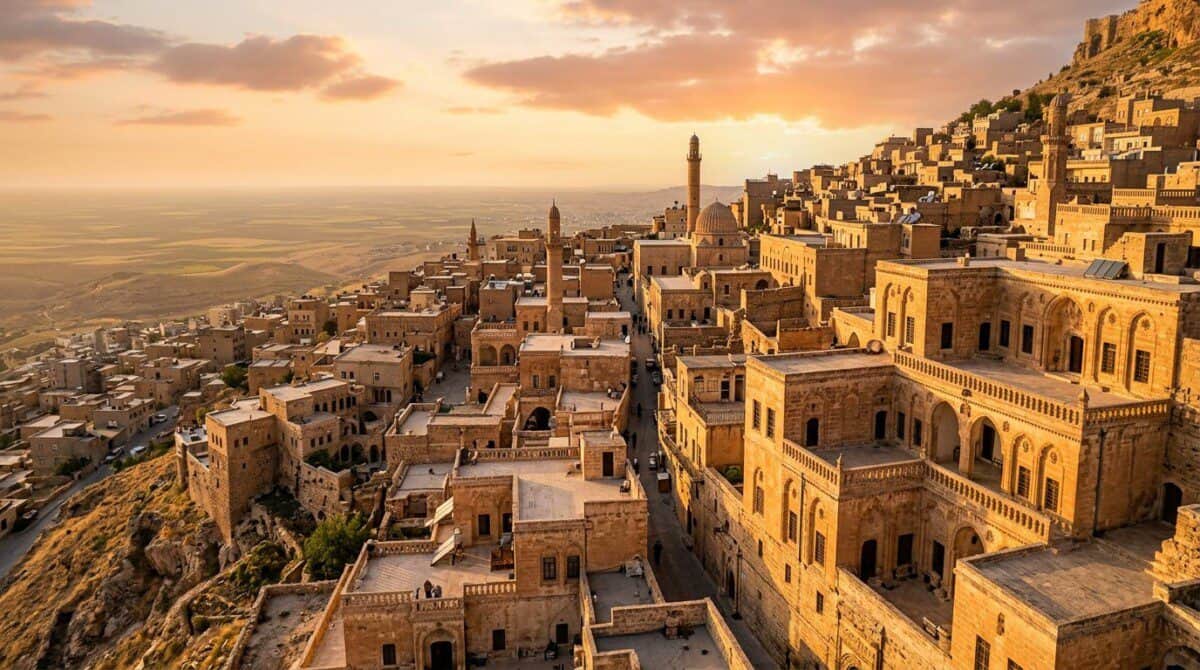
Mardin is the city of honey-colored stone houses cascading down a hillside above the Mesopotamian plain. From its commanding position at 1,000 meters elevation, with views stretching south across northern Syria to the curve of the horizon, Mardin has watched empires rise and fall for over 4,000 years. The city was a major center of the early Christian church (the Syriac Orthodox Patriarchate was based here for centuries), of medieval Islamic civilization (under the Artuqid dynasty in the 12th and 13th centuries), and of Ottoman provincial administration. The unique combination of Kurdish, Arab, Turkish, Armenian, Syriac and Yezidi populations has produced one of the most culturally diverse cities in Turkey, with churches, mosques, madrasas and palaces all crowded into the narrow streets that wind across the steep hillside. Mardin is one of those rare places that genuinely feels like nowhere else in the country.
In this guide I will share the spectacular Old City architecture, the early Christian heritage including the Syriac Orthodox monasteries of Deyrulzafaran and Mor Gabriel, the unique cuisine that combines Arab, Kurdish, Syriac and Turkish traditions, the practical experience of staying in one of the restored Mardin stone mansion hotels, and the practical logistics of reaching this remote southeastern Turkey city. I will tell you why Mardin is one of the most rewarding cultural destinations in Turkey and how to combine it with the wider southeastern region including Hasankeyf and Diyarbakir.
Key Takeaways
- Mardin is one of the most beautifully preserved medieval Islamic cities in the world, with honey-colored limestone houses cascading down a hillside at 1,000 meters elevation overlooking the Mesopotamian plain.
- The city has been home to Kurdish, Arab, Turkish, Armenian, Syriac and Yezidi populations for centuries, with the resulting cultural diversity visible in the dozens of churches, mosques, madrasas and palaces from multiple religious traditions.
- The Deyrulzafaran Monastery (Saffron Monastery) 6 kilometers from central Mardin was the seat of the Syriac Orthodox Patriarchate from 1160 to 1932 and remains an active Syriac Christian center.
- The Old City is best explored on foot, with the main pedestrian street (the First Street) running along the contour of the hillside past the major mosques, madrasas and stone mansions.
- Restored stone mansion hotels (called Mardin Konaklari) offer one of the most atmospheric accommodation experiences possible in Turkey, with private courtyards, original wood ceilings and rooftop terraces.
- Mardin is 100 kilometers east of Diyarbakir, with the wider southeastern Turkey region including Hasankeyf, Midyat (with its Syriac Christian craft tradition) and the Mesopotamian villages worth multi-day exploration.
The Old City of Mardin
The Old City of Mardin is a UNESCO tentative-list site (formal World Heritage nomination has been pending for years) that contains hundreds of medieval Islamic stone buildings spread across the steep hillside. The architectural style is unique to the region, with honey-colored local limestone, elaborate carved decoration, traditional stone vaulting and the distinctive courtyard arrangement that adapts ancient Mesopotamian house types to the cliff-side terrain.
The Stone Architecture
Mardin’s distinctive architecture developed over centuries as builders adapted to the steep limestone hillside, the local building stone (a soft yellow limestone that hardens after exposure to air, making it ideal for elaborate carving), and the climate (very hot summers, cold winters with snow). The result is a unique architectural language with no close parallels elsewhere in Turkey or the wider region.
Houses are typically built into the hillside, with the lower floors carved partly into the rock and the upper floors built up in cut stone. The courtyards (called havus) are central to the house plan, with rooms arranged on multiple levels around the open courtyard. The entrance from the street is typically through a small door that leads into the courtyard, where the actual house entrance is found on the inner wall.
The exterior decoration includes elaborate carved doorways, window frames, balcony brackets and decorative friezes. The carving styles range from severe geometric patterns to elaborate floral and calligraphic designs, with the most elaborate examples on the major mosques, madrasas and palace buildings. Many houses also have decorated rooftops with elaborate stone railings and decorative chimneys.
The Major Religious Buildings
The Ulu Cami (Grand Mosque) in central Mardin, dating from the 12th century with later modifications, is the most important Islamic religious building in the city. The mosque has a unique minaret that has been called the most beautiful in Turkey, with elaborate spiral carving covering its full height. The interior contains the traditional Friday congregational prayer hall plus several smaller chapels and tombs.
The Zinciriye Madrasa, built in 1385 by the Artuqid sultan Isa, is one of the most spectacular medieval Islamic educational buildings in Turkey. The building has a central courtyard with two iwans (arched chambers) for teaching, surrounded by smaller rooms for student dormitories and teaching staff. The exterior is decorated with elaborate carved stone work that combines geometric patterns, calligraphic inscriptions and floral motifs.
The Kasimiye Madrasa, built in the late 15th century, sits on a hillside on the western edge of central Mardin with sweeping views over the Mesopotamian plain. The building combines a madrasa, a small mosque, a mausoleum and a public fountain into one integrated complex. The architecture and the panoramic setting make this one of the most photogenic buildings in the city.
The Bazaar Area
The central bazaar (Sipahi Carsisi) of Mardin runs along the main pedestrian street and includes sections devoted to traditional crafts, textiles, copper work, leather goods, jewelry and food. The bazaar atmosphere is more authentic than many Turkish bazaars because the customer base is primarily local rather than tourist, with families from the surrounding villages doing their shopping alongside the visiting tourists.
Mardin is particularly famous for its silver filigree jewelry (telkari), a craft that has been practiced in the city for centuries. The technique creates delicate wire designs that resemble lace work in metal. Workshop shops in the bazaar sell both traditional and modern designs at prices significantly below similar quality work in Istanbul or Ankara.
The leather goods, copper work and traditional textiles are also worth attention. The local Mardin specialty in textiles is the elaborate hand-embroidered fabric called ipek (silk), used for traditional clothing and household decoration. The patterns combine Islamic geometric designs with Syriac Christian motifs in ways that reflect the multi-religious heritage of the city.
The Syriac Christian Heritage
One of the most distinctive aspects of Mardin is the extensive Syriac Christian heritage of the region. The Syriac Orthodox Church, which preserves liturgical Aramaic (the language of Jesus) as its religious language, was one of the major Christian denominations of the medieval Middle East and remained based in Mardin until the early 20th century.
The Deyrulzafaran Monastery
The Deyrulzafaran Monastery (Saffron Monastery), 6 kilometers east of central Mardin, was the seat of the Syriac Orthodox Patriarch of Antioch from 1160 until 1932 when the Patriarchate moved to Damascus. The monastery is one of the most important religious sites in the Syriac Christian tradition and remains an active Syriac Christian center under the leadership of a metropolitan bishop.
The name Deyrulzafaran (House of Saffron) comes from the yellow tone of the local limestone used in construction, which resembles saffron. The monastery’s main church dates from the 5th century AD, making it one of the oldest continuously operating churches in the world. The interior preserves original stone altars, ancient liturgical objects and the traditional layout that has changed little in 1,500 years.
The visit includes the main church, the throne room of the patriarchs (with the actual throne used by the patriarchs from 1160 to 1932), the manuscript library (which holds important Syriac Christian texts), the chapels dedicated to various saints and martyrs, and the underground chamber that is believed to date from a pre-Christian sun temple that occupied the site before the monastery was built.
Tours of the monastery are conducted by Syriac Christian guides (often the resident monks or members of the local Syriac community) who explain the religious significance and historical importance of each space. The monastery is open to visitors from all backgrounds, with appropriate dress (covered shoulders and knees) expected. Allow 2 to 3 hours for a thorough visit.
The Other Syriac Churches
The city of Mardin itself contains several active Syriac Orthodox and Syriac Catholic churches, including the Forty Martyrs Church (Kirklar Kilisesi), the Church of the Mother of God (Meryem Ana Kilisesi), the Church of the Apostles, and several smaller churches and chapels. Most are open to visitors during non-service times and welcome respectful observers.
The Forty Martyrs Church, in central Mardin, dates from the 6th century AD and is the oldest church in the city. The interior contains 17th-century wooden iconostasis (icon screen), original Syriac liturgical objects, and frescoes depicting the forty Christian martyrs of Sebaste who give the church its name. The church holds Sunday services in Aramaic, attracting both local Syriac Christians and visitors interested in the ancient liturgy.
The Church of the Mother of God (Meryem Ana) is the seat of the Syriac Catholic community in Mardin. The building was originally Syriac Orthodox but was converted to Syriac Catholic in the 19th century when a portion of the community accepted union with Rome. The architecture is unchanged but the liturgy is now bilingual Aramaic and Latin.
The Mor Gabriel Monastery
About 60 kilometers east of Mardin, near the town of Midyat, the Mor Gabriel Monastery is the oldest functioning Christian monastery in the world, founded in 397 AD. The monastery has operated continuously for over 1,600 years and remains an active center of Syriac Christianity with a small community of monks.
The monastery is set in beautiful rural country with olive groves and vineyards. The buildings include the original 5th-century main church (with extraordinary preserved frescoes), a 6th-century octagonal baptistery, multiple chapels added over the centuries, dormitories for the monks and guest rooms for visiting pilgrims. The architectural ensemble shows the gradual accretion of Syriac Christian building traditions across 1,600 years of continuous occupation.
Visiting Mor Gabriel requires a day trip from Mardin (about 1.5 hours each way). The monastery is open to visitors during daylight hours with no admission fee (donations welcome). The current Syriac Orthodox archbishop of Tur Abdin lives at the monastery and often greets visitors personally. A simple lunch can be arranged with advance notice.
Mardin Cuisine and the Multicultural Food Tradition
Mardin cuisine is one of the most distinctive regional traditions in Turkey, blending Arab, Kurdish, Syriac, Turkish and even some Armenian and Persian influences into a uniquely Mardin food culture. The diversity reflects the multi-religious and multi-ethnic character of the city.
Distinctive Dishes
The most famous Mardin dish is the lahmacun (thin pizza-like flatbread topped with spiced minced meat), which the Mardin version differs from the more familiar Turkish version by using a special spice blend (including sumac, cumin and Aleppo pepper) and a thinner more crispy crust. The Mardin lahmacun is so distinctive that local establishments boast about being authentically Mardin rather than Turkish.
The kibbeh (called icli kofte in Turkish) is another major Mardin specialty, with the local version using a bulgur shell stuffed with spiced minced meat, walnuts and pomegranate molasses. The kibbeh can be served fried, boiled or grilled, with different cooking methods producing very different textures and flavors. Many Mardin restaurants specialize in kibbeh and serve multiple varieties as a meze platter.
The dolma (stuffed vegetables) tradition in Mardin uses a wider range of vegetables than in mainland Turkey, including not just grape leaves and peppers but also eggplant, zucchini, cabbage and various wild greens. The stuffing typically combines rice with minced meat, pine nuts, currants and elaborate spice blends. A meze plate of various dolma varieties is a beautiful introduction to the regional cuisine.
The Spices and Ingredients
Mardin’s location on the medieval Silk Road trade routes gave the city access to spices from across the Indian Ocean trade network. The local cuisine still reflects this spice heritage, with elaborate spice blends used in dishes that would be relatively plain elsewhere in Turkey. Cumin, sumac, Aleppo pepper, cardamom, cinnamon and nutmeg all play prominent roles.
The local pomegranate (especially the variety called narsuyu) produces the famous Mardin pomegranate molasses (nar eksi), used as a souring agent in many dishes and as a salad dressing. The molasses is sold in glass bottles throughout the bazaar and makes an excellent souvenir.
The local cheeses include the famous Mardin orgu peyniri (braided cheese), made by stretching the curd into long ropes and braiding them. The cheese has a distinctive chewy texture and salty flavor. Other regional cheeses include the herbed white cheese (otlu peynir) and the smoked goat cheese (tulum). All are sold at the central market and at specialized cheese shops in the bazaar.
Where to Eat
The Cercis Murat Konagi, in a restored stone mansion in central Mardin, is one of the most atmospheric restaurants in the city. The menu features traditional Mardin dishes prepared with attention to authentic recipes. The setting in the courtyard of an Ottoman-era stone mansion adds significantly to the experience. Expect to pay 400 to 700 Turkish lira per person for a multi-course meal.
The Antik Sur Konak, another restored mansion restaurant, focuses on Syriac Christian-influenced dishes alongside traditional Muslim Mardin cuisine. The combination of religious traditions on the menu reflects the city’s diversity. The rooftop terrace provides views over the city and the plain below.
For more casual dining, the Sehir Lokantasi serves traditional home-style Mardin food at moderate prices. The lunch buffet includes a daily selection of stews, rice dishes and vegetables, with prices around 200 to 300 lira per person. The atmosphere is informal and the food is consistently good.
How to Get to Mardin and Practical Planning
Mardin is in southeastern Turkey, in a region that few international visitors reach. The logistics require deliberate planning but the journey is part of the experience.
Getting In
Mardin has its own airport (MQM) with daily flights from Istanbul (Sabiha Gokcen and main airports) and from Ankara. International flights to Mardin are limited but several European cities have seasonal charter flights in summer. The airport is 20 kilometers from central Mardin, with shuttle buses and taxis available.
From Diyarbakir (which has more frequent flight connections from Istanbul and Ankara), the drive to Mardin takes about 90 minutes on the modern highway. Some visitors fly to Diyarbakir, spend a day or two there, then drive to Mardin.
By bus, daily intercity services connect Mardin with Istanbul (16 hours), Ankara (12 hours), Diyarbakir (90 minutes) and Sanliurfa (3 hours). Bus travel from western Turkey is exhausting but affordable.
Where to Stay
The most distinctive Mardin accommodation experience is in one of the restored stone mansion hotels (Mardin Konaklari). These are 17th to 19th century Ottoman-era mansions that have been carefully restored as boutique hotels, with original architectural features preserved alongside modern bathrooms and air conditioning.
The Antik Tatlidede Konagi, the Reyhani Kasri and the Erdoba Evleri are three of the most established stone mansion hotels. Prices range from 1,500 to 4,000 Turkish lira per night for atmospheric rooms with original wood ceilings, stone walls, courtyards and (in some cases) panoramic rooftop terraces.
For modern comfort, the Hilton Garden Inn Mardin (in the new city) offers international-standard accommodation at around 2,000 to 3,500 lira per night. The location is less atmospheric than the Old City stone mansions but the amenities are higher.
For budget travelers, several smaller pensions and family-run hotels in the Old City offer simple rooms for 500 to 1,000 lira per night. The atmosphere is excellent even in budget accommodations because the buildings themselves are historical.
The Visit Itself
Allow 2 to 3 days for a thorough Mardin visit. Day 1: walking tour of the Old City including the Ulu Cami, Zinciriye Madrasa, the bazaar and several smaller mosques and churches. Day 2: Deyrulzafaran Monastery in the morning, lunch in the city, Kasimiye Madrasa and the western edge of the Old City in the afternoon. Day 3 (optional): day trip to Midyat and Mor Gabriel Monastery, returning to Mardin in the evening.
The Old City is car-free in the most historic sections, with narrow stepped streets that require comfortable walking shoes. The hillside terrain involves substantial climbing between the lower bazaar area and the upper viewpoints. The traditional eaves and overhanging upper floors create welcome shade in summer but the walks can be tiring.
Bring water, comfortable shoes, a hat for the open viewpoints, and modest clothing for visits to mosques and churches. Many restaurants and shops in the Old City are open through traditional siesta hours (14:00 to 16:00) but the religious sites typically close. Plan your itinerary around these timing constraints.
Combining with the Wider Region
Mardin combines naturally with several other southeastern Turkey destinations. Diyarbakir (90 minutes northwest) has the largest continuous city walls in the world after the Great Wall of China, plus the Ulu Cami (one of the oldest mosques in Anatolia) and the Diyarbakir bazaar.
Sanliurfa (3 hours west) has the famous Gobekli Tepe (the world’s oldest known temple, see my Gobekli Tepe guide) and the Pool of Sacred Fish (Balikligol). Combining Mardin, Sanliurfa, Gobekli Tepe and possibly Mount Nemrut (see my Mount Nemrut guide) creates a substantial 5-7 day southeastern Turkey itinerary.
Hasankeyf, the medieval city that was partly flooded by the Ilisu Dam in 2020, is 100 kilometers northeast of Mardin. The remaining above-water portions of the city (the medieval cave dwellings on the cliff and several surviving stone monuments) are worth a day trip for visitors interested in the history of the region.
Frequently Asked Questions
Is Mardin safe for tourists?
Mardin city is generally safe for visitors. The southeastern Turkey region as a whole has had security concerns in the past, but Mardin itself has been stable for many years and welcomes international visitors. Check your government’s current travel advisory before visiting for the most up-to-date guidance. Most international tourists have no issues whatsoever.
How many days should I spend in Mardin?
Three days is ideal, covering the Old City (1 day), the Syriac monasteries (1 day for Deyrulzafaran and the in-city churches, optionally another day for Mor Gabriel), and the broader region (1 day for Midyat and the Syriac craft villages, or for Hasankeyf). A focused 2-day visit covering just the highlights is also possible.
What is the best time to visit Mardin?
April, May, September and October offer the best balance of comfortable temperatures and good light. Summer (June through August) is extremely hot, often exceeding 40 degrees Celsius. Winter (December through February) is cold with occasional snow, but the city is atmospheric in winter weather. Avoid Ramadan if you want restaurants and cafes to operate normal hours.
Can I attend a Syriac Orthodox service?
Yes, both the Deyrulzafaran Monastery and several Mardin city churches hold regular services in Aramaic. Visitors of any background are welcome to attend. The services are long (typically 2 to 3 hours) and follow ancient liturgical patterns that have not changed substantially in 1,500 years. A truly memorable cultural and religious experience.
Is Mardin good for photographers?
Yes, exceptionally so. The combination of the honey-colored stone, the hillside topography, the views over the plain, the elaborate architectural details and the multicultural character of the city makes for outstanding photography. The light is best in the early morning (golden glow on the stone) and late afternoon (long shadows emphasizing the texture).
What should I bring as souvenirs?
Mardin silver filigree (telkari) jewelry, pomegranate molasses (nar eksisi), the local braided cheese (vacuum-sealed for travel), traditional silk textiles, copper work and various spice blends are all good purchases. The bazaar offers fair prices for quality work, and bargaining is expected but not aggressive. The UNESCO tentative list includes Mardin as a nominated cultural heritage site.
About the Author
I’m Ilknur Acar, the founder of Bir Dakikada Geziyorum. Mardin is the Turkish city that most consistently surprises my visiting friends, partly because it looks unlike anywhere else in the country and partly because the cultural depth of the multi-religious heritage rewards repeated exploration. I write history-rooted travel guides that respect the layered past of Turkey and the eastern Mediterranean. Follow along for more.