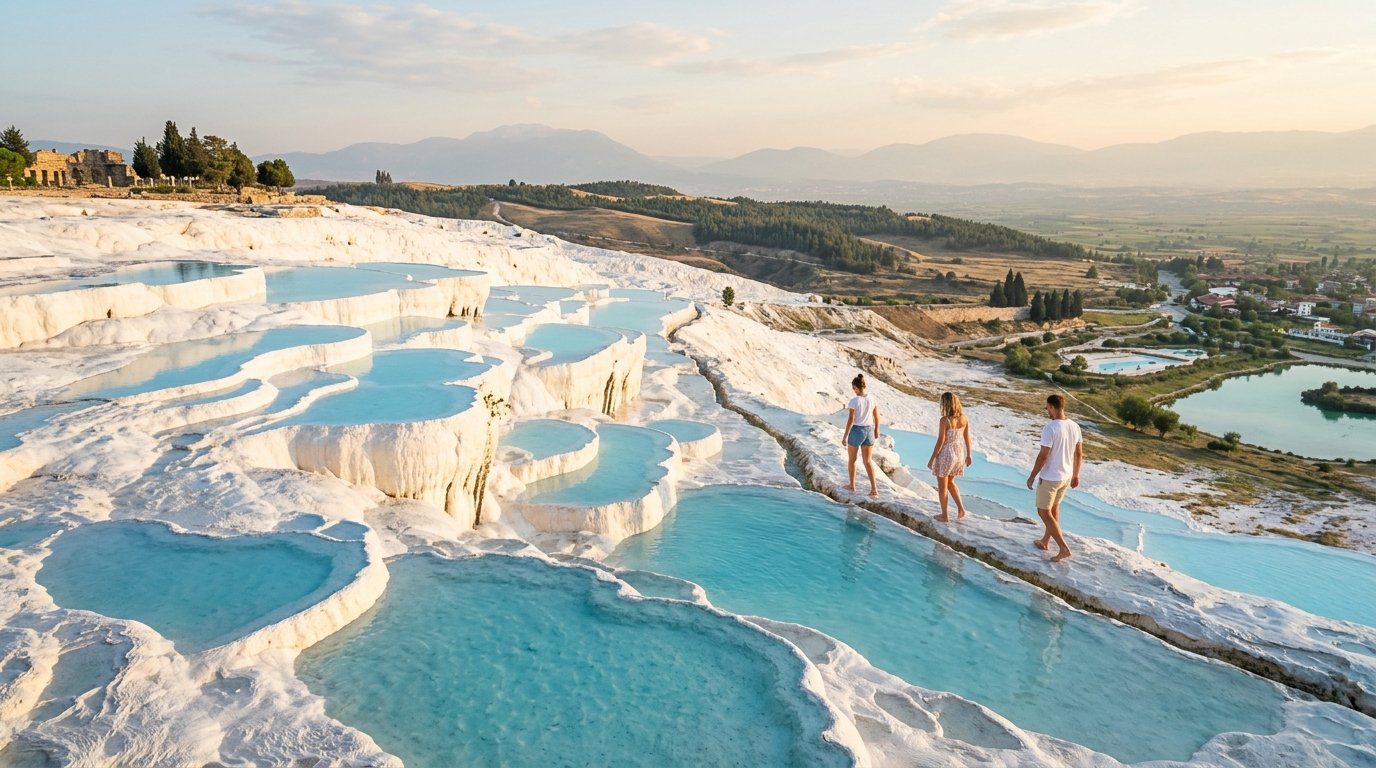
The first time I saw Pamukkale, from a distance, I genuinely thought I was looking at a glacier on a hillside in southwestern Turkey. The terraces of white travertine cascade down the slope so completely that they look like ice frozen mid-flow. Then you walk up barefoot (mandatory on the site), step into the first pool, and feel that the water is warm. The Pamukkale day trip is one of the strangest and most beautiful experiences in the country.
Last Updated: 17 May 2026
Key Takeaways
- Pamukkale means “cotton castle” in Turkish and refers to the white travertine terraces formed by 14,000 years of mineral-rich thermal water
- The site shares a single UNESCO World Heritage listing with the Greco-Roman city of Hierapolis above it (listed 1988)
- Shoes must be removed at the entrance to protect the soft travertine surface from wear and erosion
- Thermal water emerges from underground at around 35°C and deposits calcium carbonate to form new travertine
- Cleopatra’s Pool, a separate paid attraction inside Hierapolis, lets you swim in 36°C mineral water over Roman temple columns
- Most travelers visit as a day trip from Antalya (3.5 hours), Izmir (3 hours), or as part of a Cappadocia-Pamukkale-coast loop

What Exactly Is Pamukkale and How Did It Form?
Understanding the geology of Pamukkale changes how you experience the visit. This is not a frozen waterfall or a snow-capped slope, despite what it looks like. It is a slow, continuous geological process that has been depositing the same white stone for fourteen thousand years.
The Geological Process Behind the White Terraces
Pamukkale sits on top of a major fault line in the Buyuk Menderes graben. Underground, rainwater seeps down through sedimentary rock layers, is heated by geothermal activity, and dissolves calcium carbonate as it moves. When this calcium-rich water reaches the surface and starts to cool, the carbonate precipitates out and forms travertine, a soft white limestone.
The process began approximately 14,000 years ago and continues today. The water emerges from 17 separate springs at around 35°C and flows down the hillside, depositing thin layers of travertine as it cools. Over millennia, these layers have built up the cascading terraces and shallow pools you see today.
The Turkish name Pamukkale, “cotton castle”, captures the visual effect perfectly. The mineral water itself is clear, but it scatters light through the white limestone underneath into the pale turquoise that has made the site famous worldwide.
UNESCO Listing and Why the Site Is Protected
Pamukkale and the ancient city of Hierapolis above it were added to the UNESCO World Heritage List in 1988 as a single combined property. The dual listing reflects two interlocking values: the natural travertine system below, and the Greco-Roman thermal spa city built on top.
The site faced serious damage in the 20th century. From the 1960s through the 1980s, hotels were built directly on top of the travertines, mineral water was diverted into hotel pools, and visitors walked the terraces in shoes. Sections of the white stone turned gray, the water flow shifted, and the natural process was interrupted.
UNESCO intervention prompted a major restoration program in the 1990s and 2000s. The hotels were demolished, the original water flow was restored, and the mandatory barefoot rule was implemented. The site has since recovered substantially, though some sections remain closed to allow continued regeneration.
The Healing Water and Its Mineral Composition
Pamukkale’s thermal water contains a distinctive mix of dissolved minerals: calcium and magnesium bicarbonate, sulfate, sodium chloride, and trace amounts of iron and silica. Local tradition has credited the water with healing properties for at least 2,500 years.
The ancient Greeks and Romans believed Pamukkale’s water cured conditions ranging from skin diseases and rheumatism to digestive disorders. Modern balneotherapy research has documented measurable benefits for certain skin and joint conditions when patients bathe in the water regularly over several weeks.
For a single visit, you are not going to be cured of anything. But sitting in 36°C lightly carbonated mineral water for an hour in Cleopatra’s Pool inside Hierapolis is genuinely relaxing, and the slight effervescence on the skin is a small physical pleasure that travelers rarely forget.
Walking the Travertines Barefoot
The barefoot walk down (or up) the travertine cascade is the central Pamukkale experience. It takes about 90 minutes at a relaxed pace, including stops in the shallow pools along the way. The surface is uneven, the water flows continuously, and the sensation underfoot is unlike anything else in Turkey.
The Three Entrance Gates and Which One to Use
Pamukkale has three entrance gates. The South Gate sits at the top of the hill, accessed by car or shuttle bus, and is where most organized day tours arrive. You walk down through Hierapolis first, then descend the travertines from the top.
The North Gate is similar but enters from a different angle, again at the top. The South Gate is the more popular and better-signed of the two upper entrances.
The Town Gate sits at the bottom of the hill in Pamukkale village. This is the entrance you use if you are staying in the village overnight. You walk up the travertines and visit Hierapolis from below. The advantage is that you do the most photogenic walk (looking down through the cascade) in the warmer late-morning light. The disadvantage is the long climb back to the village afterward.
Where to Stop in the Pools
Not every section of the travertines is open. The marked path leads you along the central ridge through approximately 12 to 15 accessible pools. The water in the upper pools is warmer (35°C) and shallower; the lower pools are cooler and deeper, with some reaching 30 to 40 cm.
The best photographic stops are roughly one third and two thirds of the way down. From these levels you get the full cascade in the frame, with the village at the bottom and the sky above. Bring a waterproof phone case; the bottom of every pool is wet.
Sit in any pool for ten to fifteen minutes. The water is mineral-rich and the slight tingling on the skin is part of the experience. Do not touch your face afterward without rinsing your hands; some travelers report mild stinging if they get the water in their eyes.
Photography Tips and the Best Light
The most photographed shot of Pamukkale is taken from the central ridge, looking down through three to four pools toward the village below. The best time is the last 90 minutes before sunset. The white travertine catches the warm light, the turquoise pools glow more saturated, and the long shadows give the terraces texture and depth.
Sunrise is the second-best window. The light is cooler, the crowds are absent, and you can have entire pools to yourself for fifteen minutes at a time. Stay overnight in Pamukkale village to make sunrise possible; the gates open around 06:30 in summer.
Avoid midday. The sun is harsh, the white surface reflects glare, and the crowds are at peak between 11:00 and 14:00. If your tour arrives at midday, head into Hierapolis first and walk the travertines in the late afternoon as the light improves.

Hierapolis: The Ancient City on Top
Most day-trippers underestimate Hierapolis, the Greco-Roman thermal spa town that sits above the travertines. This is a mistake. The ancient city is genuinely one of the most rewarding archaeological sites in southwestern Turkey, with a 12,000-seat Roman theater, a 2-kilometer necropolis, and the famous Plutonium “Gate of Hell” all walkable in 2 to 3 hours.
The Roman Theater
The Roman theater of Hierapolis was built in the 2nd century CE during the reign of Hadrian. It seated approximately 12,000 spectators, and its three-story stage building is among the best-preserved in the world. Recent restoration has rebuilt much of the upper stage, giving you the closest possible visual sense of how it looked during performances 1,900 years ago.
Walk down to the orchestra level. The acoustics are remarkable. Standing in the center, you can have a normal conversation with someone in the upper rows. Look up at the marble facade above; the carved friezes still show traces of original paint pigments in red and blue.
Climb to the top tier for the view back over the travertines and the wider Hierapolis site. This is one of the most cinematic spots in Turkey, comparable to the theaters of Aphrodisias and Ephesus.
The Plutonium: The “Gate of Hell”
The Plutonium is one of the strangest sites in any ancient city. Ancient writers including Strabo and Cassius Dio described a sacred chamber at Hierapolis where any animal that entered would die instantly, while the surrounding priests survived unharmed. For 2,000 years this was assumed to be legend or religious exaggeration.
Italian archaeologists rediscovered the actual site in 2013 and confirmed the natural mechanism behind the ancient reports. A fault line beneath the chamber leaks deadly carbon dioxide, which collects in the low recess of the Plutonium overnight when air movement is minimal. Animals (which breathe at ground level) suffocated almost immediately. Standing priests, breathing at head height above the gas layer, survived.
You can stand on the modern observation platform looking down into the chamber today. CO2 sensors monitor the air continuously and the site is fenced for safety. It is one of the few ancient mysteries that has a satisfyingly scientific modern explanation.
The Necropolis and the Tombs
Because Hierapolis was a healing spa town, many of the wealthy travelers who came for cures died here instead, and their families built elaborate tombs to mark the burials. The result is a 2-kilometer necropolis stretching north of the city, with over 1,200 tombs in every Greco-Roman style.
The variety is remarkable: simple tumulus mounds for less wealthy burials, two-story marble house tombs for the merchant class, monumental sarcophagi for the elite, and elegant elevated mausolea for the most prominent families. The carved inscriptions, many still legible, record names from across the Roman Mediterranean world: Anatolia, Italy, Syria, Greece, and Egypt.
Walking the main necropolis road is like walking a Roman funerary architecture museum. Allow 45 minutes for a slow visit. It is one of the largest preserved necropoleis in the entire Mediterranean.

Cleopatra’s Pool: Swim Among Roman Columns
Inside the Hierapolis archaeological zone, a separate paid attraction called the Antique Pool, popularly known as Cleopatra’s Pool, is the single most memorable swim you will have in Turkey. The pool is filled with 36°C mineral water, and submerged across its floor are fallen marble columns from a Roman temple destroyed by an earthquake.
The Story Behind the “Cleopatra” Name
Local legend holds that Mark Antony gave the pool as a gift to Cleopatra. There is no firm historical record to support this claim, but the romantic story has stuck for centuries and gives the pool its modern English name.
What is definitely historical is that the pool sits over one of Hierapolis’s main thermal springs and was a major bathing facility throughout the Roman and Byzantine periods. The Roman temple of Apollo stood here originally. An earthquake (probably the major 7th-century event) brought the columns down into the pool, where they have remained since.
The current pool was formalized in modern times, but the spring itself and the submerged columns are entirely ancient. Swimming over a marble column 1,500 years old is one of those small Mediterranean miracles that travelers rarely forget.
Practical Tips for Swimming
Bring a swimsuit, a towel (rentals available but expensive), and waterproof footwear if you have it. The pool’s bottom is a mix of natural rock, fallen marble, and travertine deposits, and some surfaces are sharper than others. Cheap rubber sandals from the village shops work fine.
The entrance fee is separate from the main Pamukkale-Hierapolis ticket and runs around €15 to €20 per adult in 2026, with reduced rates for children. Locker rental is an additional €2 to €3. There is a small cafe at the pool serving cold drinks and snacks.
The pool is open daily, with longer summer hours (08:00 to 19:00) and shorter winter hours (08:00 to 17:00). Avoid the midday rush; the most relaxed swimming is during the first hour after opening or the last 90 minutes before closing.
What the Mineral Water Does to Skin and Jewelry
The mineral water leaves your skin feeling slightly tight and very soft. The carbonation creates tiny bubbles that cling to your skin and hair while you swim, a small but very pleasant sensation.
Remove any silver jewelry before entering the water. The sulfur content of the spring will tarnish silver almost immediately, sometimes irreversibly. Gold is unaffected, though steel and certain plated metals can show discoloration after extended exposure.
Rinse your hair with fresh water afterward. The mineral content can make light-colored hair appear dull or slightly green if not rinsed within a few hours. The on-site changing rooms have basic fresh-water showers.
How to Get to Pamukkale (and Where to Stay)
Pamukkale is more accessible than most first-time visitors expect. Whether you come on a day trip or stay overnight, the practical logistics work in your favor.
Reaching Pamukkale From Major Cities
Denizli Cardak Airport (DNZ) is the closest, 65 km from Pamukkale, with daily Turkish Airlines and Pegasus flights from Istanbul (90 minutes). Airport transfers cost €25 to €40, or shared shuttles for €10 per person.
Most travelers visit Pamukkale as a day trip from major coastal cities. From Antalya the drive is 3.5 hours each way; from Izmir it is 3 hours; from Fethiye 3.5 hours; from Selcuk (Ephesus base) 2.5 hours. Day-trip buses run from all the major coastal resorts in summer, departing around 06:00 and returning around 19:00.
From Istanbul, the long overnight bus or a domestic flight makes Pamukkale a 1-day side trip if you are willing to spend most of the day in transit. Most travelers add Pamukkale to a Cappadocia or Mediterranean coast itinerary instead.
Day Trip vs Overnight Stay
The honest answer is: stay overnight. Day-trip travelers arrive at midday with the harsh light and the peak crowds, and they have only 2 to 3 hours on site before the long drive back. They see Pamukkale but they do not really experience it.
Overnight stays let you split visits between sunset (the photogenic walk down) and sunrise (the quiet morning walk up). You also gain time for Hierapolis, the necropolis, and Cleopatra’s Pool without rushing.
Pamukkale village has dozens of small family-run pansiyons with rooms in the €30 to €80 per night range, often including breakfast. The Melrose House Hotel and the Hal-Tur Hotel are reliable mid-range choices. For something more upscale, the Doga Thermal Health and Spa Hotel (10 minutes’ drive from the site) has thermal pools and rates from €120.
The Best Time of Year to Visit
April to early June and September through November are the best months. The weather is pleasant (18 to 28°C), the pools hold water reliably, and the crowds are manageable. Spring also brings wildflowers across the surrounding hills.
Summer (July and August) is brutally hot. The white surface of the travertines reflects intense sun, the unshaded ascent becomes punishing, and the site is at peak crowd capacity. If summer is your only option, prioritize early morning and late evening visits.
Winter (December to February) is the quietest season. The pools still hold water (the spring water keeps the upper terraces warm even in subfreezing air temperatures), and you can have the site almost to yourself. The trade-off is cool weather (5 to 12°C daytime) and some Hierapolis sections may have reduced hours.
Frequently Asked Questions About a Pamukkale Day Trip
Is one day enough for Pamukkale?
For the travertines alone, yes. For the full Pamukkale, Hierapolis, and Cleopatra’s Pool experience, plan a full day or stay overnight so you can split visits between sunrise and sunset. Overnight stays in Pamukkale village add disproportionate value because they give you the morning and evening light without the crowds.
Can you swim in Pamukkale?
You can sit in the shallow terrace pools as you walk down or up the cascade, though “swim” is overstating it. For actual swimming, head to Cleopatra’s Pool inside the Hierapolis ticket area, where the depth is 1.2 to 2 meters and the 36°C mineral water makes for a long, relaxing soak.
What is the best time of day to visit Pamukkale?
Sunrise and the last 90 minutes before sunset are best for photography and crowds. Midday (11:00 to 14:00) is the worst time: harsh light, intense glare from the white surface, and peak crowd capacity. Schedule your visit around the light, not around the convenience of the day-tour buses.
Why do you have to walk barefoot at Pamukkale?
The travertine surface is soft and easily damaged. Shoes (especially harder soles) wear down the limestone, leaving permanent gray streaks and accelerating erosion. The barefoot rule has been mandatory since the 1990s UNESCO restoration program and has been credited with significant recovery of the surface color.
Is Pamukkale child-friendly?
Yes for older children (8+), with some caveats. The barefoot walk on the uneven surface is too challenging for very young children, and the long climb (uphill or downhill, depending on entry gate) can be tiring. Cleopatra’s Pool is supervised but children must be confident swimmers given the variable depth and the submerged columns.
Pamukkale, for me, is the kind of place that has been collecting visitors for over two thousand years, and stepping barefoot into its warm pools feels like a small ritual people have been performing since Rome. Pair it with my Hierapolis Pamukkale guide for deeper coverage of the ancient city on top, and the Aphrodisias guide for the best half-day combination on this side of Turkey. External: UNESCO listing for Hierapolis-Pamukkale.
About the author: İlknur Acar is the founder of Bir Dakikada Geziyorum, a Turkish travel publication with 250+ long-form destination guides. She is a third-year history student, has lived for three years in Kyiv, and has visited 11 countries.