Last Updated: 17 May 2026
Mykonos has a reputation that arrives at the harbor before you do. Glamorous, expensive, party-driven, the playground of yachts and DJs and beach clubs at 200 euros for two cocktails. All of that is true, and it is also a small fraction of what the island actually contains. Walk five minutes inland from the harbor of Chora and you find old Greek families sitting at chipped plastic tables, sailors mending nets, white chapels nestled between vineyards, and the windmills that have been part of Mykonos’s silhouette for 400 years. Take a 20-minute boat ride west and you reach Delos, one of the most important archaeological sites in Greece, an entire ancient sacred city you can walk through almost alone.
In this guide I will share the Mykonos beyond the beach clubs, the iconic windmills above Chora, the sacred island of Delos with its terrace of marble lions, the best beaches for both energy and quiet, and how to enjoy the famous Mykonos atmosphere without spending the price of a small car on dinner. I will tell you which neighborhoods of Chora are worth losing yourself in, and how to combine the famous party vibe with a side of genuine Greek history.
Key Takeaways
- The Mykonos windmills date from the 16th century and were built to grind wheat using the strong island winds, with the iconic Kato Mili group of five overlooking Chora harbor.
- Delos was the mythological birthplace of Apollo and Artemis, a sacred island where no one was allowed to be born or die, and it remained the religious center of the Cyclades for over a thousand years.
- The Terrace of the Lions on Delos features five surviving marble lions from an original row of nine or twelve, dedicated by the people of Naxos around 600 BC.
- Mykonos beach culture splits into party beaches (Paradise, Super Paradise, Paraga) and family/relaxed beaches (Agios Sostis, Fokos, Kapari), each at opposite ends of the spectrum.
- The Little Venice neighborhood, with houses built directly into the sea, is the most photogenic spot at sunset and has the best harbor-side bars.
- Visiting Delos requires a boat (30 minutes from Mykonos) and the island is open only from morning until early afternoon, so plan a half-day excursion not a full day.
Chora, the Windmills and Little Venice
The main town of Mykonos, called Chora or Mykonos Town, is the visual icon of the Cyclades. The whitewashed houses with blue and red doors, the bougainvillea cascading over walls, the windmills on the hill above the harbor, the church domes painted blue and white, all of it has been photographed so many times that visiting feels like stepping into a postcard you have known since childhood. The reality lives up to the image, especially in the early morning before the cruise crowds arrive and in the late evening after the day-trippers have gone.
The Windmills of Kato Mili
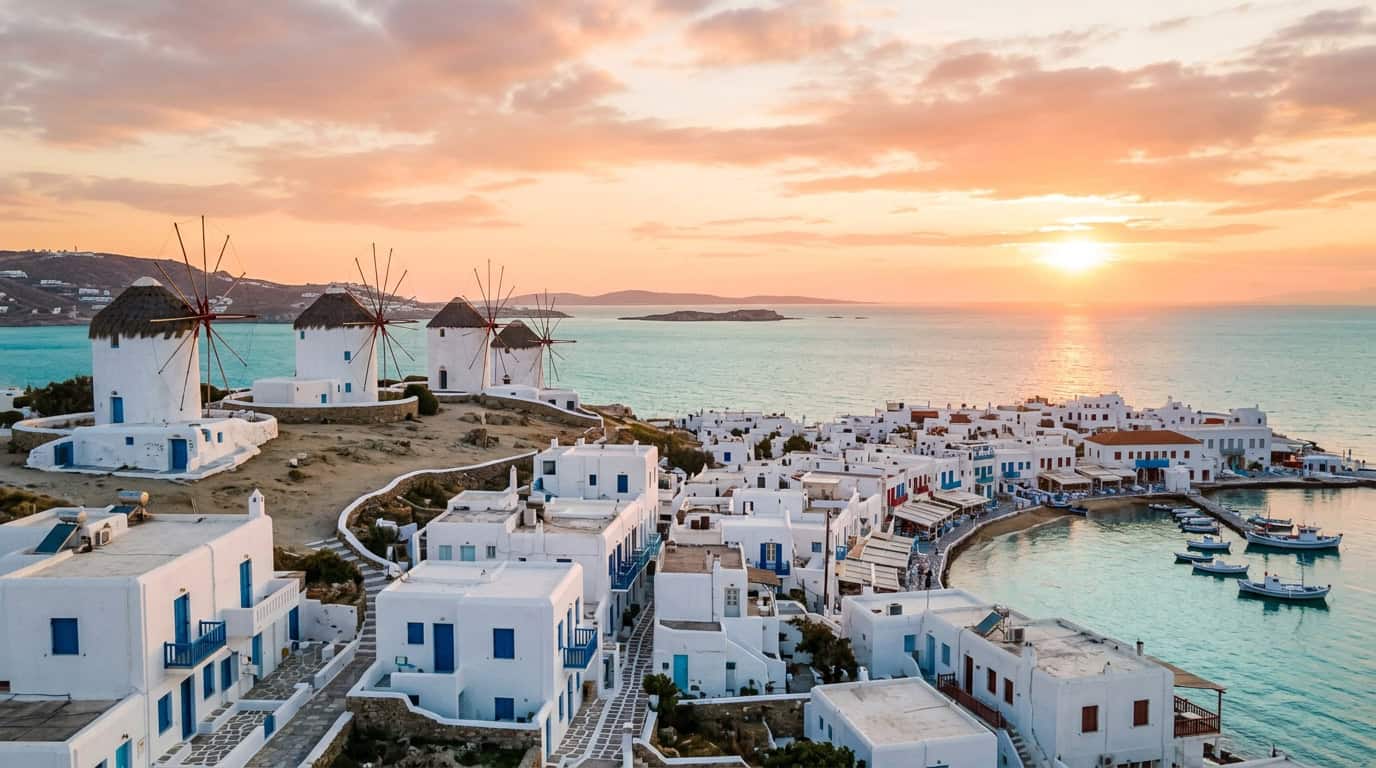
The most famous landmark in Mykonos is the row of five windmills on a low hill at the southern edge of Chora, called Kato Mili (Lower Mills). They were built in the 16th century by the Venetians, who ruled Mykonos at the time, to take advantage of the strong winds that blow through the Aegean almost year-round. At their peak in the 19th century there were 20 active windmills on Mykonos, used to grind wheat from across the Cyclades into flour that was shipped throughout the eastern Mediterranean.
The windmills stopped working in the early 20th century when steam and electric mills made them obsolete. Today they are preserved as monuments, with one (the windmill of Boni) restored to working order and open to visitors as a small museum. The other four are kept in good external condition but are not open inside.
The classic photo of the windmills is taken from the small cove of Alefkandra below them, with the white round buildings on the hilltop framed against the deep blue sky. The light is best in the late afternoon, about an hour before sunset, when the western sun illuminates the white walls and casts long shadows from the sail arms. Bring a wide lens to fit the entire row of five into the frame. From the windmills themselves, you have a sweeping view over Chora, Little Venice and the harbor.
Little Venice and the Sunset Strip
Little Venice (Mikri Venetia) is the neighborhood at the western edge of Chora, where 18th-century merchant houses were built directly into the sea on rocky foundations. The waves wash against the lower stories, and balconies hang directly over the water. The buildings were built by wealthy ship captains and pirates who wanted private docks for unloading goods and treasure away from the official port.
Today Little Venice is a strip of bars, restaurants and cafes with the best sunset views in town. Caprice Bar, Galleraki Bar, Kastro Bar and Verandah Bar all have tables and stools along the water’s edge, where you can sip a cocktail while the sun sets behind the windmills on the hill above. Prices are tourist prices (15 to 20 euros per cocktail) but the location justifies the cost for at least one evening.
Behind Little Venice, the narrow streets of the Alefkandra neighborhood wind through whitewashed houses and small shops. The Paraportiani Church, one of the oldest and most photographed churches in Greece, sits at the edge of this neighborhood. The church is actually five small chapels merged into one structure over four centuries (15th to 17th), creating an organic sculptural shape that looks almost like a sand castle. It is open for occasional services but rarely for tourists, so admire it from outside.
Wandering the Back Streets
The real pleasure of Chora is getting lost in the back streets. The town is designed as a defensive maze, with twisting alleys, dead ends, sudden turns and intersections at strange angles, all built this way originally to confuse pirates who might attack from the harbor. Today the maze just confuses tourists in a charming way. Set out without a map and let yourself drift.
The shopping streets along Matogianni Street and the back streets of Petros Loulou are lined with designer boutiques (Louis Vuitton, Prada, Dior have stores here), local jewelry shops, leather sandals makers, and art galleries. Prices are higher than Athens for almost everything, but the quality is generally good and the selection in some categories (handmade leather goods, contemporary Greek art) is the best in the country.
For breakfast, head to Joanna’s Niko’s Place on Mavrogenous Square. The Greek breakfast (yogurt with honey and walnuts, fresh bread, hard cheese, olives, eggs, coffee) costs around 18 euros and is enough to keep you going until late afternoon. For evening atmosphere, Niko’s Tavern just inland from the harbor has been serving traditional Mykonian food for over 50 years and remains family-owned and reasonably priced.
Delos, the Sacred Island and Birthplace of Apollo
Delos sits in the middle of the Cyclades, a small uninhabited island 25 minutes by boat west of Mykonos. In ancient Greek religion it was the most sacred place in the Aegean, the birthplace of Apollo and Artemis, and the religious center of the Delian League led by Athens in the 5th century BC. Visiting Delos today is one of the most extraordinary archaeological experiences available in Europe, an entire ancient sacred city you can walk through with very few other people around.
The Mythology and the History
According to Greek mythology, the goddess Leto, pursued by the jealous Hera, found refuge on the floating island of Delos to give birth to her divine twins, Apollo and Artemis, the children of Zeus. The island was anchored to the sea bed in gratitude for sheltering Leto and became the sacred birthplace of two of the most powerful Olympians. For this reason, no one was allowed to be born or die on Delos throughout much of classical antiquity. Pregnant women and the dying were transported to neighboring islands.
By the 8th century BC, Delos was an important pan-Hellenic religious center, hosting the Apollonian festival every four years that drew pilgrims from across the Greek world. In the 5th century BC, Athens established the Delian League with its treasury initially based on Delos, then moved it to Athens (the treasury financed the Parthenon construction). The island became one of the most prosperous trading centers in the eastern Mediterranean during the Hellenistic period, with up to 30,000 residents at its peak.
The end came in 88 BC, when Mithridates of Pontus sacked the island during his war with Rome, killing 20,000 residents in one day. A second sacking by pirates in 69 BC essentially ended Delos as an inhabited place. The island was abandoned and forgotten until French archaeologists began systematic excavations in 1873, work that continues today and has uncovered an unprecedented complete ancient sacred city.
The Terrace of the Lions
The most iconic monument on Delos is the Terrace of the Lions, a row of marble lions facing the Sacred Lake where, according to legend, Leto gave birth to Apollo and Artemis. The original dedication was made around 600 BC by the people of Naxos, with somewhere between 9 and 12 lions standing guard. Five lions survive in situ today, weathered by 2,600 years of Aegean wind and sun, their faces eroded but their poses still powerful.
One of the original lions was taken to Venice in the late 17th century where it stands at the entrance to the Venetian Arsenal. The lion is heavily restored (with a misshapen head added by Venetian sculptors) and looks somewhat awkward, but it shows the original quality of the carving in its body and legs. The lions you see on Delos today are actually copies, with the original five removed to the Delos Museum for protection in the 1990s.
Standing in front of the lions on the terrace, with the dry Cycladic hillside behind them and the empty Aegean visible through the gaps in the ruins, is one of the most evocative experiences in classical archaeology. The lions are positioned to guard the Sacred Lake, which is now dry but in antiquity was filled with sacred swans dedicated to Apollo. The hollow in the ground where the lake stood is still visible, with a palm tree marking the spot where Leto is said to have given birth.
The Theater, the Mosaics and the Mount Kynthos Climb
Beyond the lions, Delos contains an entire city of marble streets, theaters, temples, residential houses, harbor facilities and storage warehouses. The Hellenistic theater, carved into a hillside, could seat 5,500 spectators and is partly preserved with the lower 20 rows of seats still in their original positions. Plays were performed here as part of the religious festivals dedicated to Apollo.
The residential quarter of Delos includes private houses with surviving mosaic floors of remarkable quality. The House of the Dolphins, the House of the Masks and the House of Dionysus all have central courtyards with mosaic floors depicting their namesake subjects. The mosaics are made of thousands of tiny colored stone fragments (tesserae) and show the level of luxury that prosperous Delian residents enjoyed in the 2nd century BC.
For the best overview of the entire site, climb Mount Kynthos (113 meters), the small hill at the center of the island. The climb takes about 30 minutes on a stepped path and rewards you with a 360-degree view of the entire ancient city, the surrounding islands of the Cyclades and the open Aegean. At the top is a small sanctuary to Zeus Kynthios, dating from the 4th century BC.
How to Visit Delos
You reach Delos by boat from the old port of Mykonos. Boats depart at 09:00, 10:00 and 11:30 in summer (April to October) and the journey takes about 30 minutes. The last return boat leaves Delos around 15:30. The boat ride costs 25 euros round trip, and entry to the archaeological site is an additional 20 euros (cash only).
Time your visit to spend at least 3 hours on Delos. Take the 09:00 boat from Mykonos, arrive at 09:30, walk the site until 13:00, have a snack at the small site cafe, climb Mount Kynthos for the views, and return on the 15:00 boat. This gives you a full unrushed visit.
Bring water, a hat, sunscreen, sturdy shoes and a small backpack. There is almost no shade on the island and the marble streets reflect heat in midday. The site has a small cafe near the museum but it is overpriced and has limited options, so bring sandwiches if you are budget-conscious. The Delos Museum, near the harbor, is small but contains the original lions and other key sculptures from the site, allow 30 minutes for the museum at the start or end of your visit.
The Beaches, Where to Find Both Party and Peace
Mykonos beaches fall into two distinct categories. The famous party beaches, with their beach clubs, day-into-night DJ sets and crowds of glamorous people, are concentrated along the southern coast. The quieter family beaches, with their shallow water, sand-bottom coves and unfussy tavernas, are scattered around the northern and eastern shores. Knowing which beach to visit on which day is the key to a satisfying Mykonos beach experience.
The Party Beaches
Paradise Beach is the most famous of the party beaches, a long curve of golden sand with deep clear water, a large beach club at the western end and a smaller club at the eastern end. The Cavo Paradiso super club, perched on the cliff above the beach, hosts international DJs from June to September with door prices of 50 to 80 euros. Sunbed rental on the beach runs from 20 to 60 euros per person per day depending on the location, with the front rows costing the most.
Super Paradise Beach, around the headland from Paradise, is slightly smaller and slightly more upmarket, with the Jackie O Beach Club at the western end and the Super Paradise Beach Club at the eastern end. The atmosphere is somewhat more LGBTQ-friendly than Paradise, though both beaches welcome everyone. Same sunbed pricing as Paradise.
Paraga Beach is the most accessible of the party beaches from Chora, with two main beach clubs (Scorpios at the eastern end is the most famous, Kalua at the western end is more relaxed). Scorpios is the place to spend serious money if you have it, with day beds at 200 to 500 euros, brunch sets, sunset DJ sessions and a vibe that mixes Burning Man with luxury yacht culture. Reservations are essential, often weeks in advance for prime weekends.
The Quieter Beaches
For a relaxed beach day without DJ music and 30-euro cocktails, head north or east. Agios Sostis on the north coast is one of the most beautiful undeveloped beaches on Mykonos, with no beach clubs, no sunbeds and only one small taverna (Kiki’s) at the southern end. The water is shallow and crystal clear, and the surrounding hills protect the bay from the strong northern winds. The dirt road access discourages day trippers.
Fokos Beach, on the northeast coast, is another favorite quiet beach with just one taverna (Fokos Taverna, serving simple grilled food at moderate prices). The beach is sand and pebbles, with shallow turquoise water perfect for swimming. The access road is rough and you need a 4WD or scooter, which keeps the crowds away.
Kapari Beach, a small cove on the western side of the island near the Armenistis lighthouse, has white sand, calm water and no facilities except a small kiosk in summer. It is sheltered from the wind and good for families with small children. The walk down from the parking area is about 5 minutes on a stone path.
Wind and the Weather
Mykonos is famous for its strong winds, called the meltemi, that blow from the north every summer afternoon. The winds typically pick up around midday and continue until evening, with peak intensity in July and August. They can be strong enough to make the southern beaches uncomfortable (sand blowing) and rough out the sea on the northern beaches.
The trick is to match your beach to the wind direction. On windy days, head to the southern beaches (Paradise, Super Paradise, Paraga, Platis Gialos) which are sheltered by the southern hills. On calm days, head to the northern beaches (Fokos, Agios Sostis, Panormos) which are exceptionally beautiful but exposed to the meltemi.
The Mykonos weather forecast on platforms like Windy or Windguru is reliable for predicting wind direction and intensity 3 to 5 days out. Check the forecast each evening for the next day and plan your beach accordingly. If the meltemi is forecast at 7 to 8 Beaufort, even sheltered beaches can be uncomfortable, and you might want to swap a beach day for a Delos visit or a town walking day instead.
Where to Stay, Eat and Experience the Mykonos Atmosphere
Mykonos accommodation, food and nightlife span a vast price range, from budget hostels and family tavernas to 5,000-euro-per-night villas and tasting menu restaurants. Knowing where to spend and where to save is the key to enjoying the island without being ruined by it.
Where to Stay
For maximum convenience, stay in Chora (Mykonos Town). You can walk everywhere, the windmills and Little Venice are at your doorstep, and you can wander between bars and restaurants without taxis. Mid-range hotels like Hotel Tagoo, Hotel Lefteris and Boheme Mykonos cost 250 to 600 euros per night in summer. Budget options include the Hostel Paraga (the only hostel in the Chora area) at around 60 to 100 euros for a dorm bed.
For a beach-focused stay, the southern coast around Ornos, Platis Gialos and Psarou has many beach hotels with direct beach access. Hotels here cost 300 to 1,500 euros per night for sea-view rooms. The Royal Myconian, Mykonos Grand and Petasos Beach are all reliable upper-end options. You will need a taxi or rental car to reach Chora for evening activities.
For a quieter experience, the inland villages of Ano Mera and Vrisi offer simple guesthouses and family-run hotels at much lower prices (80 to 200 euros per night). You will be 15 to 20 minutes by car from the beaches and from Chora, but you will have a more authentic experience of village Mykonos.
Where to Eat
For traditional Mykonian food at reasonable prices, head to Niko’s Tavern in Chora, To Maereio on the Lakka neighborhood, or Sakis Grill House for souvlaki and grilled meat. Expect to pay 30 to 50 euros per person including wine. The lobster spaghetti at Niko’s is a Mykonian classic worth trying once.
For a special dinner with a view, Kounelas Tavern serves fresh fish and traditional Greek food on a terrace overlooking the harbor. Prices are moderate (40 to 70 euros per person). For more upscale dining with views, Nammos at Psarou Beach and Spilia at Agia Anna Beach offer Mediterranean cuisine with their feet in the water, prices in the 150 to 250 euro per person range with wine.
For a quick lunch, the souvlaki shops in Chora (Sakis Grill, Jimmy’s) serve excellent souvlaki wraps for 5 to 8 euros, with quality much better than the prices suggest. Greek breakfast can be had at any cafe for 12 to 18 euros, including Greek yogurt, honey, fresh bread and coffee.
The Nightlife
Mykonos nightlife runs in two waves. The first wave is the sunset and early evening at the bars of Little Venice, the windmills area and the harbor cafes. Cocktails cost 15 to 25 euros, and the atmosphere is relaxed and chatty until about 23:00.
The second wave starts after midnight, when the beach club crowd makes its way back to town. Skandinavian Bar, Galleraki, Caprice and the various clubs along Matogianni Street are open until 04:00 to 06:00, with door covers of 20 to 50 euros at the busier spots. Cavo Paradiso, the open-air super club on the cliff above Paradise Beach, hosts the most famous international DJs and is a destination in itself.
If you are not on the party schedule, the harbor cafes are open all evening and serve coffee, ice cream and light snacks at moderate prices. Walking the harbor at 22:00 with an ice cream and watching the yachts come and go is one of the great pleasures of a Mykonos evening, no cover charge required. For other Greek island destinations, see my guides to Santorini and Crete.
How to Get to Mykonos and Practical Planning
Mykonos is well connected by both air and sea, with direct international flights in summer and frequent ferries from Athens and other Greek islands. The logistics are straightforward.
Getting In
Mykonos Airport (JMK) has summer flights from Athens (45 minutes), Thessaloniki (75 minutes), and many European cities including London, Paris, Berlin, Rome, Milan and Frankfurt. Aegean Airlines, Sky Express, EasyJet, Ryanair and Lufthansa all serve the airport. Domestic flights run year-round, international flights mostly summer only.
Ferries from Piraeus (Athens) take 4 to 5 hours by conventional ferry, or 2.5 to 3.5 hours by high-speed catamaran. The ferries arrive at the new port at Tourlos, about 2 kilometers north of Chora. Buses and taxis connect Tourlos to Chora and the beaches.
From Santorini, the high-speed ferry takes about 2.5 hours and runs 2 to 3 times daily in summer. From other Cyclades islands (Paros, Naxos, Tinos, Ios) frequent ferries make island-hopping easy. From Crete, ferries run 4 to 5 times per week in summer and take about 5 to 7 hours.
Getting Around
The Mykonos bus system (KTEL) connects Chora with the main beaches and inland villages. Buses run frequently in summer (every 15 to 30 minutes to the major beaches) and fares are 2 to 5 euros per ride. The Chora bus terminal at Fabrika Square is the hub. Buses are old but reliable.
For more flexibility, rent a car (40 to 100 euros per day) or scooter (20 to 50 euros per day) in Chora or at the airport. Driving on Mykonos is straightforward but parking in Chora is limited, with most visitors using the large parking lot at the northern edge of town and walking in. The roads are generally good, though some access roads to remote beaches are unpaved.
Taxis are limited on Mykonos (around 30 taxis on the island) and difficult to find in peak summer. Pre-book transfers through your hotel or use a private transfer service. Uber-style apps work in Mykonos through the Beat app, but availability is limited and surge pricing common in peak season.
When to Visit
The party season runs from late May to mid-September, with peak intensity from mid-July to late August. Beach clubs, DJ events and the full Mykonos atmosphere are at their best during this period, but so are crowds and prices.
For a calmer experience with similar weather, visit in May, early June, late September or October. The temperatures are pleasant (20 to 28 degrees Celsius), the sea is warm, most restaurants and bars are open, and prices are 30 to 50 percent lower than peak season. The meltemi winds are also less intense in these months.
Winter on Mykonos (November to March) is quiet, with most tourist services closed and only a few year-round restaurants open in Chora. The island has its own quiet beauty in winter, but most visitors will find it disappointingly empty. Avoid these months unless you specifically want a Greek island in hibernation.
Frequently Asked Questions
How many days should I spend in Mykonos?
Three full days is a good minimum, allowing one day for Chora and the windmills, one day for Delos and the museum, and one day at the beaches. Four to five days lets you enjoy multiple beach experiences and the nightlife without rushing. With a week you can also combine Mykonos with a 2-3 day visit to nearby Santorini or another Cycladic island.
Is Mykonos really as expensive as people say?
Yes, in peak season (July-August). Hotels, restaurants and beach clubs charge premium prices that can shock first-time visitors. However, the island has options at all budget levels, and you can have a great Mykonos experience for 100-150 euros per person per day if you stay in modest accommodation, eat at local tavernas rather than beach clubs, and use the bus system. A luxury Mykonos trip can easily cost 1,000+ euros per person per day.
What is the best beach for families?
Platis Gialos on the south coast is a long sandy beach with shallow water, multiple family-friendly tavernas, and easy bus access from Chora. Ornos Beach is similar but slightly more crowded. Both have organized sunbed sections at moderate prices (15 to 25 euros for a pair of sunbeds with umbrella). Agios Stefanos in the north is another good family option, sheltered from the meltemi winds.
Do I need to dress up for Mykonos restaurants and clubs?
For the high-end beach clubs and the famous restaurants like Nammos and Spilia, yes, smart casual is expected (no flip-flops or swimwear at dinner). For ordinary tavernas and Chora bars, ordinary holiday clothes are fine. The nightclubs have variable dress codes depending on the venue, with the more upscale places enforcing smart casual for entry.
Is Mykonos LGBTQ-friendly?
Yes, Mykonos is one of the most LGBTQ-friendly destinations in Europe and has been a popular gay destination since the 1960s. Multiple bars, clubs and beach clubs cater specifically to gay travelers (notably Jackie O Beach Club, Super Paradise Beach, the various venues around Little Venice). The atmosphere across the island is welcoming and inclusive, with same-sex couples openly visible everywhere.
Can I do Delos as a day trip on the same day as the beaches?
Yes, the timing works well. Take the 09:00 boat to Delos, spend 3 to 4 hours on the site, return on the 13:30 or 15:00 boat to Mykonos, then head to a beach for the late afternoon and evening. The whole day is well-paced and shows you both sides of the island. The UNESCO World Heritage listing for Delos has additional historical context.
About the Author
I’m Ilknur Acar, the founder of Bir Dakikada Geziyorum. Mykonos is the island where I learned that the most famous tourist destinations often hide their real character behind a screen of glamour, and you only need to walk a few minutes away from the harbor to find it. I write history-rooted travel guides that respect the layered past of the Mediterranean. Follow along for more.